Business Card Thickness: 14pt vs 16pt in Inches and mm
Tomas Amaya
September 15, 2026Updated September 18, 20268 min read
How Thick Is a Business Card?
Business card thickness is measured in points, where one point is one thousandth of an inch. A 14pt card is 0.014 in, or 0.36 mm. A 16pt card is 0.016 in, or 0.41 mm, about 14 percent thicker, and 16pt is the stock most professionally printed cards land on.
Written down, two thousandths of an inch sounds like nothing. In a hand it is the difference between a card that bends when someone takes it and a card that stays flat, and people register that before they read your name.
Every card in the table below is the same 3.5 x 2 inches. Only the caliper changes, which is why thickness is the one card spec you cannot judge from a picture.
| Stock | Points | Inches | Millimeters | A stack of 100 |
|---|---|---|---|---|
| 14pt cardstock | 14 pt | 0.014 in | 0.36 mm | about 1.4 in |
| 16pt cardstock | 16 pt | 0.016 in | 0.41 mm | about 1.6 in |
| 32pt cardstock | 32 pt | 0.032 in | 0.81 mm | about 3.2 in |
| 0.025 in aluminum | 25 pt | 0.025 in | 0.64 mm | about 2.5 in |
| 0.040 in aluminum | 40 pt | 0.040 in | 1.02 mm | about 4 in |
That last column is the one people forget. Going thicker does not change how many cards you hand out. It changes how many you can keep on you.
What Does pt Mean on Business Card Stock?
A point measures thickness, not weight. One point is 0.001 inch, so multiply the point number by a thousandth of an inch and you have the caliper of the stock: 14pt is 0.014 in, 16pt is 0.016 in, 32pt is 0.032 in. There is no conversion table to learn.
Here is the part that trips people up. Paper is also sold by weight, in pounds or grams per square meter, and those numbers do not convert cleanly to points. Two sheets can weigh the same and measure differently, because bulk depends on how the fiber was pressed. So when a shop quotes a 100 lb cover card and will not give you a point number, you have nothing to compare it against. Ask for the caliper.
Thickness is also separate from the coating on top. Gloss, matte and uncoated change how a card looks and how it takes a pen without changing the stock underneath, and the two decisions are made independently.
14pt vs 16pt Business Cards: Which Should You Choose?
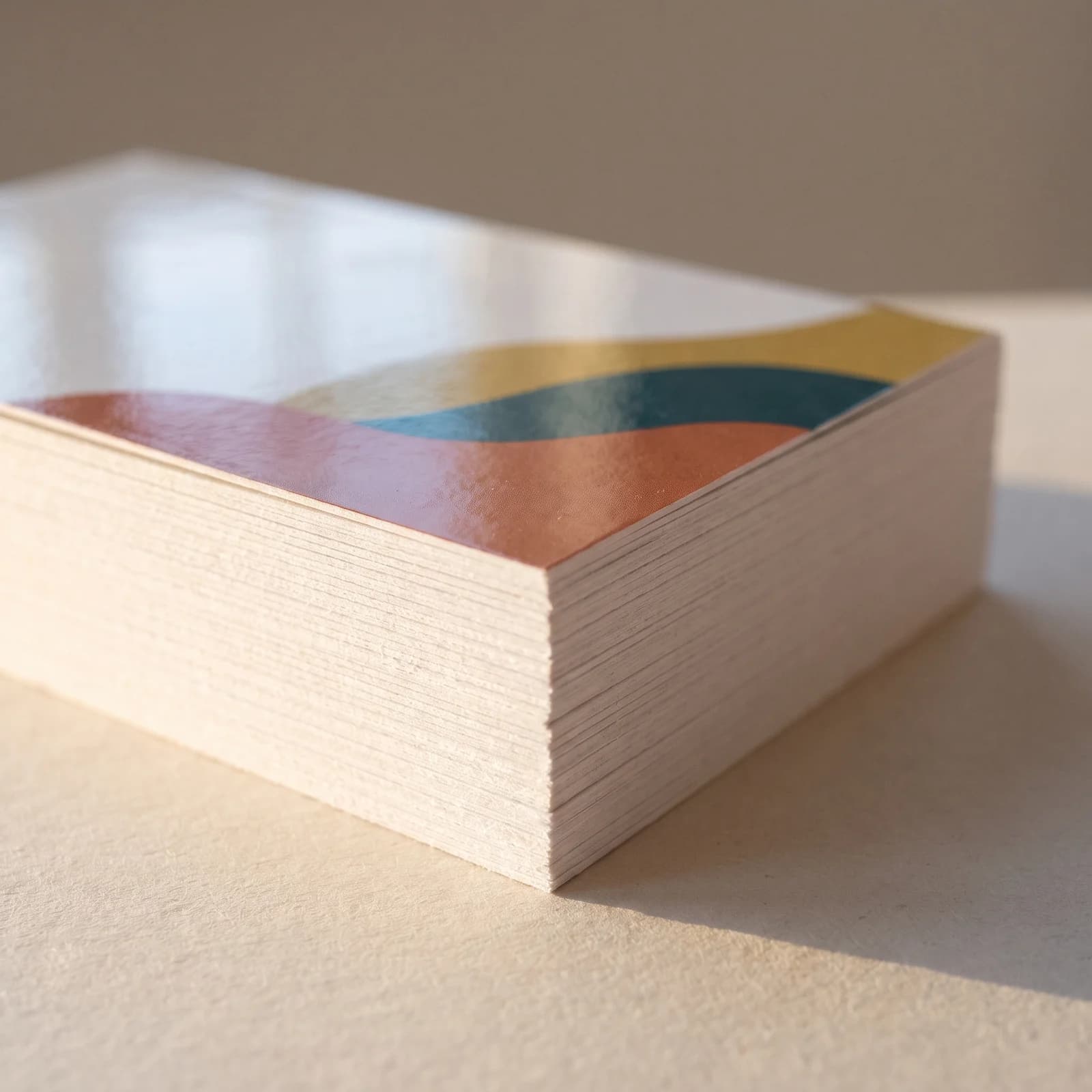
Choose 16pt unless the card is deliberately disposable. Hold the two side by side and you can tell in under a second: a 14pt card bends under light pressure between a thumb and a forefinger, and a 16pt card resists, then springs back.
14pt is not a bad card. It is the common budget stock, it takes full color printing well, and for a one weekend event handout it does the job. What it does poorly is survive. A 14pt card that rides in a back pocket for a week comes out soft at the corners, and a soft card reads as a soft business.
16pt still looks right at the end of the card's life: in a wallet, in a card case, clipped to a work order, taped inside a cabinet door. It is the only paper stock we run, so there is no cheaper tier to talk yourself into, and every pack is printed in the USA and shipped anywhere in the country. If pack pricing is what you are weighing, how much business cards cost has the whole ladder with the per-card math on it.
Business Card Thickness Chart, 14pt to 40pt
Here is every stock on this page drawn edge on, at the same scale, with the caliper written out in points, inches and millimeters.
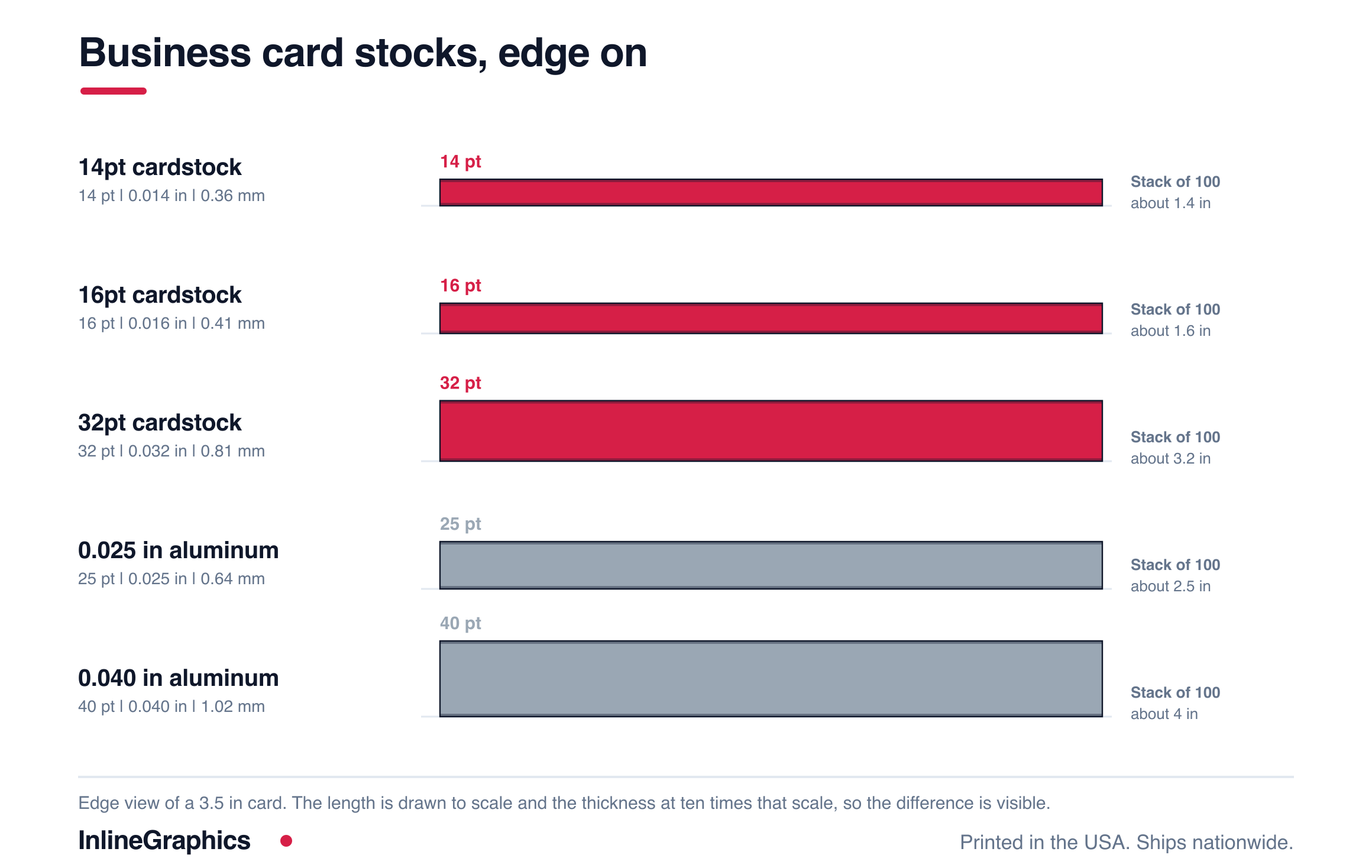
The bars are drawn with the card length to scale and the thickness at ten times that scale, because at true scale a 16pt card is a hairline on a screen. The numbers beside each bar are the real ones.
14pt cardstock
- Caliper
- 14 pt
- 0.014 in
- 0.36 mm
- Stack of 100
- about 1.4 in
- Where it shows up
- The common budget stock
- Not a stock we print
16pt cardstock
- Caliper
- 16 pt
- 0.016 in
- 0.41 mm
- Stack of 100
- about 1.6 in
- Where it shows up
- Our Standard Business Cards
- Packs of 50 to 3,000
0.025 in aluminum
- Caliper
- 25 pt
- 0.025 in
- 0.64 mm
- Stack of 100
- about 2.5 in
- Where it shows up
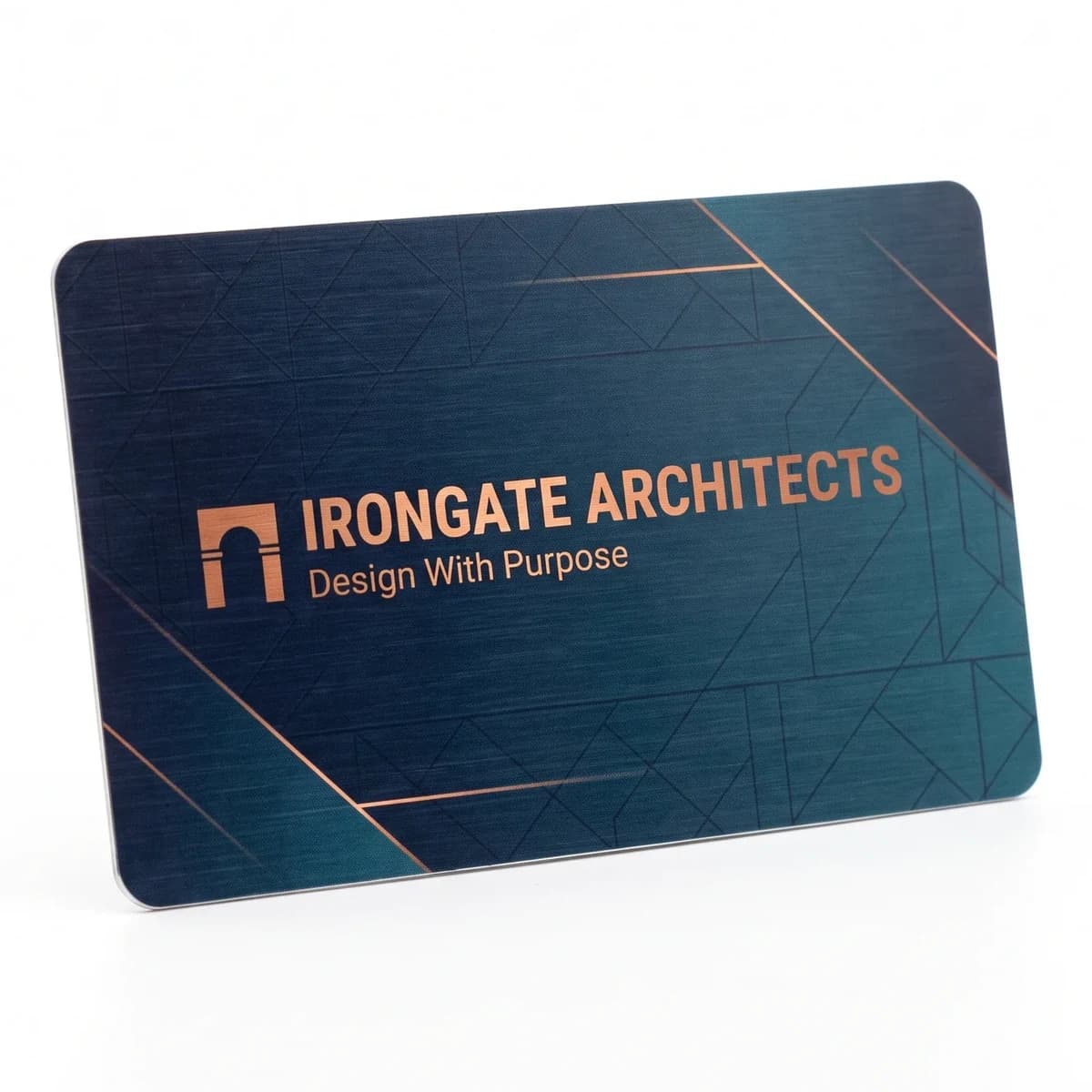
- Our Aluminum Hard Cards
- Packs of 50 to 1,000
Is a Thicker Business Card Worth It?
32pt and up is a real category, and a double thick card is impressive to receive: colored edges, triplex builds with a bright core showing at the trim, cards closer to a chip than to paper.
Two honest cautions before you chase it. First, a 32pt card is twice the caliper of 16pt, so it fills a wallet slot at roughly half the count, and the person you hand it to has to decide what to take out to make room. Second, it costs more per card, and it only earns that when the person receiving it is worth the difference. A consultant handing out fifteen cards a month can justify it. A restaurant owner going through a thousand a quarter cannot.
What we print online today is 16pt. If you want a heavier specialty stock, a colored edge, or a triplex build, tell us the quantity at our contact page or call (210) 293-5651 and we will quote it honestly rather than pretend the online configurator covers it.
Where Metal Lands on the Same Scale
Our Aluminum Hard Cards are sold in inches rather than points, and converting them puts metal on the same ruler as paper: 0.025 in is 25pt and 0.040 in is 40pt.
The 0.025 in card is thinner than a 32pt paper card, has a slight flex, and still reads unmistakably as metal the moment it lands in a palm. The 0.040 in card is rigid and noticeably heavier. Neither one is a volume card. A pack of 50 in the lighter aluminum is $129.99 against $49.99 for a pack of 50 on 16pt paper, and both ladders sit side by side with the per-card math in paper vs metal business cards.
How Thickness Changes Corners, Folds, and Wallet Life
Corners. Heavier stock holds a corner longer. On 14pt the corners go soft first, and on 16pt they stay square through normal carrying, which is most of what people mean when they say a card still looks new.
Folding. Any card meant to fold has to be scored first, and the heavier the stock, the more it wants to crack along the fold instead of bending. 16pt is close to the practical ceiling for a clean fold and 32pt is past it, so a folded card is a quote rather than a checkbox.
Trim. Cards are cut in stacks rather than one at a time, and a thicker stack is harder to keep perfectly square through the cut. That is one more reason to keep type back from the edge and let backgrounds bleed past it. The standard business card size guide has the exact bleed and safe zone numbers.
The wallet test. The card you want still presents well when somebody digs it out three months later. That is caliper, coating and a square trim working together, and caliper is the part you buy first.
What We See on Proofs
The thickness question almost never arrives on its own. It arrives attached to a file problem, and here is the pattern we see most.
Somebody picks a heavy stock to make the card feel expensive, then sends artwork with a hairline frame sitting an eighth of an inch inside the edge. Thick stock cuts in shorter stacks and the trim is accurate rather than perfect, so that frame reads even on some cards in the run and visibly uneven on others. The heavier the stock, the more a thin border punishes you. Let the color bleed off the edge instead and the same run looks flawless.
The other one is a reorder. A customer brings in a card they have carried for months, and what gave out is never the print. It is the corners. That is the whole case for 16pt in one worn card.
Which Thickness Should You Order?
Most businesses: 16pt. A contractor, a church office printing cards for three staff members, a real estate agent restocking before open house season. It feels correct in a hand, it survives being carried, and it is the stock behind every paper card in our business card lineup.
High volume handouts: 16pt, bigger pack. If you move through cards at a weekend market booth or a trade show table, buy more of the same stock instead of moving up a tier. Thickness does not create conversations. Running out of cards ends them.
A short list of introductions that matter: metal. Keep paper for everyday volume and 50 aluminum cards in a separate pocket for the conversations worth the difference.
Something heavier, a colored edge or a fold: ask for a quote. We will tell you what it costs and whether it still fits in a wallet.
One last thing that has nothing to do with caliper. Get the content right before you spend on stock, because a 32pt card with a missing area code is an expensive mistake. What belongs on a business card covers the six things every card needs, and the ten questions to ask before buying business cards is the checklist to run before you approve a proof.
Settled on a weight? Get started now.
Frequently Asked Questions
A 16pt business card is 0.016 inches thick, which is 0.41 mm. One point is one thousandth of an inch, so 16pt means sixteen thousandths. A stack of 100 of them is about 1.6 inches tall, and the card stays flat instead of flexing when someone takes it from your hand.
16pt is better for almost every business, because it holds its corners and still looks professional months into a wallet. 14pt is 0.014 inches against 0.016 inches, which is 14 percent thinner, and it goes soft at the corners first. 14pt earns its place on a one weekend handout where the card is disposable by design.
Most professionally printed business cards are 14pt or 16pt, and 16pt is the common standard for a premium card. The point number is a caliper, not a weight, so 16pt is 0.016 inches whatever the sheet weighs. Every paper card we print is 16pt, cut to the standard 3.5 x 2 inches.
16pt is 0.41 mm, because 0.016 inches multiplied by 25.4 is 0.4064 mm. For the other common stocks, 14pt is 0.36 mm, 32pt is 0.81 mm, 0.025 inch aluminum is 0.64 mm, and 0.040 inch aluminum is 1.02 mm. Points and millimeters both measure caliper, so they convert cleanly.
Yes, thicker stock costs more per card, because you are buying more material. The jump is small between 14pt and 16pt and large once you move to 32pt or metal. Our 16pt packs run from $49.99 for 50 cards up to $209.99 for 3,000, and anything heavier than 16pt is quoted by hand.
Our brushed aluminum cards come in 0.025 inches and 0.040 inches, which on the same points scale printers use for paper is 25pt and 40pt. The 0.025 inch card has a slight flex and still reads unmistakably as metal. The 0.040 inch card is rigid and carries real weight in a hand.
A 16pt card can fold, but only if it is scored first, and 16pt is close to the practical ceiling for a clean fold. Heavier stock wants to crack along the fold instead of bending, so 32pt is past it. Folded cards are a specialty job here, so ask for a quote rather than assuming thick stock will behave.
Related Articles
Standard Business Card Size: 3.5 x 2 in, Bleed and Pixels
The standard business card size is 3.5 x 2 in, 1050 x 600 pixels at 300 dpi. Bleed and safe [...]
Read More: Standard Business Card Size: 3.5 x 2 in, Bleed and Pixels
Matte vs Glossy Business Cards: How to Pick a Finish
Gloss business cards keep color saturated and resist a pen, matte reads softer and writes [...]
Read More: Matte vs Glossy Business Cards: How to Pick a Finish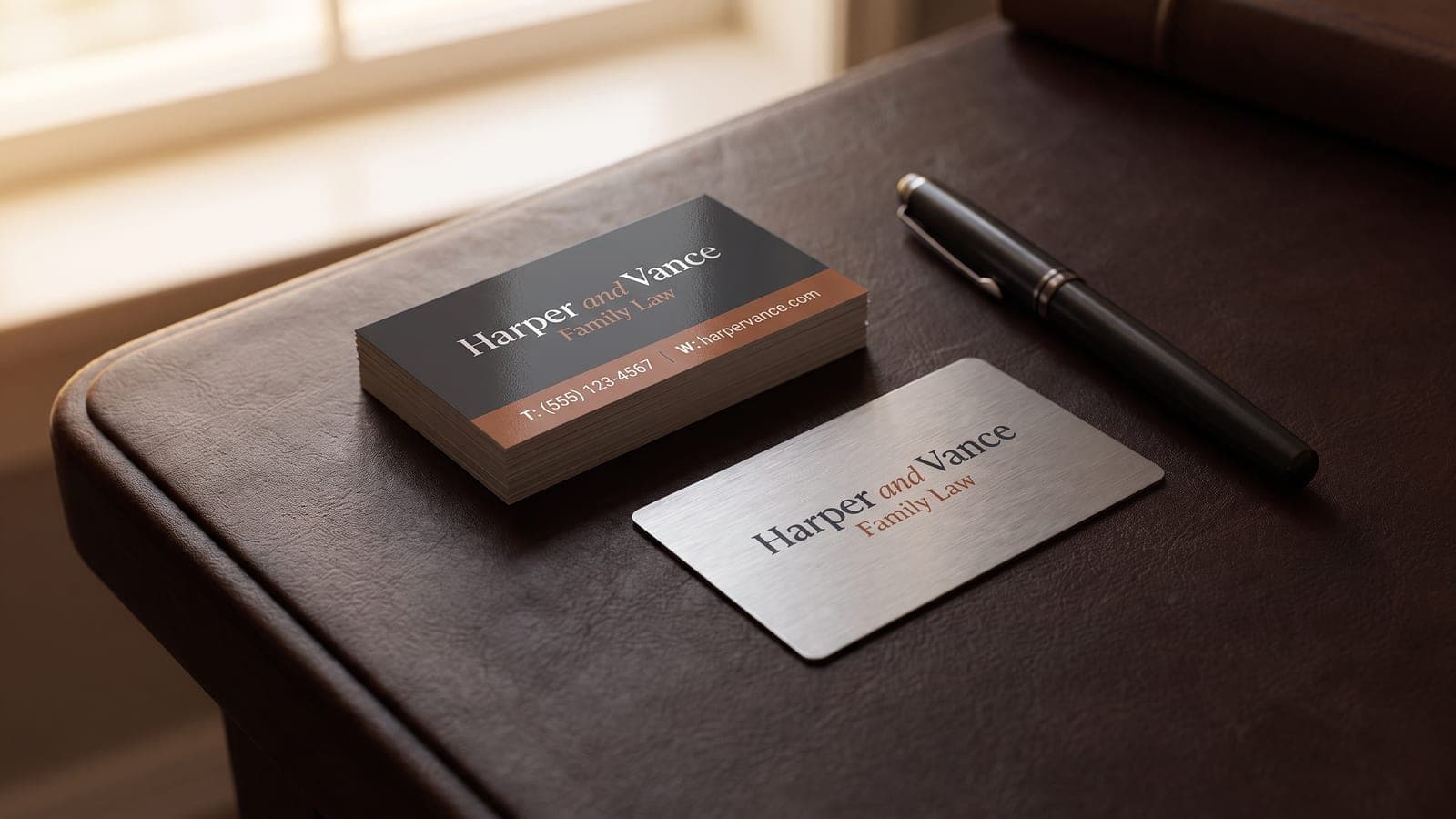
Metal Business Cards vs Paper: Cost Per Card and Feel
Metal business cards run about $2.30 each at 100 against about $0.60 for 16pt paper. Compare [...]
Read More: Metal Business Cards vs Paper: Cost Per Card and Feel
How Much Do Business Cards Cost? Pack and Per-Card Prices
Business cards cost $49.99 for 50, $89.99 for 500 and $109.99 for 1,000 in full color on both [...]
Read More: How Much Do Business Cards Cost? Pack and Per-Card Prices