Questions to Ask Before Buying Business Cards: 10 Answered
 Jean
January 12, 2026Updated October 16, 202610 min read
What Should You Ask Before You Order Business Cards?
Ask 10 questions before buying business cards: stock, finish, print sides, minimum quantity, proof, file setup, bleed and safe zone, color matching, turnaround, and the all-in total. Compare the final price for the same quantity and specifications, including setup and shipping.
Business cards look simple until two quotes use different stocks, quantities, finishes, or fees. Ask the same 10 questions in the same order so each answer can be compared directly before you pay. File setup and shipping are two of the fastest ways an attractive per-card number becomes a higher total.
Here is the whole checklist, with what a straight answer sounds like.
| # | Ask this | A straight answer sounds like |
|---|---|---|
| 1 | What paper stock am I getting? | A number in points, such as 16pt |
| 2 | What coating or finish? | Gloss or matte, and whether it costs extra |
| 3 | Is the second side extra? | A yes or a no, at the quantity you want |
| 4 | What is the minimum order? | A pack size, with the price of that pack |
| 5 | Do I get a proof? | Yes, digital, before production starts |
| 6 | What makes a file print ready? | PDF, CMYK, 300 dpi, bleed, fonts embedded |
| 7 | What are the bleed and safe zone? | 0.125 in out, 0.125 in in |
| 8 | Is color CMYK or Pantone matched? | Which one, stated plainly |
| 9 | What is the turnaround? | A production window and what starts it |
| 10 | What is the all in total? | One number with setup and shipping in it |
1. What Paper Stock Am I Getting?
The answer should be a number in points, and for most businesses that number should be 16pt. Points measure thickness, not weight, so 16pt is a physical fact about the card rather than a marketing word.
The three you will run into: 14pt is noticeably lighter and bends in the hand, 16pt is the professional standard and what we print, and 32pt is a heavyweight that reads as a statement and costs accordingly. If a shop answers this question with the word premium instead of a number, ask again. We measured the difference a point makes in 16pt versus 14pt cardstock.
2. What Coating or Finish Is Standard?
Ask which finish is included and which is an upgrade line at checkout. Our standard card is full color gloss on 16pt, included, with no finish surcharge hiding at the end of the order.
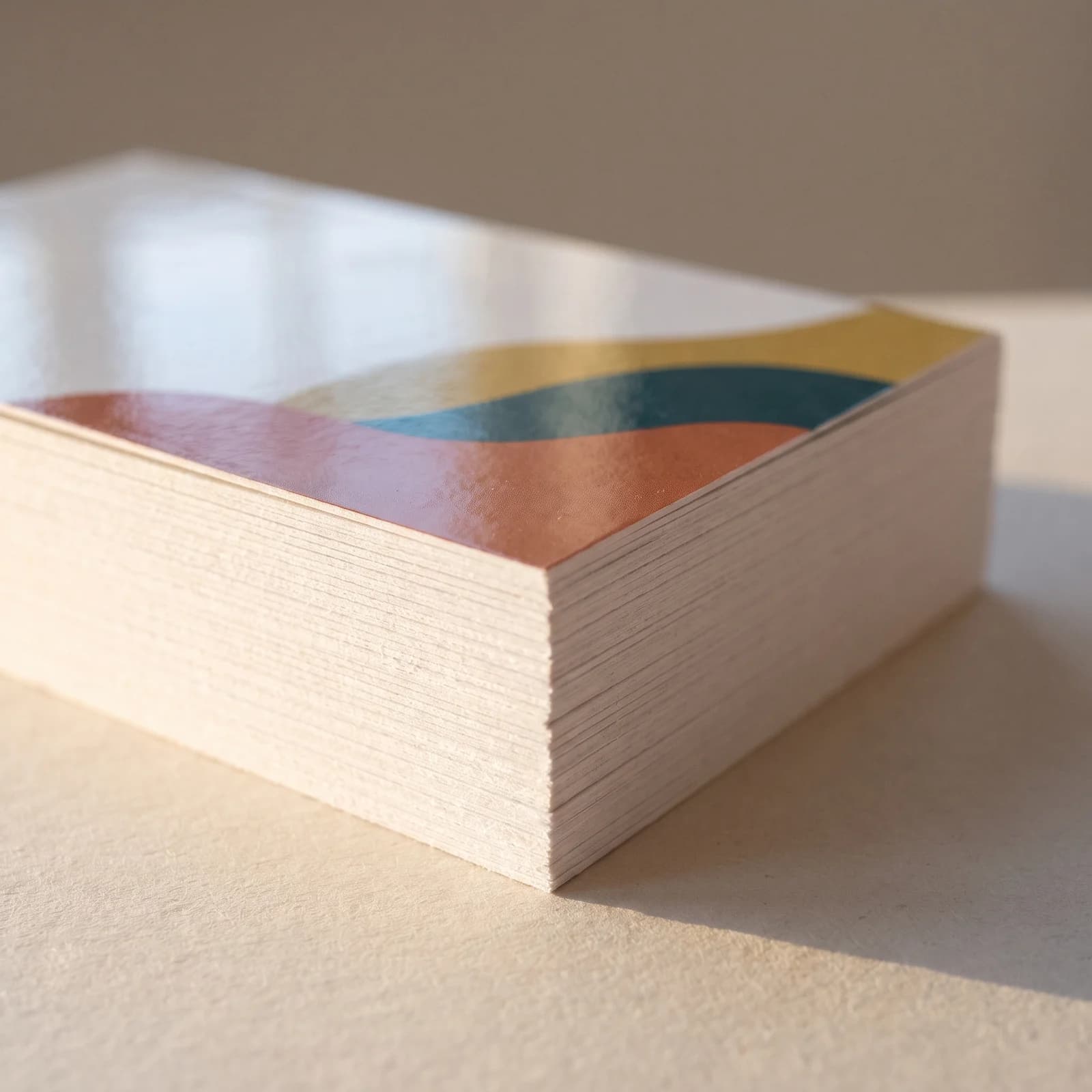
Gloss is reflective, makes photographs and saturated color pop, and wipes clean. Matte is non reflective, reads calmer, is kinder to small type and takes a pen, and we quote it by hand rather than selling it on the order form. Neither is better; they answer different brands. The comparison, with how each one holds up in a wallet, is in matte vs glossy business cards.
3. Is Double Sided Printing Extra?
On our 16pt cards, no. Single sided and double sided cost the same at every quantity, so a 500 pack is $96.29 whichever way you print it. Plenty of shops do charge for the second side, which is exactly why this belongs on a checklist rather than in your assumptions.
Once you know the back is free, use it. A QR code to a booking or review page, a short service list, hours, a license number, or the whole card again in a second language. What belongs on each face is in what information should be on a business card.
4. What Is the Minimum Order Quantity?
Ask for the smallest pack and its price, not a per card rate. Ours starts at 50 cards for $53.49, and the ladder runs up through 250 at $74.89, 500 at $96.29 and 1,000 at $117.69.
Small packs are the most expensive cards per piece, because the file check, the press setup and the trim cost the same whether the run is 50 or 3,000. That is fine when 50 is genuinely all you need for one event. It is expensive when you order 250 now and another 250 in three months, which costs $149.78 for the same 500 cards a single $96.29 pack would have covered. The full ladder and the per card math are in how much business cards cost.
5. Do I Get a Proof Before It Prints?
Ask whether a proof is included, what kind it is, and whether production starts before or after approval. We provide a free digital proof after you order, and nothing goes to press until you approve it.
A proof is the cheapest insurance in printing. What it catches, in the order we see it: a wrong digit in a phone number, a font that did not embed and silently substituted, a logo pulled off a website at screen resolution, artwork built with no bleed, and color that looked right on a bright screen and lands darker on paper. All five are free to fix in the file and impossible to fix in a cut stack.
6. Are My Files Print Ready?
Print ready means a PDF at 3.75 x 2.25 inches including bleed, CMYK color, 300 dpi, fonts outlined or embedded, and both sides as separate pages. A JPG or PNG pulled from a screen, a Word document, or a slide exported at screen size is not print ready, however good it looks on the monitor.
If your file is not there, ask what it costs to get it there. Here it is $14.99 once per item through AI image to print, and the free digital proof gives you a chance to check the prepared artwork after ordering. If you have no layout at all, Design it for me is +$29.99 and a designer builds the card from scratch with two rounds of revisions.
7. What Are the Bleed and Safe Zone?
Bleed is the 0.125 inch of artwork that runs past the cut line and gets trimmed away. The safe zone is the 0.125 inch inside the cut line where nothing important is allowed to sit. On a 3.5 x 2 inch card that means a 3.75 x 2.25 inch file and a 3.25 x 1.75 inch box for your text.
Cards are not trimmed one at a time. They print many up on a large sheet, the sheets are stacked, and the stack goes through a blade, so the cut is accurate rather than perfect. Bleed is why a navy card comes back navy to the corner instead of carrying a white sliver. The safe zone is why the website across the bottom edge survives. Every number in inches, millimeters and pixels is in the standard business card size guide.
8. Can You Match a Pantone Color?
Ask whether the shop prints CMYK or true Pantone spot color, because the honest answer changes what your brand color will look like. Our cards are full color CMYK, which reproduces most Pantone colors closely but not exactly.
The colors that shift most are the ones outside what four inks can mix: saturated oranges, some bright greens, and electric blues. If an exact brand color is critical to you, say so before you approve the proof rather than after the run, and we will tell you plainly how close the CMYK build gets.
9. What Is the Turnaround Time?
Ask two things: the production window, and what starts the clock. Ours is 48 hours of production, and it starts when you approve your proof, not when you check out.
That distinction is where most missed dates come from. An order placed Monday with a proof approved Thursday is a Thursday order. Add ground transit on top, and leave room for one round of corrections, because the proof exists precisely so corrections can happen. If the cards have a date attached, work backward from the event to the approval, not from the event to the order.
10. What Is the Total Cost, Not the Per Card Price?
Ask for one number, all in, for the exact quantity and stock you want. A per card price that leaves out file prep, the second side, the proof, the finish and shipping is not comparable to a total that includes them.
Here the whole list is short: the pack price, one artwork option ($14.99 once per item to make your file print ready, or +$29.99 to have it designed), and flat $10 ground shipping per order to any US address. That is the entire bill. Five hundred cards land at $106.29 with shipping, before the artwork option.
What We See on Proofs
The question nobody asks, and the one that costs the most, is what happens to the second side. We regularly proof a double sided order where the back is blank, because the customer assumed the back was an upgrade and designed as if it were. It costs the same either way, so that blank back is space already paid for and left on the table.
The second pattern is the logo. A logo copied off a website is usually a few hundred pixels wide, which is fine on a screen and soft on a card, and it often arrives with a white box behind it that only shows up once it sits on a colored background. Ask your designer for the vector file, an AI, EPS or PDF, and keep it somewhere you can find it, because you will need it again for every sign, shirt and banner you ever order.
The third is the phone number. Typos in a phone number survive every check except reading it out loud, which is worth doing once on the proof before you approve it.
Which Extras Are Worth Paying For?
Pay for extras that change how the card is used, not extras that only change how it looks in a photo. Rounded corners and square cards are the two people ask about most, and both are quoted by hand rather than sold on the order form, so tell us the quantity and stock at our contact page or call (210) 293-5651 and we will price them and send the artwork specs back with the quote.
A QR code is free and often the highest value thing on the card. Metal is the genuine step change: brushed aluminum cards start at $139.09 for 50, and they earn it in a meeting where the card itself is part of the pitch. We compared them in paper vs metal business cards, and both stocks sit side by side on the business cards page. Whatever you order, it is printed in the USA and shipped to all 50 states for that flat $10.
Frequently Asked Questions
10 questions cover the stock in points, finish, second-side cost, minimum quantity, proof, print-ready file requirements, bleed and safe zone, CMYK or Pantone color, turnaround, and the all-in total with setup and shipping.
16pt cardstock is the professional standard and what our cards are printed on. 14pt is noticeably lighter in the hand, 32pt is a heavyweight that reads as a statement, and any shop that answers the stock question with the word premium instead of a number is worth a follow up question.
500 cards cost $96.29 with either single-sided or double-sided printing on our 16pt stock. Some printers charge for the second side, which is why it belongs on the list of questions rather than in the assumptions.
Yes. A free digital proof is provided after you order, and proofing is what catches a wrong digit in a phone number, a font that did not embed, a low resolution logo, and artwork with no bleed. Production starts when you approve the proof, not when you place the order.
A print ready business card file is a PDF at 3.75 x 2.25 inches including bleed, in CMYK at 300 dpi, with fonts outlined or embedded and all text inside the 3.25 x 1.75 inch safe zone. Either way, send it through AI image to print and we prepare it for press for $14.99 once per item before anything runs.
Our cards are printed full color CMYK, which reproduces most Pantone colors closely but not exactly. Very saturated oranges, some greens and bright blues are the ones that shift most. If an exact brand color is critical, say so before you approve the proof so we can advise on the closest build.
Production takes 48 hours after proof approval, with ground transit on top of that. The clock starts at approval rather than at checkout, so if your cards have a date attached, count backward from approval and leave room for one round of corrections.
Compare all in totals for the same quantity, stock and number of sides. A per card price that excludes file prep, proofing, the second side and shipping is not comparable to one that includes them, and the gap is usually larger than the difference in the card itself.
Related Articles
Standard Business Card Size: 3.5 x 2 in, Bleed and Pixels
The standard business card size is 3.5 x 2 in, 1050 x 600 pixels at 300 dpi. Bleed and safe [...]
Read More: Standard Business Card Size: 3.5 x 2 in, Bleed and Pixels
How Much Do Business Cards Cost? Pack and Per-Card Prices
Business cards cost $53.49 for 50, $96.29 for 500 and $117.69 for 1,000 in full color on both [...]
Read More: How Much Do Business Cards Cost? Pack and Per-Card Prices
Business Card Thickness: 14pt vs 16pt in Inches and mm
A 14pt business card is 0.014 in thick and a 16pt card is 0.016 in, or 0.36 mm and 0.41 mm. [...]
Read More: Business Card Thickness: 14pt vs 16pt in Inches and mm
What Information Should Be on a Business Card? 6 Essentials
A business card needs 6 things: name, title, company, phone, email and website. What belongs on [...]
Read More: What Information Should Be on a Business Card? 6 Essentials