How to Make Trading Cards: Size, Files and Print Steps
 Tomas Amaya
January 29, 2026Updated October 29, 20268 min read
How do you plan a trading card before designing it?
Make trading cards by choosing the 3.5x2.5 inch size, designing both faces, adding bleed and safe margins, and approving the proof before printing. Inline Graphics prints 50 double-sided cards on 16pt gloss cardstock for $53.49, with flat $10 ground shipping per product nationwide. Single and double sided printing cost the same.
Write down the card's purpose, the content it needs and the number of copies you can use. A team giveaway needs a recognizable player and clear information. A game card needs readable instructions. A brand card needs a memorable image and a useful next action. Those purposes should shape the design before decorative elements are added.
Separate the number of cards from the number of designs. A pack of printed copies is not automatically a complete roster or mixed game deck. Make a list showing each proposed front, the matching back and the desired quantity, then confirm how that set can be ordered before committing to a print run.
Start with original artwork or photographs you have permission to reproduce. Keep the source files, approved wording and any image permissions together. That makes later corrections easier when several cards share the same layout.
1. What size should you choose for trading cards?
Choose the product's finished 3.5x2.5 inch size, using a 2.5 inch wide by 3.5 inch high layout when the card is portrait.
The custom trading card product specifies that size on 16pt gloss cardstock. Set the document's trim size before placing images. A different size used by another kind of card should not become the starting file for this product.
Decide whether the front and back are portrait or landscape, then keep that decision clear in the filenames and proof notes. A horizontal photograph can work in a portrait card if it is cropped deliberately. Stretching it to fill the space changes the subject's proportions and does not improve the composition.
Avoid promising special corners or finishes in the design brief unless they are confirmed for the order. The product described here is a full-color card on 16pt gloss cardstock. Build the visual effect with the printed artwork rather than assuming an extra manufacturing option.
2. How should you design the front and back?
Give the front a recognizable subject and identifier, then use the back for supporting information appropriate to the card's purpose.
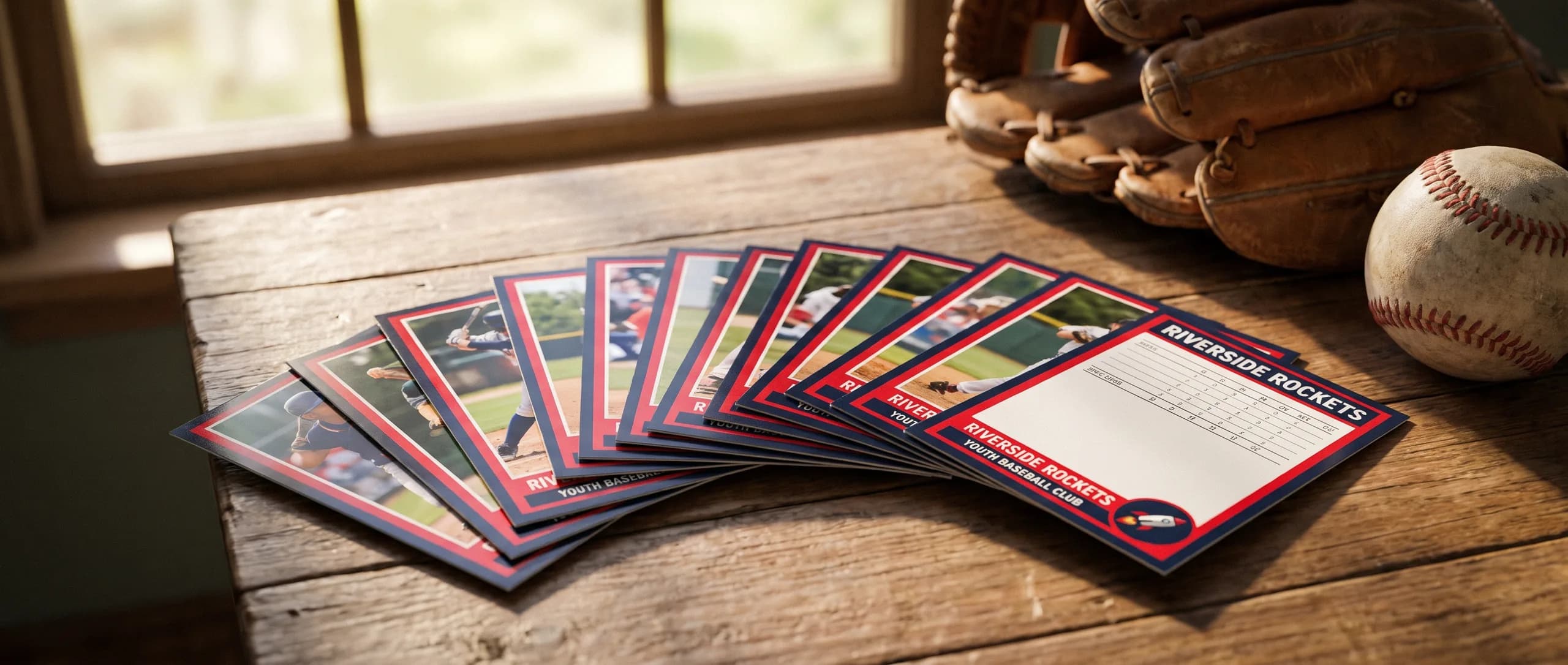
For a sports card, reserve consistent places for the player image, name and team identification. Put the season and verified statistics in an organized back layout if they are part of the project. For an original game, define a consistent position for the card name, resource values and rules so players can find the same kind of information quickly.
Make the design work with the longest name and the longest description before applying it to every card. A layout that fits only the shortest entry will force tiny type or inconsistent spacing later. Use a real-size paper draft to check the small text before repeating the format.
Decide whether the reverse changes for each card or uses a shared design. A game may need identical backs; an educational series may need a different fact on each reverse. Record that decision in the design list so a correct front does not get paired with the wrong back.
3. How do you set up bleed, safe areas, resolution and color?
Extend backgrounds 0.125 inch beyond trim, keep text and logos 0.125 inch inside trim, and aim for 300 ppi image resolution at the final print size.
Bleed and safe area solve different problems. Bleed is extra artwork outside the finished edge so the background can continue through trimming. Safe area is the inset that keeps important content away from that edge. A name placed in the bleed is at risk of being cut off, even if it appears in the exported file.
Use these setup checks for each face:
- Set the finished card to 3.5x2.5 inches, oriented as intended.
- Extend background colors and photographs 0.125 inch past every trim edge.
- Keep names, logos, statistics and essential game text at least 0.125 inch inside trim.
- Aim for 300 ppi at print size for raster images, or use suitable vector art.
- Outline fonts before exporting, as the published artwork guidance specifies.
- For double-sided cards, provide two files, front and back, or one two-page PDF with the front first; a single-sided card needs one file.
The published specifications call for CMYK color mode. Keep your original source images and prepare a separate print export, reviewing color changes before approval. Bright screen colors may shift in print; the RGB to CMYK guide explains that difference.
The artwork guidance lists 150 dpi as the minimum and 300 dpi as ideal. For a small card viewed closely, aim for the ideal. Changing an image's resolution label does not add missing detail. Inspect the photograph at its placed size, especially faces and small lettering, and use the print file error checklist before sending the file.
4. What should you check on the digital proof?
Check content, trim safety, orientation and front-to-back matching on the digital proof sent after your order.
The proof comes free with the order, and nothing prints until you approve it. Existing files and images go through AI image to print for $14.99 per item. Design it for me costs +$29.99, includes two revisions and is free when the item itself is $499 or more. There is no production setup fee.
Read the proof in two passes. First check the content: names, numbers, rules, spelling and any contact details. Then check the layout: cropping, safe margins, orientation and the intended reverse. This keeps an attractive image from distracting the reviewer from a wrong statistic or missing instruction.
Use your own full-size paper printout to assess how comfortably the text reads. It is a layout check rather than a production sample. A digital proof also cannot communicate the physical thickness of cardstock or guarantee that a screen's color matches ink exactly.
5. How much does printing on 16pt cardstock cost?
3.5x2.5 inch trading cards on 16pt gloss cardstock start at $53.49 for 50 cards, with the same product price for single and double sided printing.
Choose the quantity after confirming how many copies of each design you need. These are product prices for the specified size and stock.
| Item and details | Price |
|---|---|
| 50 trading cards, 3.5x2.5 inches, 16pt gloss cardstock, single or double sided | $53.49 |
| 100 trading cards, 3.5x2.5 inches, 16pt gloss cardstock, single or double sided | $64.19 |
| 250 trading cards, 3.5x2.5 inches, 16pt gloss cardstock, single or double sided | $85.59 |
| 500 trading cards, 3.5x2.5 inches, 16pt gloss cardstock, single or double sided | $106.99 |
| 1,000 trading cards, 3.5x2.5 inches, 16pt gloss cardstock, single or double sided | $128.39 |
The trading card cost guide covers the price comparison in more detail. Ground shipping is a flat $10 per product, with each different product in the cart carrying that charge.
Production is about 48 hours after artwork approval. Approve on a weekday before 12 PM Central for production to start the next business day; later approvals shift the start. Ground transit takes about 3 business days after production. Plan for both stages and proof review instead of assuming the cards arrive within 48 hours of ordering.
What can you use custom trading cards for?
Use trading cards for team promotions, original games, brand collections and school projects that benefit from a small, repeatable format.
A sports team can create a player introduction series. A game designer can use a consistent layout to present characters and actions. A business can build a product or staff introduction series, while a school project can organize vocabulary, historical subjects or science facts into compact cards.
For every use, choose the information that matters when the card is held in a hand. Leave longer explanations on a supporting page or separate sheet. The print marketing collection offers other formats when the content needs more space. Keep the card focused enough that its image, identifier and purpose remain clear at actual size.
Need trading cards or other custom printing? Inline Graphics helps businesses, churches, schools, and event organizers across the country design and print cards, banners, signs, decals, displays, and marketing materials that get noticed. Contact us today for a quote.
Frequently Asked Questions
The product uses a 3.5x2.5 inch finished size. A portrait design is 2.5 inches wide by 3.5 inches high. Choose the orientation before laying out photographs, names and game text.
Extend backgrounds 0.125 inch beyond every trim edge. Keep text and logos 0.125 inch inside every trim edge. Bleed is outside the finished card; the safe area protects important content inside it.
Aim for 300 ppi at the final print size. The published artwork guidance lists 150 dpi minimum, 300 dpi ideal or vector art. Increasing the resolution label alone does not restore detail to a small image.
No. Single and double sided trading cards have the same product price. Use the back for a biography, statistics, instructions or a shared design that supports the purpose of the cards.
50 3.5x2.5 inch trading cards on 16pt gloss cardstock cost $53.49; 1,000 cost $128.39. Each price applies to either single or double sided printing. Artwork and shipping are separate.
Confirm the design count and quantity for each front and back before ordering a set. The published pack prices state a card quantity; they do not establish how many different designs may be combined at that price.
Production is about 48 hours after artwork approval. A weekday approval before 12 PM Central starts production the next business day. Allow about 3 business days of ground transit after production rather than treating production time as an arrival promise.
Related Articles
Trading Cards Cost: Prices by Quantity and Card Size
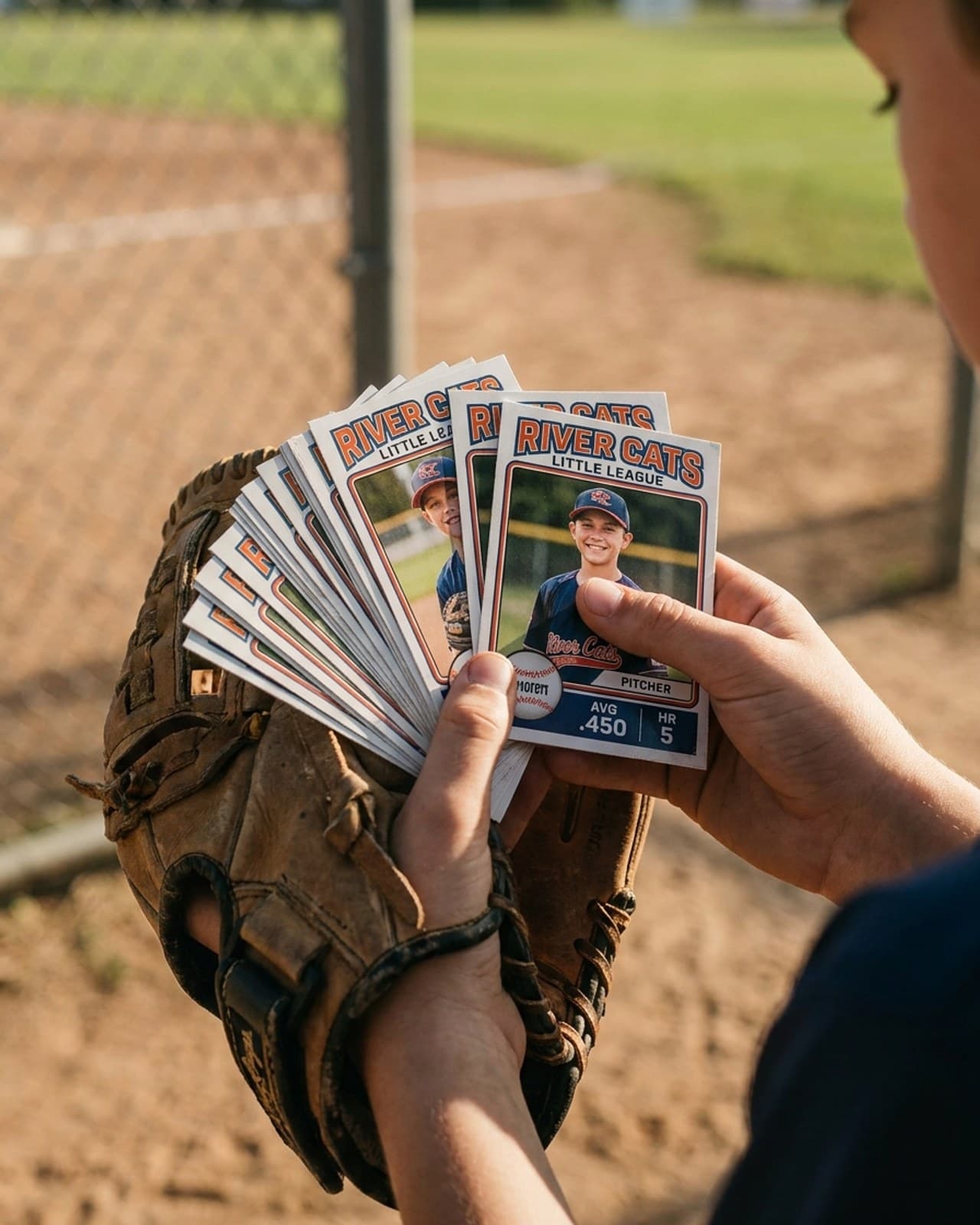
Trading cards measure 3.5 x 2.5 in and come in packs of 50 to 1,000. Compare every double-sided [...]
Read More: Trading Cards Cost: Prices by Quantity and Card Size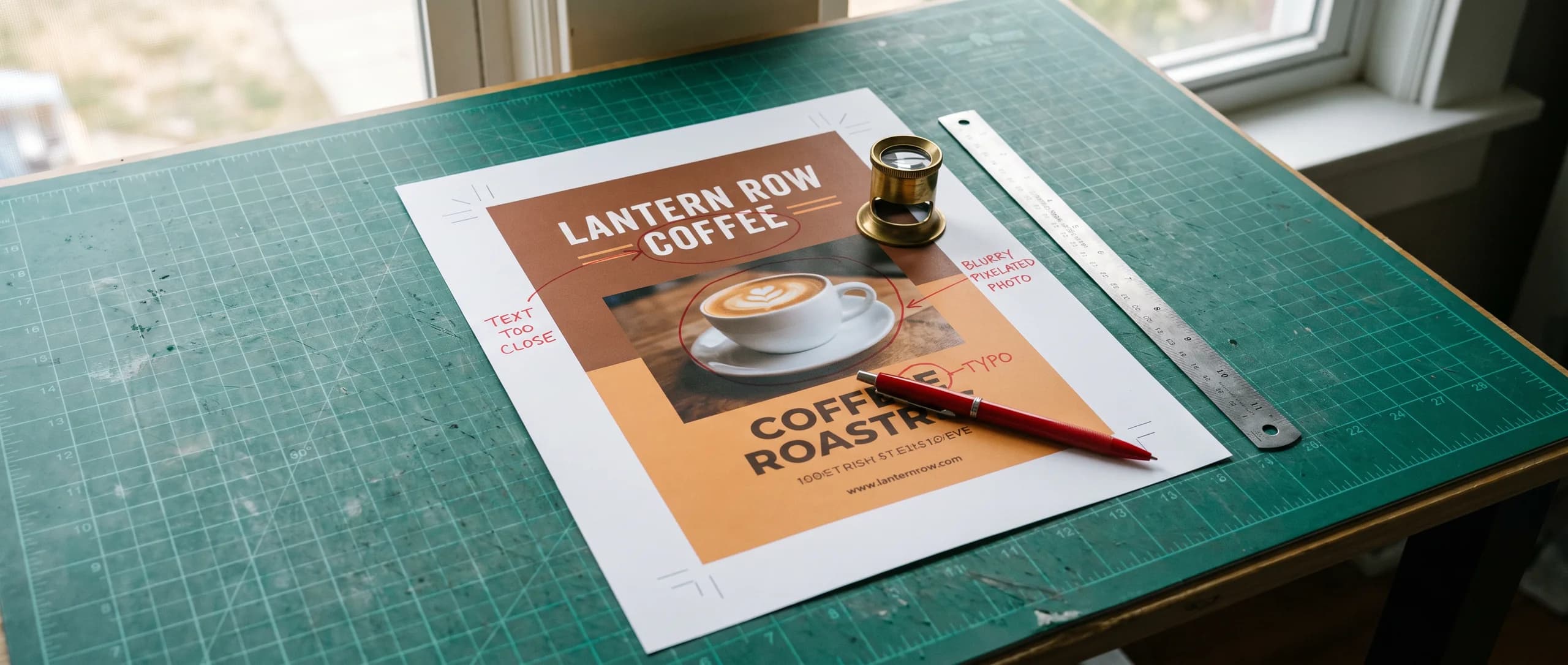
Print File Errors: The Checklist Before You Approve
No bleed, low resolution, and RGB files are the usual print file errors. 100 of the 4 x 6 in [...]
Read More: Print File Errors: The Checklist Before You Approve
RGB to CMYK: Prepare Flyer Colors for Accurate Print
RGB to CMYK converts screen color to 4 print inks. Learn why bright colors shift, how to [...]
Read More: RGB to CMYK: Prepare Flyer Colors for Accurate Print
Campaign Door Hangers and Push Cards That Voters Keep
Campaign door hangers start at $246.09 for 250 at 3.5 x 8.5 in, double sided with a UV gloss [...]
Read More: Campaign Door Hangers and Push Cards That Voters Keep