Flyer Paper Stock: Compare 16pt, 100# Cover and 70# Text
 Jean
February 18, 2026Updated October 19, 20268 min read
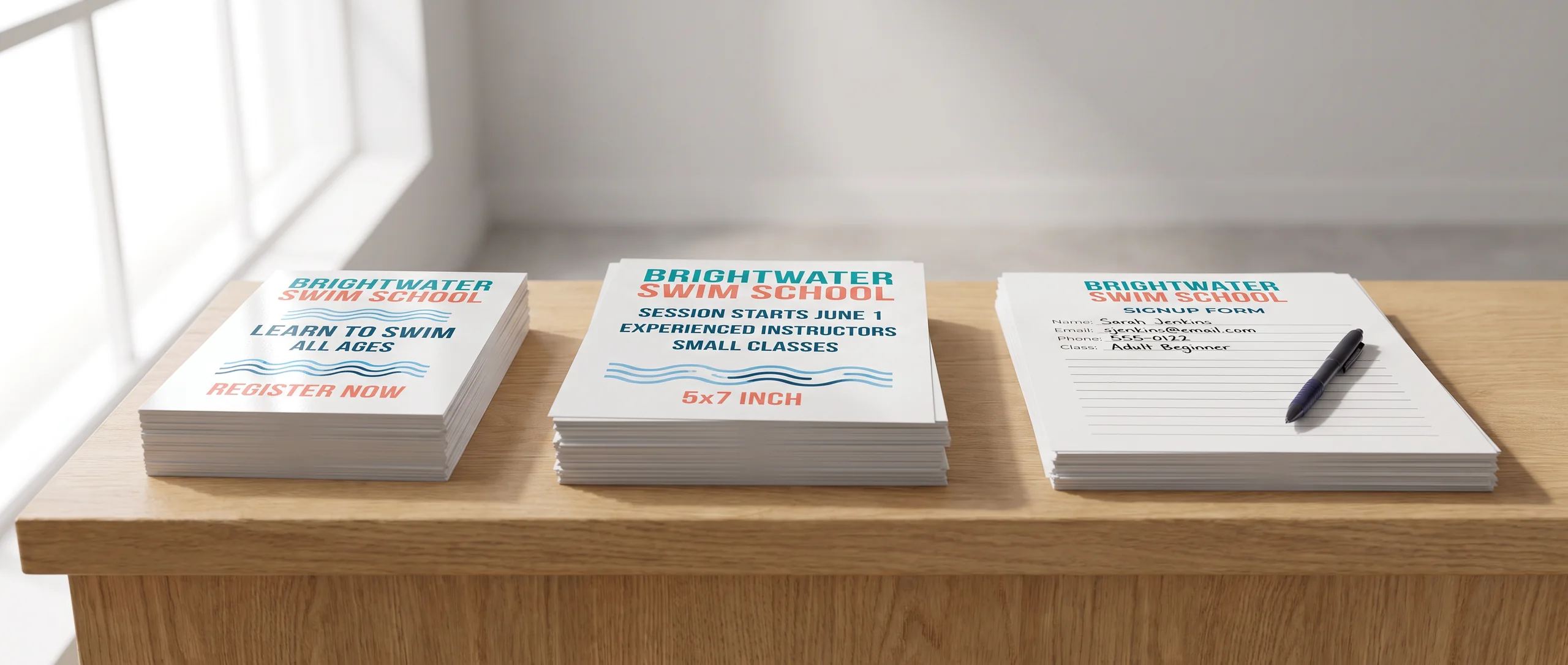
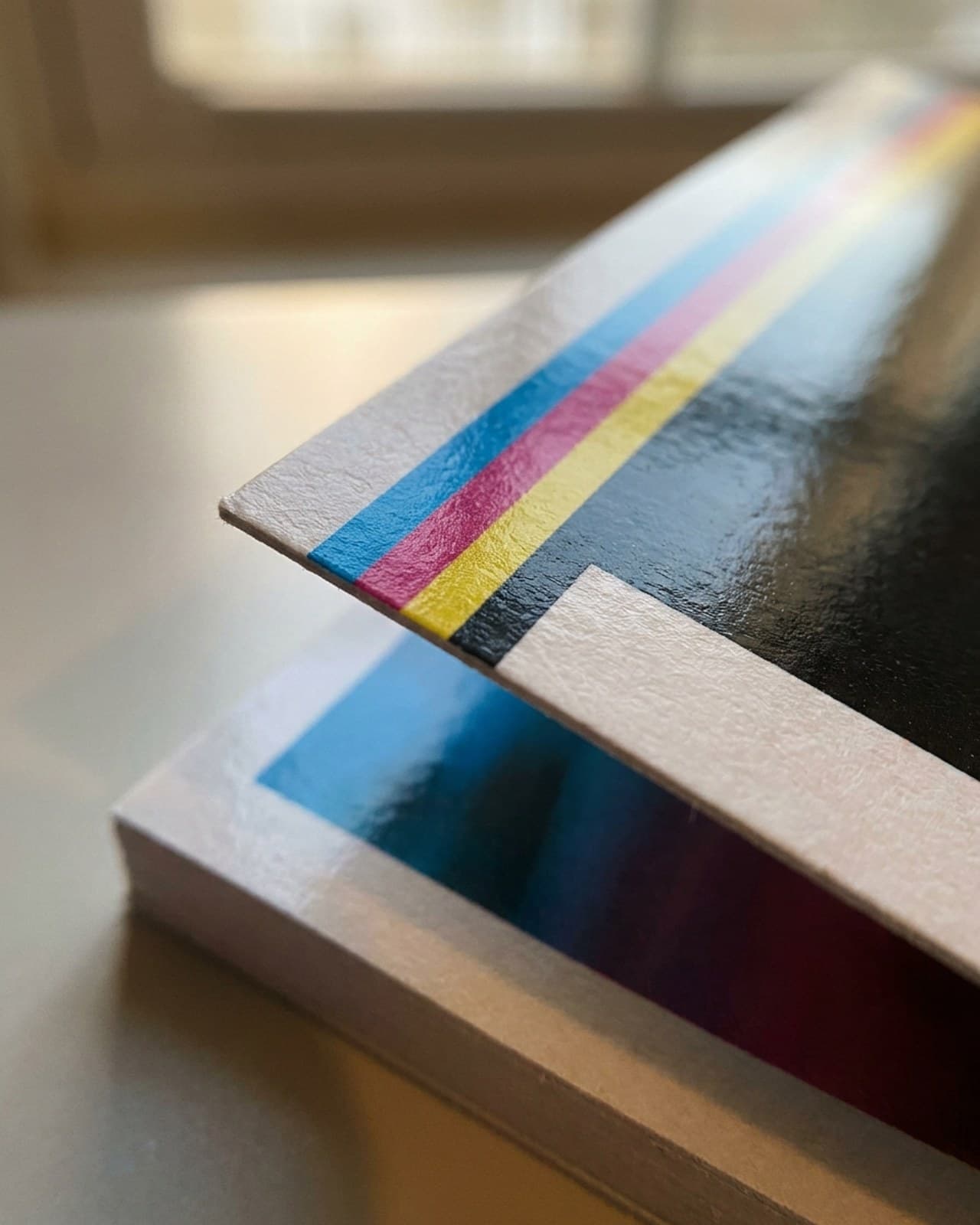
Which flyer paper stock should you choose?
Inline Graphics offers flyer paper stock in 16pt gloss cardstock, 100# gloss cover, and 70# uncoated text. A pack of 25 double-sided 4 x 6 in Standard 16pt Gloss flyers costs $53.49, with flat $10 ground shipping per product to any US address.
Start with what the recipient will do with the sheet: keep a card, read a handout, or fill in a form. That decision separates the three stocks more usefully than calling one budget and another premium. A glossy card can suit a product photograph; a writable sheet can suit a class worksheet.
Paper also determines which sizes and pack quantities you can buy. Choosing the size first can send you toward a combination that is not sold. The custom flyer product page lets you select the stock, then an available size and pack. Every flyer, on all three stocks, prints full color on both sides at the price shown.
What do the three flyer stocks feel like?
16pt gloss feels like a card, 100# gloss cover offers a substantial glossy handout, and 70# uncoated text feels like a flexible paper sheet.
Standard 16pt Gloss cardstock has a smooth, shiny finish. It suits a compact offer, product introduction, or insert that should retain a card-like shape. It can also work as a mailer, provided you check the mailing requirements separately. A sturdy sheet does not automatically qualify for a particular postage price.
Premium 100# Gloss is cover stock, not 100# text. It suits a polished handout with photography or broad color areas, particularly when you have enough recipients for its larger minimum orders. The product page calls Premium 100# Gloss a heavier cover stock. It does not give a point thickness, so do not convert 100# into a point number.
Standard 70# Uncoated is text stock with a matte, writable surface. It suits information sheets, response forms, workshop exercises, and schedules with room for notes. It bends more readily than a card. Choose it because the surface and sheet format serve the job, rather than assuming a lighter paper must have the smallest order total.
Which sizes and minimum quantities can you order?
Standard 16pt Gloss starts at 25 per size, while the other stocks have minimums that depend on the format.
- Standard 16pt Gloss: 4 x 6, 5 x 7, 6 x 9, and 8.5 x 11 in, each starting at 25 flyers.
- Premium 100# Gloss cover: 4 x 6 in starts at 750; 5 x 7 in starts at 500; 5.5 x 8.5 in starts at 250.
- Standard 70# Uncoated text: 8.5 x 11 in only, starting at 500 flyers.
The 5.5 x 8.5 in size is not available in 16pt gloss. The uncoated flyer option does not include a postcard-size sheet. Those are actual product boundaries, so do not prepare a small writable card and assume the full-sheet stock can be ordered in that size.
Use the flyer size guide to plan the reading space. Keep the surface decision separate: reducing a form to fit a glossy card may make both the writing area and the stock unsuitable. For a stock or size outside these combinations, request a custom quote.
How do flyer stock prices compare?
The stock comparison needs two shared sizes because no single flyer size is sold on all three papers.
| Flyer configuration, full color on both sides | Price |
|---|---|
| 250 flyers, 4 x 6 in, Standard 16pt Gloss cardstock | $106.99 |
| 750 flyers, 4 x 6 in, Premium 100# Gloss cover, its minimum for this size | $181.89 |
| 250 flyers, 8.5 x 11 in, Standard 16pt Gloss cardstock | $246.09 |
| 500 flyers, 8.5 x 11 in, Standard 70# Uncoated text, its minimum | $256.79 |
| 250 flyers, 5.5 x 8.5 in, Premium 100# Gloss cover, its minimum for this size | $189.00 |
These are printing prices for the stated packs, before artwork services and shipping. The quantities differ, so the table does not isolate the cost of changing paper alone. In particular, the 4 x 6 in premium pack contains three times as many flyers as the 16pt pack shown beside it.
For the regular 16pt quantity ladder, see custom flyer printing costs. Here, the useful question is whether the available pack and surface match your job. Neither a heavier feel nor a larger order automatically makes a flyer better suited to its reader.
What do text, cover, pt, and pound ratings mean?
Text and cover identify paper categories, while pt measures thickness and a pound rating describes basis weight.
In general paper practice, a pound rating is the weight of a standard ream at a specified basis sheet size. Text and cover use different basis sizes. That is why 70# text and 100# cover cannot be compared as though their numbers were measurements on the same thickness scale. Keep the category attached to the number.
A paper point is one thousandth of an inch, so 16pt describes a nominal thickness of 0.016 in. It does not describe a paper's gloss level or its finished mailing eligibility. Gloss refers to the surface appearance, and uncoated describes the absence of a coating. These terms answer different questions.
There is no dependable universal conversion from pounds to points. Paper construction and finish affect the relationship. For this order, use the stock's complete name and the product's description of its surface. Do not infer that 100# gloss cover must be a stated number of points when the catalog does not give that measurement.
How should the paper choice affect your design?
A writable flyer needs open response areas, while a glossy promotional flyer can devote more space to imagery and a clear offer.
On an uncoated form, give each response enough room for handwriting. Use clear labels and separate instructions from answer spaces. A decorative background behind a blank can make handwriting difficult to read even when the paper itself accepts a pen well. Keep the practical task visible at a glance.
On gloss, use contrast and hierarchy to make the main message readable without depending on shine. Small reversed text over a busy photograph can be hard to follow. A card-like stock gives the handout substance, but it cannot compensate for a crowded layout or an offer buried among unrelated details.
For every flyer file, extend backgrounds 0.125 in beyond each trim edge and hold text and logos 0.125 in inside the trim. Supply CMYK artwork, outline every font before export, and use images at 150 dpi minimum at final size, with 300 dpi ideal. Enlarging a small image does not restore missing detail.
How do artwork, proofing, and production work?
Artwork preparation is charged per item, and the free digital proof arrives after you place the order.
There is no production setup fee. Your existing image or file goes through AI image to print for $14.99 per item, including when you send it after checkout. That is one charge for the cart item, not one charge for each printed side. The alternative, Design it for me, is +$29.99 with two revisions and is free when the item itself is $499 or more.
Check the proof for the selected size, front and back orientation, wording, cropping, and readable response spaces. The digital view does not reproduce the feel of the sheet or guarantee identical color on every screen. Approve the layout only after the content is correct.
Standard 16pt Gloss production takes about 48 hours after proof approval. Premium 100# Gloss and 70# Uncoated run a few business days depending on quantity. Transit follows production and is additional time; do not use the production window as an arrival promise. The flyers are printed in the USA and ship nationwide. The broader print marketing range can help when you also need folded information or another paper format.
Need flyers or other custom printing? Inline Graphics helps businesses, churches, schools, and event organizers across the country design and print cards, banners, signs, decals, displays, and marketing materials that get noticed. Contact us today for a quote.
Frequently Asked Questions
Standard 70# Uncoated text has a matte, writable surface. It comes only in 8.5 x 11 in, with orders starting at 500 flyers. Use it for forms, worksheets, and handouts that need notes.
The Premium 100# Gloss flyer option is cover stock. The word cover matters because pound ratings for text and cover use different basis sheet sizes. A pound number alone does not tell you the thickness.
No. Standard 16pt Gloss starts at 25 flyers. Premium 100# Gloss starts at 750 for 4 x 6 in, 500 for 5 x 7 in, and 250 for 5.5 x 8.5 in. Standard 70# Uncoated starts at 500.
Every flyer prints full color on both sides at the price shown. Every listed pack price identifies its stock, size, and quantity. Artwork preparation is a separate per-item choice, not a charge for each side.
No. The 5.5 x 8.5 in size is available on Premium 100# Gloss cover only. Standard 16pt Gloss comes in 4 x 6, 5 x 7, 6 x 9, and 8.5 x 11 in.
A free digital proof comes after you place the order and before printing. Your own file or image goes through AI image to print for $14.99 per item. Review the proof before approving production.
Related Articles
Custom Flyers Cost: Prices for 100, 250 and 500 Flyers
Custom flyers come in 100, 250, and 500 piece packs on 4 x 6 in stock. Compare every quantity, [...]
Read More: Custom Flyers Cost: Prices for 100, 250 and 500 Flyers
Flyer Sizes: Five Cuts, Three Stocks, and Their Prices
Flyers come in 4 x 6, 5 x 7, 6 x 9 and 8.5 x 11 in on 16pt gloss, plus 5.5 x 8.5 in on 100# [...]
Read More: Flyer Sizes: Five Cuts, Three Stocks, and Their PricesFlyer vs Brochure: When Folded Panels Earn the Cost
250 4 x 6 in 16pt gloss flyers cost $106.99. 250 half-fold 8.5 x 11 in brochures cost $246.09. [...]
Read More: Flyer vs Brochure: When Folded Panels Earn the Cost
Campaign Door Hangers and Push Cards That Voters Keep
Campaign door hangers start at $246.09 for 250 at 3.5 x 8.5 in, double sided with a UV gloss [...]
Read More: Campaign Door Hangers and Push Cards That Voters Keep