Flyer vs Brochure: When Folded Panels Earn the Cost
 Daniel
September 17, 2026Updated October 18, 20269 min read
What is the difference between a flyer and a brochure?
A flyer is one sheet and a brochure is a folded sheet. Inline Graphics prices 250 full-color 4 x 6 in Standard 16pt Gloss flyers at $106.99, and 250 full-color 8.5 x 11 in half-fold brochures on 70# text at $246.09. Both ship for a flat $10 to any US address.
The flyer is in production for 48 hours after artwork approval. The half-fold brochure takes 3 to 5 business days after that same approval. The days are the part of the choice the price table does not show.
The priced flyer in this comparison is one flat sheet: 4 x 6 in, Standard 16pt Gloss cardstock, full color, with the second side included. It has two faces and no fold. Other flyer cuts are sold, and each one has its own price. The quantity ladder for this 4 x 6 build is in custom flyers cost.
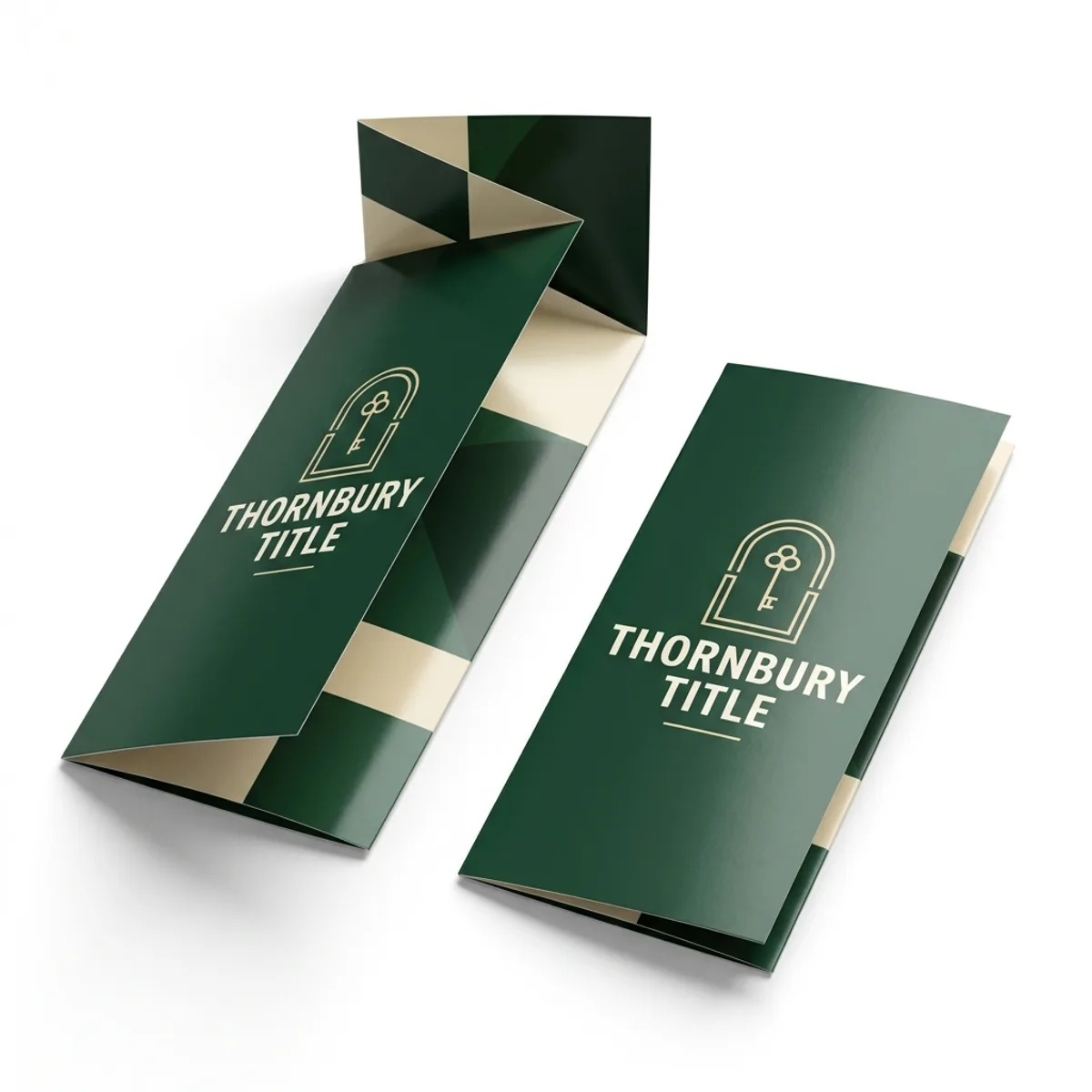
The priced brochure is a sheet that is folded before it ships: 8.5 x 11 in, half-fold, 70# text stock, full color on both sides. A half-fold makes four panels. We also sell an 8.5 x 11 in tri-fold and an 8.5 x 14 in tri-fold, six panels each, on the same 70# text stock. 250 of the 8.5 x 11 in tri-fold are $246.09, the same as the half-fold, and 250 of the 8.5 x 14 in tri-fold are $331.69. All three folds are ordered on the custom brochures page. The panel maps are drawn in how to make a professional brochure.
Pamphlet is the everyday word for a small folded handout. Order that job as a brochure. Order the flat sheet as a flyer. There is no third product sitting between them.
The stocks belong to that split. Flyer prices in this article use Standard 16pt Gloss, a card meant to stay flat. Brochure prices use 70# text stock, a text weight that is folded before it ships. Folding the card does not turn it into this brochure, and leaving the text sheet flat does not turn it into this flyer.
When is one page enough?
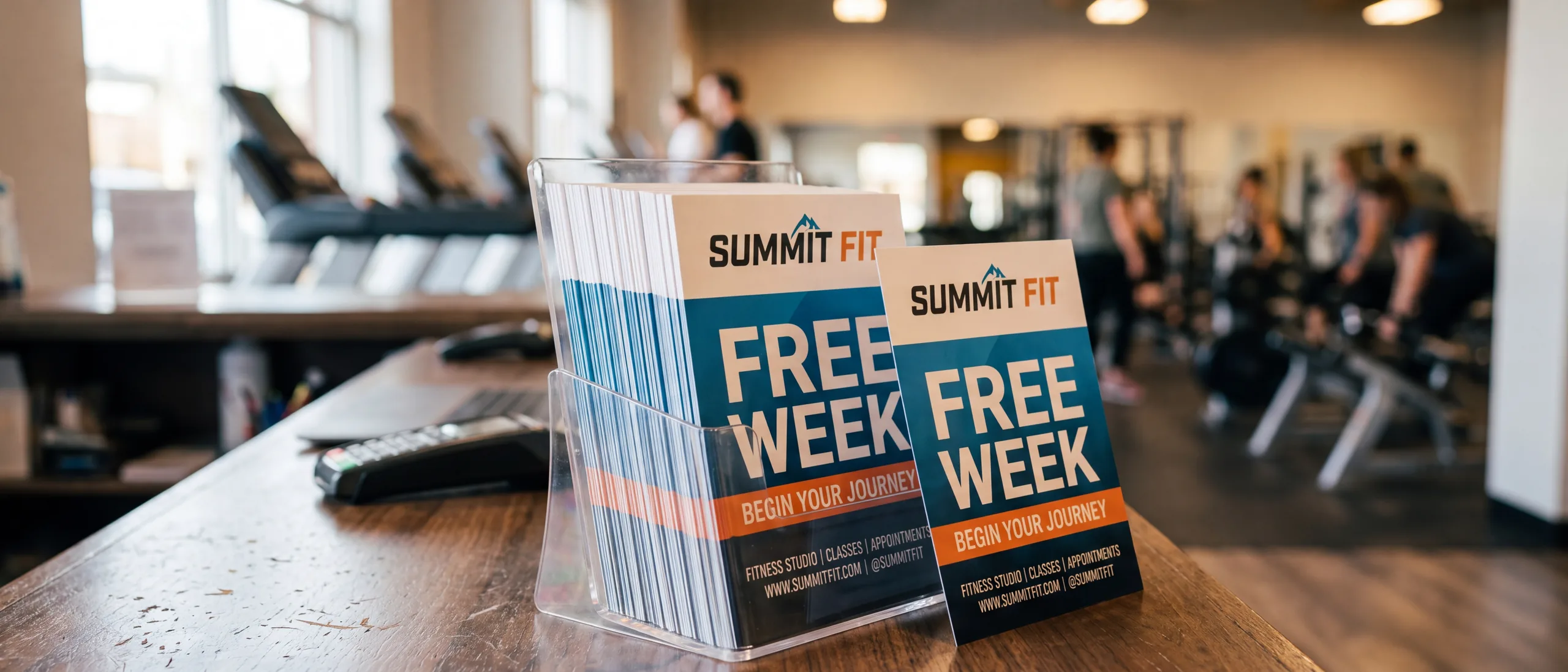
One page is enough when a person can act on a single offer without opening a fold. 250 of the 4 x 6 in Standard 16pt Gloss flyers are $106.99, about $0.43 each, and the press window is 48 hours after the proof is approved.
Use the flyer when the message is a date, a price, a short promise, and one way to respond. The front carries the offer. The back carries the one detail that would have crowded the front, such as an address, a short list of what is included, or a code. A one-day class with one price and a signup line fits that sheet. So does a visitor card that only needs service times and a phone number.
The 4 x 6 in sheet is 24 square inches (4 times 6). It is 16pt cardstock, so it holds up in a hand better than thin copy paper, and it is still one idea. If the design needs a second headline before it makes sense, the page is already too small. Step up to a larger flyer cut, priced on its own, or move to a brochure. Do not shrink a letter-size layout onto the card and hope the type survives.
When do folded panels earn their cost?
Folded panels earn their cost when the message has more than one job and each job needs its own panel. At 500 pieces the half-fold brochure is $256.79 and the 4 x 6 flyer is $149.79. The brochure is still the larger pack, and it is the piece with room to open.
A half-fold gives four panels: a cover, two inside panels that read together as a spread, and a back. That is the right buy for a cover line, a short explanation, and a separate place for the next step. A church welcome piece with service times, a simple map of the morning, and a next step can earn those four panels, because they are three different kinds of information plus a cover. A tri-fold gives six narrower panels. Buy that when the story is a sequence: who you help, how the work goes, and how to start. At 8.5 x 11 in the tri-fold costs the same as the half-fold, $246.09 for 250, so the choice there is about the story, not the price. The longer 8.5 x 14 in tri-fold is $331.69 for 250.
Panels do not earn their cost when every panel repeats the same sentence. A cover that restates the inside, and an inside that restates the back, is a flyer that took longer to make. Brochure production is 3 to 5 business days after artwork approval, and flyer production is 48 hours. Production time is not arrival time. When an event date is close, add transit to either window and confirm the delivery date before you pick the format.
How do the prices compare at the same quantity?
250 full-color 4 x 6 in Standard 16pt Gloss flyers are $106.99, and 250 full-color 8.5 x 11 in half-fold brochures on 70# text are $246.09. Every row below is a pack price for a full-color piece. Flat $10 shipping sits on top of each order and is not inside the prices.
| Build | Quantity | Price |
|---|---|---|
| 4 x 6 flyer | 250 | $106.99 |
| 8.5 x 11 half-fold | 250 | $246.09 |
| 8.5 x 11 tri-fold | 250 | $246.09 |
| 8.5 x 14 tri-fold | 250 | $331.69 |
| 4 x 6 flyer | 500 | $149.79 |
| 8.5 x 11 half-fold | 500 | $256.79 |
The flyer rows are only that 4 x 6 in build. Smaller flyer packs of the same sheet are 25 for $53.49, 50 for $64.19, and 100 for $74.89. Further packs of the 8.5 x 11 in half-fold are 750 for $267.49, 1,000 for $278.19, and 2,500 for $460.09. At 500 pieces the 8.5 x 14 in tri-fold is $417.29. Keep every dollar on the build it belongs to. A 5 x 7, 6 x 9, or 8.5 x 11 in flyer is a different configuration with its own pack price.
Both products include a free digital proof, and any file or image you send is made print ready for $14.99 per item. Design it for me is an extra $29.99 and includes two revisions. That charge is free when the item itself is $499 or more. Neither 250-piece total above reaches that line. The 2,500 half-fold pack at $460.09 does not reach it either.
Start a flat piece on the custom flyers page. Start a folded piece on the brochure page linked above. The print marketing collection holds the other handouts when the job is neither of these.
Should you hand it out, mail it, or put it in a rack?
Hand the piece to a person, mail it only with postage arranged on its own, or set a folded piece in a rack only after you measure the pocket. The print price does not pay for any of those three trips.
A handout is the plain case. A 4 x 6 in flyer goes in a hand, a bag, or a stack you are allowed to leave. A brochure goes in a hand when someone has a reason to open it: a meeting, a counter where people wait, a packet. Count the hands first, then pick the pack. A carton that stays in the office is not the cheaper format. It is unused paper.
Mail is a second bill. The flat $10 sends the whole print order to one US address. It does not stamp each card or each brochure. A flat sheet and a folded sheet are different mail pieces, and the class depends on the finished size, the thickness, and how the addresses are prepared. Confirm that with the postal service or your mailer before you print a large run. Do not drop an unstamped flyer or brochure into a mailbox, and do not hang one on the box. Door hangers vs postcards cites the postal rule on mail receptacles.
A rack is a pocket with a measured opening. A folded brochure can stand in a literature holder when the closed piece is narrower than that pocket and the lip does not cover the cover line. We do not publish one pocket width, because racks are not all the same. Check your rack's pocket width, and check how high the lip sits. A flat flyer usually belongs in a stack, not on its edge. A tall card made to live in a rack is a rack card, with its own page and its own price, not a flyer stood up.
What should you check on the proof?
Check the offer, the date, every contact digit, and the panel order before you approve the proof. The flyer clock of 48 hours, and the brochure clock of 3 to 5 business days, both start at approval, not at checkout.
On a flyer, read both faces at the finished 4 x 6 in size. A phone number that wraps, or a code that sits on the trim, will be on every copy in the pack. On a brochure, read the panels in the order a person opens them. A flat file can look correct on a screen and still put the back panel where the cover should be. The brochure guide linked above is the map for that check.
Printed in the USA, then shipped nationwide for the flat $10. Add transit after the production window when you are counting back from an event. The proof is free. Approving it is what starts the work.
Need flyers, brochures, or other custom printing? Inline Graphics helps businesses, churches, schools, and event organizers across the country design and print cards, banners, signs, decals, displays, and marketing materials that get noticed. Contact us today for a quote.
Frequently Asked Questions
At 250 pieces, an 8.5 x 11 in half-fold brochure on 70# text stock is $246.09 and a 4 x 6 in Standard 16pt Gloss flyer is $106.99. Flat $10 shipping is charged on each order, on top of those print totals.
Pamphlet is a general word for a small folded handout. On this site that order is a brochure. A single sheet that stays flat is a flyer. There is no separate pamphlet to configure.
Flyer production is 48 hours after artwork approval. Brochure production is 3 to 5 business days after artwork approval. The clock starts when the proof is approved, and transit comes after that.
Flat $10 ground shipping sends the print order to one US address. Postage for a mailed card or a mailed brochure is a separate postal cost, and it depends on the finished piece.
The brochure page sells an 8.5 x 11 in half-fold, an 8.5 x 11 in tri-fold, and an 8.5 x 14 in tri-fold, all on 70# text stock. 250 of either 8.5 x 11 in fold are $246.09, and 250 of the 8.5 x 14 in tri-fold are $331.69. A Z-fold and a gate fold are not options on that page.
Order a size the product page already sells. For a cut or a fold that is not listed, ask for a quote rather than assuming it can be printed at one of these prices.
Related Articles
Custom Flyers Cost: Prices for 100, 250 and 500 Flyers
Custom flyers come in 100, 250, and 500 piece packs on 4 x 6 in stock. Compare every quantity, [...]
Read More: Custom Flyers Cost: Prices for 100, 250 and 500 Flyers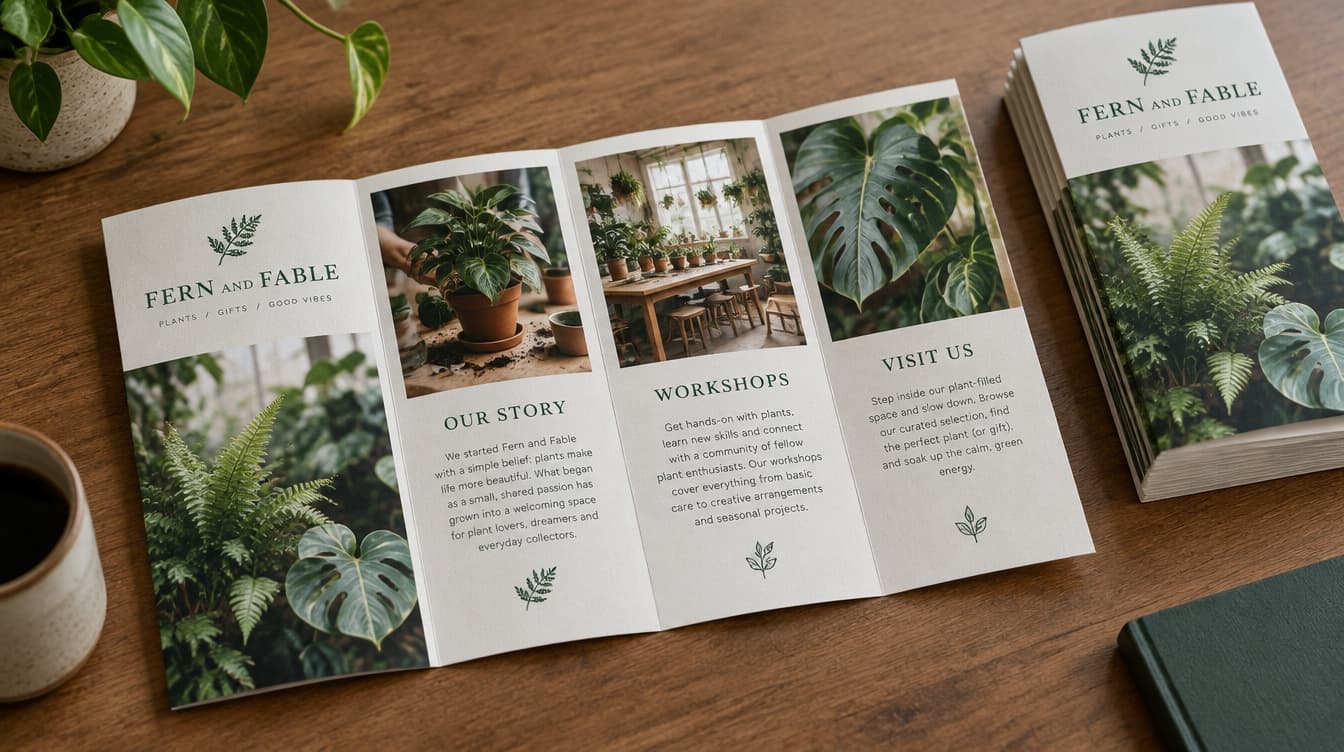
How to Make a Brochure: A Professional Print Guide
An 8.5 x 11 in brochure can use a half-fold or tri-fold, while 8.5 x 14 in supports a tri-fold. [...]
Read More: How to Make a Brochure: A Professional Print Guide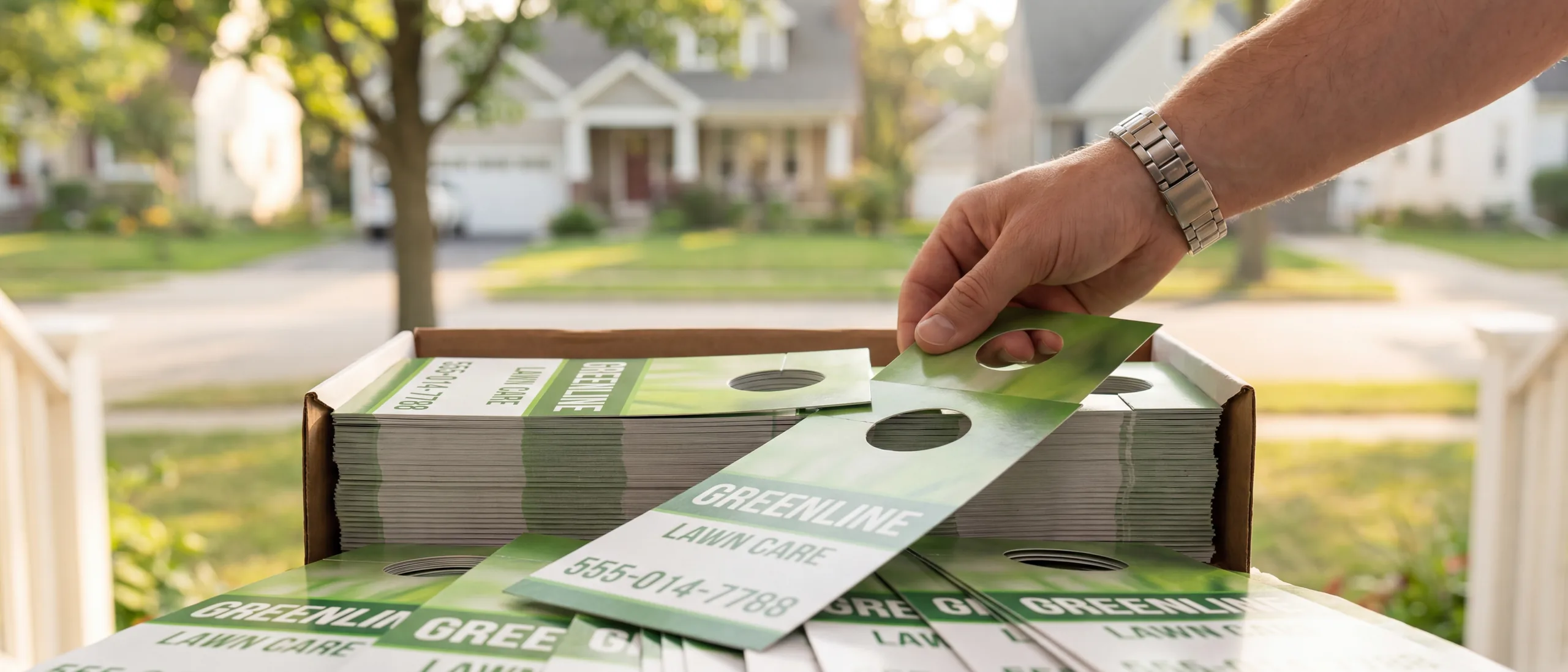
Door Hangers vs Postcards: Which Should You Print First?
250 3.5 x 8.5 inch door hangers cost $246.09; 250 4 x 6 inch postcards cost $106.99. Compare [...]
Read More: Door Hangers vs Postcards: Which Should You Print First?
Custom Posters Cost: Prices for 10 Through 250 Posters
Custom posters measure 12 x 18 in and come in packs of 10 to 250. Compare every 16pt Gloss [...]
Read More: Custom Posters Cost: Prices for 10 Through 250 Posters