How to Weigh Down a Canopy Tent: Stakes and Sandbags
 Daniel
June 23, 2026Updated October 29, 20268 min read

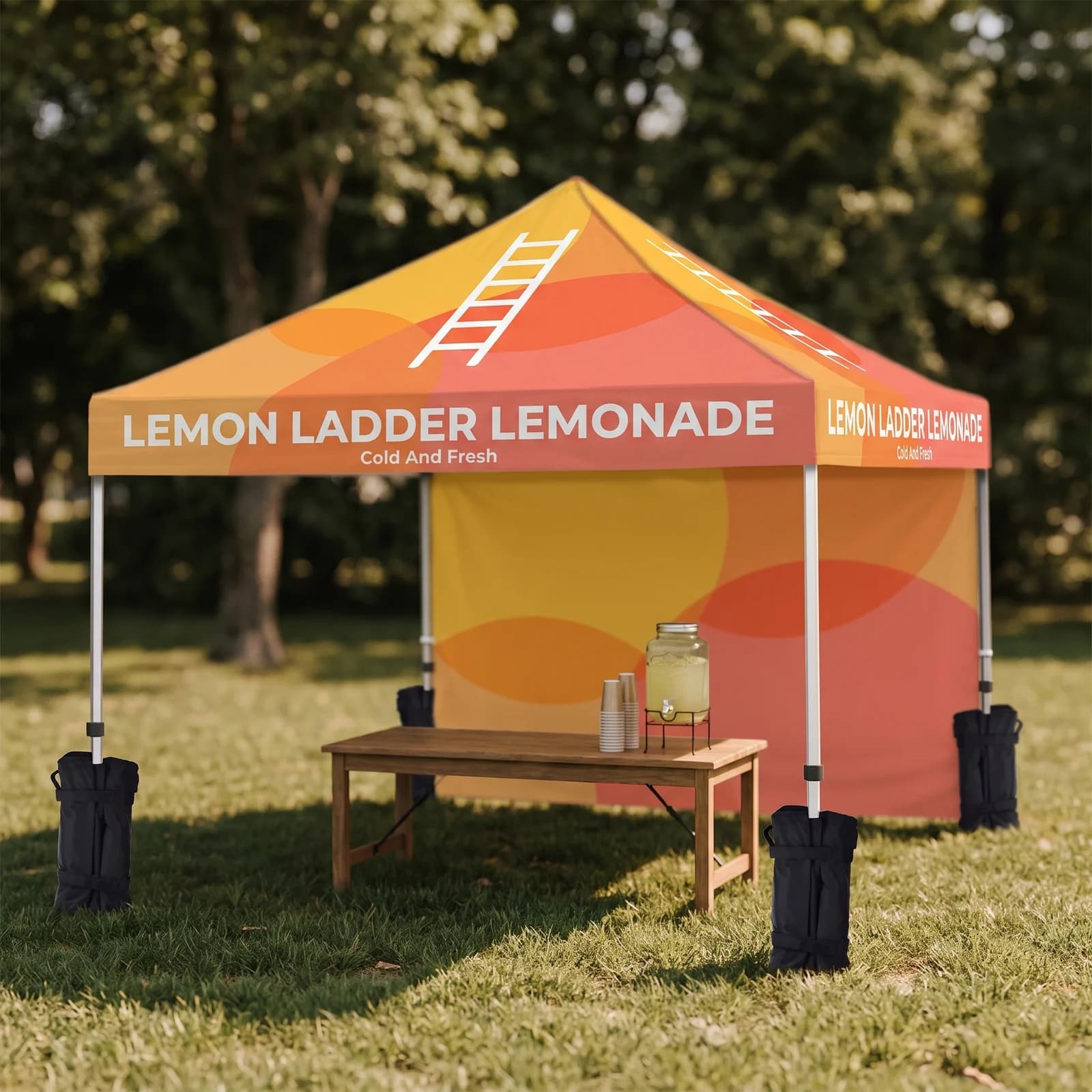
How do you weigh down a canopy tent before an event?
Weigh down a canopy tent with at least 40 lb on every leg unless the organizer sets a different number. Inline Graphics sells a fillable 4-piece sandbag set for $139.09; it holds about 76 lb filled, about 19 lb a leg, so plan extra weight. Flat $10 shipping per product. On grass, stake only where permitted.
Make anchoring part of setup before opening cartons or arranging the display. An erected, unsecured roof can catch wind while the crew is busy with the table. Have the approved equipment ready where it will be used, and keep people clear while the frame is being raised.
Start by confirming the surface, tent size and number of legs. A grass plot and a paved booth need different plans. So can two venues using the same footprint. Get the organizer's written requirements before selecting equipment rather than relying on a neighboring vendor's setup.
Our canopy tent hardware page offers the fillable sandbag set and carrying bags. The custom canopy tent collection shows the tents those accessories support. We sell the 4-piece sandbag set, not metal plates, concrete weights or other ballast systems.
Should you use stakes on grass or weights on pavement?
Stakes can be appropriate on permitted, suitable grass or soil; pavement needs an approved ballast system that does not depend on penetrating the surface.
Grass is not automatic permission to stake. Ask the property owner or organizer about underground utilities, irrigation, protected turf and any restrictions on ground penetration. Follow the frame's anchoring instructions, including the designated rope connections. Loose, soaked or shallow soil may not provide the holding conditions a stake needs.
On asphalt or concrete, do not try to hammer the supplied stakes into the surface. Use the organizer-approved weight and attachment arrangement at every leg. Do not tie the tent to a parked vehicle, nearby display or unrelated structure as a shortcut.
Every frame kit includes ropes, stakes and a standard carry bag, but those inclusions are not a statement that stakes are allowed or adequate at your event. For the sequence of raising and locking the frame, use the 10x10 canopy setup guide.
How much weight should go on each leg?
We recommend at least 40 lb on each leg, unless your organizer or venue sets a different number.
Requirements can change with the tent footprint, surface, sidewalls and event plan. Rules also vary by city, county, state, venue and property restrictions, including an HOA where relevant. For one example, the City of Boulder special event guidelines require weights for vendor tents on park turf unless stakes are approved in writing, and recommend at least 40 pounds on each corner of a 10x10 tent. That matches our recommendation, but it is one city's rule; if your organizer sets a different number, use theirs.
Ask these questions before buying or filling bags:
- What filled weight is required at each leg for this exact tent size?
- Which ballast types and attachment methods are accepted?
- Are stakes allowed on the assigned surface?
- Does adding full walls change the requirements?
- Who checks the setup, and when must it be ready?
- What conditions trigger closure or teardown?
Our 4-piece set holds about 76 lb when filled, about 19 lb a bag, so one set puts roughly half the recommended 40 lb on each leg of a 10x10. Two sets bring each leg to about 38 lb, so add a little more secured weight on top, weigh the filled bags, and confirm the arrangement with the organizer. This is general information, not legal advice.
How do you attach sandbags, straps and ropes?
Strap each filled bag snugly around the base of its leg, right at the foot, using a method the venue accepts.
A weight sitting beside a foot does not necessarily restrain the frame. The connection must keep the ballast working with the tent rather than letting the foot lift away from it. Use the bag's own straps or suitable rope; do not improvise a connection to the printed top, valance or a movable folding brace.
Keep bags low, stable and close to the leg so they do not swing into customers. Route guy ropes inside the assigned space where possible, with the organizer's approval. Protect walking routes, accessible paths and booth exits. Do not pull straps so tight that the frame bends or the leg lifts off the ground.
Check connections after raising the frame to its final height, because movement during setup can change tension. If a strap is frayed, a buckle will not hold or a bag is leaking, fix that before visitors enter. A snug-looking strap is not proof that the whole arrangement meets the venue's requirements.
How many sandbags come with each buying option?
The separate sandbag set contains 4 bags, while the 10x20 tent's sandbag kit option contains 6 for its six legs.
The bags are fillable on site. Plan how you will obtain the fill, weigh the finished bags and transport or remove the fill after the event. Do not assume filled sand is shipped with them. Verify the filled amount rather than judging by how full the bag looks.
For a six-leg frame, buying one standalone 4-piece set leaves two legs without bags. Count actual legs before checkout, including the middle supports on a longer tent. Also remember that the number of included bags says nothing about whether their filled weight will satisfy your particular event.
What do sandbags, tent kits and wheeled bags cost?
One standalone 4-piece sandbag set costs $139.09, and one full-custom 10x10 tent with its V6 frame and 4 sandbags costs $1,106.69.
The tent totals below are published configured kit prices. They are not sums of separately purchased parts. Each printed canopy top is full-custom, 6 oz dye-sublimated polyester; frame kits also include ropes, stakes and the standard carry bag.
| Item and details | Price |
|---|---|
| One 4-piece canopy sandbag set, unprinted, fillable on site; fill weight must be checked | $139.09 |
| One 10x10 full-custom canopy with V6 frame and 4 sandbags | $1,106.69 |
| One 10x15 full-custom canopy with frame and 4 sandbags | $1,523.99 |
| One 10x20 full-custom canopy with frame and 6 sandbags | $1,804.69 |
| One separate wheeled carry bag sized for a 10ft tent, no tent or ballast included | $171.19 |
Hardware ships from the USA in 3 to 4 business days. Standard tent production takes 3 to 4 business days after proof approval. Canopy artwork design is included and the AI image fee is waived. The free digital proof comes after the order, and printing waits for approval. Weekday approval before 12 PM Central starts production the next business day.
Ground shipping is flat $10 per product nationwide, with about 3 business days in transit. Each different product in the cart is a separate shipping charge. A wheeled bag helps transport the tent; it is not a canopy weight.
What should you check before the crowd arrives?
Walk the entire tent before opening and check every leg, connection, lock and walking route.
- Verify at least 40 lb, or the organizer's number, at each leg.
- Confirm the approved connections are secure and not rubbing sharp edges.
- Check that the legs are planted and pins are fully engaged.
- Clear bags and ropes from the entrance and public aisles.
- Recheck any setup changed by adding a wall or moving the booth.
- Identify the person monitoring weather and the route to safe shelter.
Skip loose bricks, unsecured household containers, display racks and stock boxes as improvised substitutes. Their movement, changing contents or unreliable attachments make them poor choices for a planned anchoring system.
When should you take a weighted canopy down?
Take the canopy down before high wind makes handling unsafe, even when every leg has ballast.
No wind rating is published for our canopies, so there is no safe operating speed to promise. Use the event's closure plan and monitor changing conditions. The canopy wind guide covers frame considerations without turning frame strength into a weather guarantee.
Plan teardown early enough to work safely. If thunder is already audible, prioritize shelter over packing equipment. The National Weather Service identifies tents as unsafe lightning shelter. A heavier bag or an additional rope does not change that.
Need canopy tent hardware or other custom printing? Inline Graphics helps businesses, churches, schools, and event organizers across the country design and print cards, banners, signs, decals, displays, and marketing materials that get noticed. Contact us today for a quote.
Frequently Asked Questions
We recommend at least 40 lb on each leg unless your organizer sets a different number. Ask the organizer which ballast and attachment methods it accepts. No wind rating is published for our canopies.
One fillable 4-piece canopy sandbag set costs $139.09 and holds about 76 lb when filled, about 19 lb on each leg of a 10x10. Reaching 40 lb a leg takes more than one set, or other secured weight.
The 10x20 tent has six legs, and its kit sandbag option contains 6 bags. One full-custom 10x20 tent with its frame and 6 sandbags is $1,804.69. The separately sold set contains 4 bags.
Use approved ballast on pavement rather than attempting to drive stakes into it. On grass, obtain permission and check the ground and buried services before using stakes.
Do not substitute merchandise, a table or a person holding a leg for a purpose-made anchoring system. Stock can be removed, tables can move, and people cannot provide dependable ballast.
No. Frame weight does not replace an anchoring plan for every leg. No published wind rating establishes a safe speed for leaving our canopy up in strong wind.
Related Articles
Heavy Duty Canopy Tent Wind: Frames, Bags and Stakes
No canopy frame publishes a wind-speed rating, and wind damage is excluded on all 5 tiers. What [...]
Read More: Heavy Duty Canopy Tent Wind: Frames, Bags and Stakes
How to Install a 10x10 Canopy Tent: The Setup Order
A 10 x 10 canopy sets up in 5 steps: top on, frame open, legs out, then stakes or weight on all [...]
Read More: How to Install a 10x10 Canopy Tent: The Setup Order
Canopy Tent Sizes Guide: 10 x 10, 10 x 15, and 10 x 20
Canopy tent sizes are 10 x 10, 10 x 15, and 10 x 20 ft. Compare each footprint, event layout, [...]
Read More: Canopy Tent Sizes Guide: 10 x 10, 10 x 15, and 10 x 20
10x10 vs 10x20 Canopy Tents: How the 10x15 Fits Between
A 10x10 canopy tent with frame starts at $973.69, a 10x15 at $1,390.99 and a 10x20 at [...]
Read More: 10x10 vs 10x20 Canopy Tents: How the 10x15 Fits Between