Indoor and Outdoor Signage: Materials, Sizes and Cost
 Jean
February 17, 2026Updated October 19, 202610 min read
What Is the Best Material for Outdoor Signage?
Outdoor signage needs UV printed material rated for weather: 13 oz vinyl banners, 4 mm coroplast yard signs, and .040 aluminum panels guaranteed 5 years or more. Indoor signage can use 3/16 inch foam board, low tack wall fabric and window film. Match the material to the wall, not the budget.
Two specifications decide whether an outdoor sign survives: UV stability and structural durability. A sign that holds its color for a full season and does not tear in a storm is doing its job, and both of those are material choices made before anyone opens a design file.
Here is the whole lineup, indoor and outdoor, with what each one is made of and what it starts at.
| Sign | Where it belongs | Material | Starts at | Production |
|---|---|---|---|---|
| Vinyl banner | Outdoor walls, railings, fences | 13, 15 or 18 oz scrim vinyl | $64.19 | 3 business days |
| Mesh banner | Outdoor fences and windy walls | 9 oz perforated polyester | $64.19 | 3 business days |
| Yard sign | Lawns, medians, job sites | 4 mm coroplast | $53.49 | Next business day |
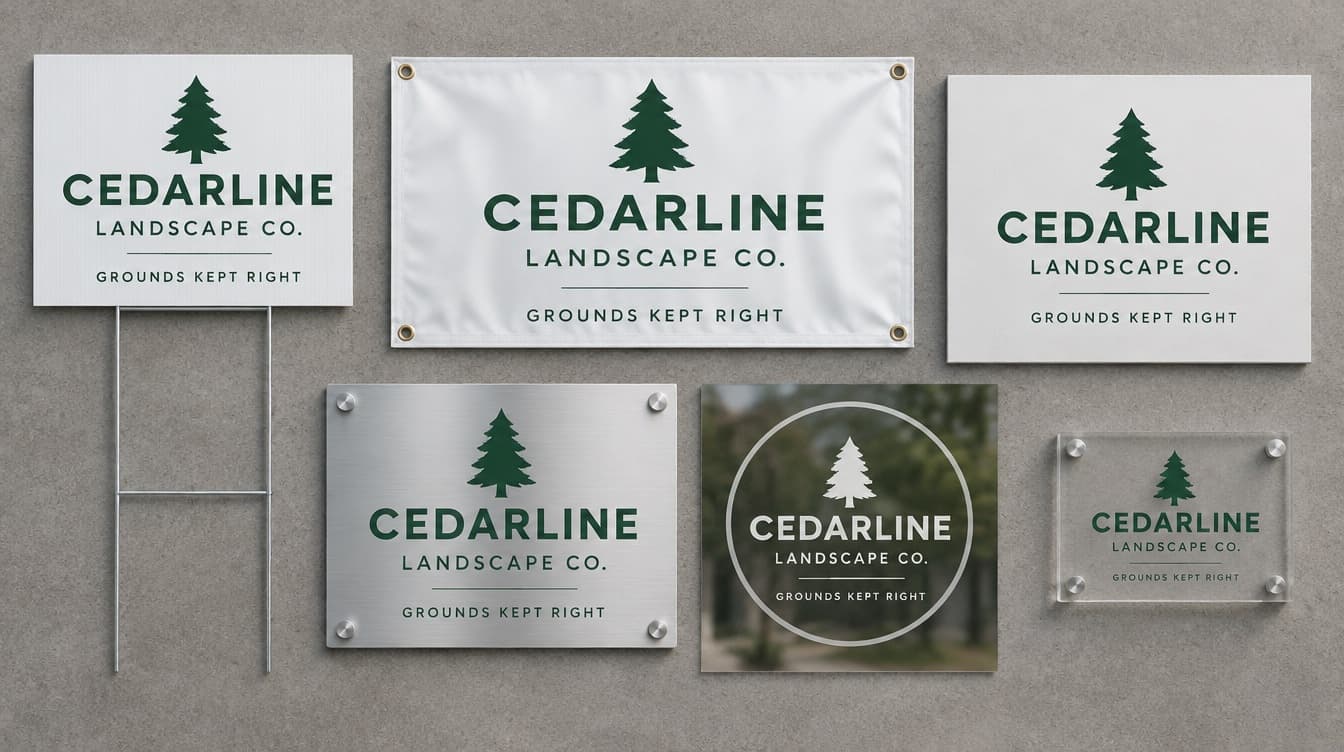
| Aluminum sign | Posts, walls, fences, permanent | .040 aluminum | $74.89 | 3 business days |
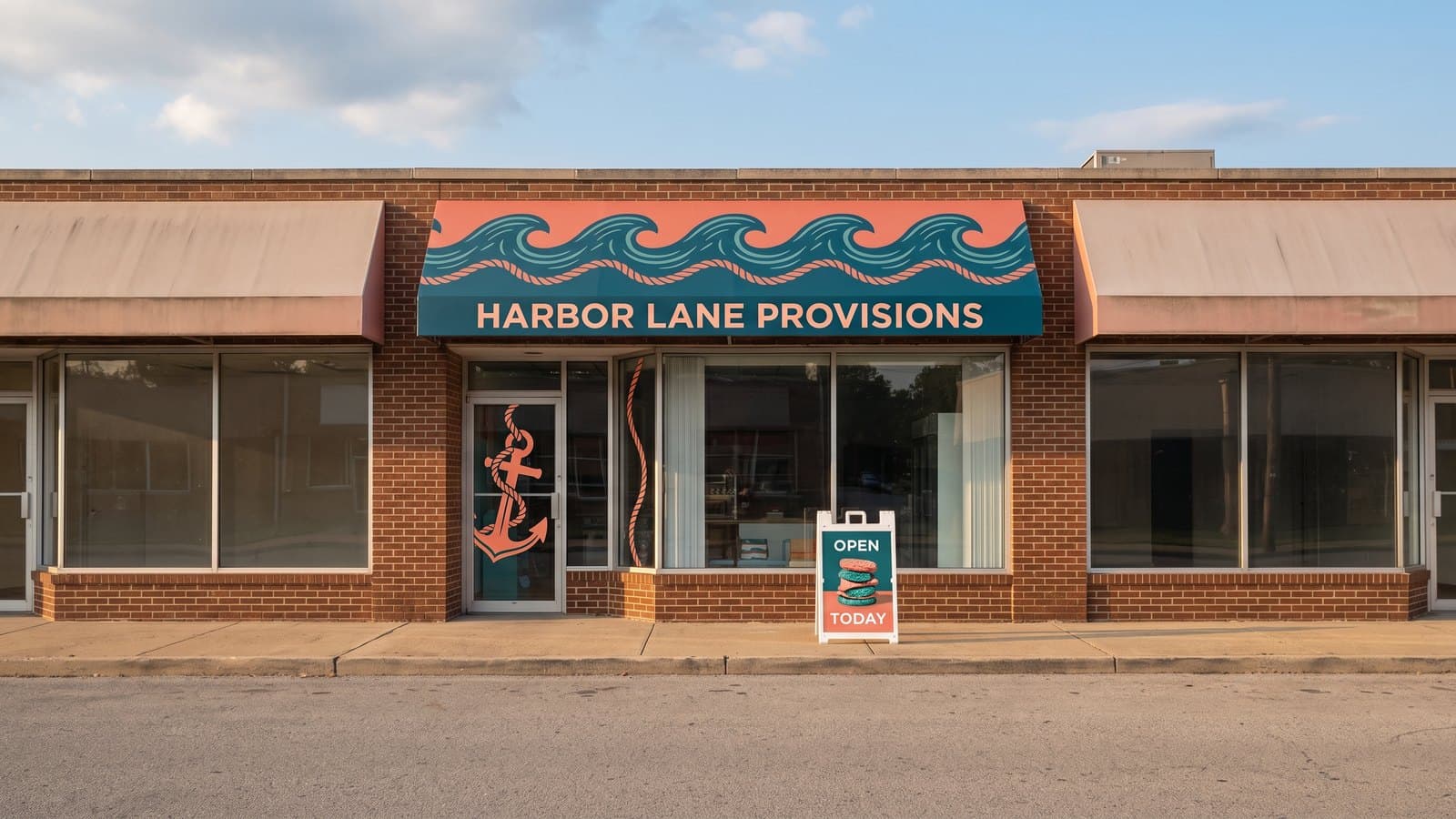
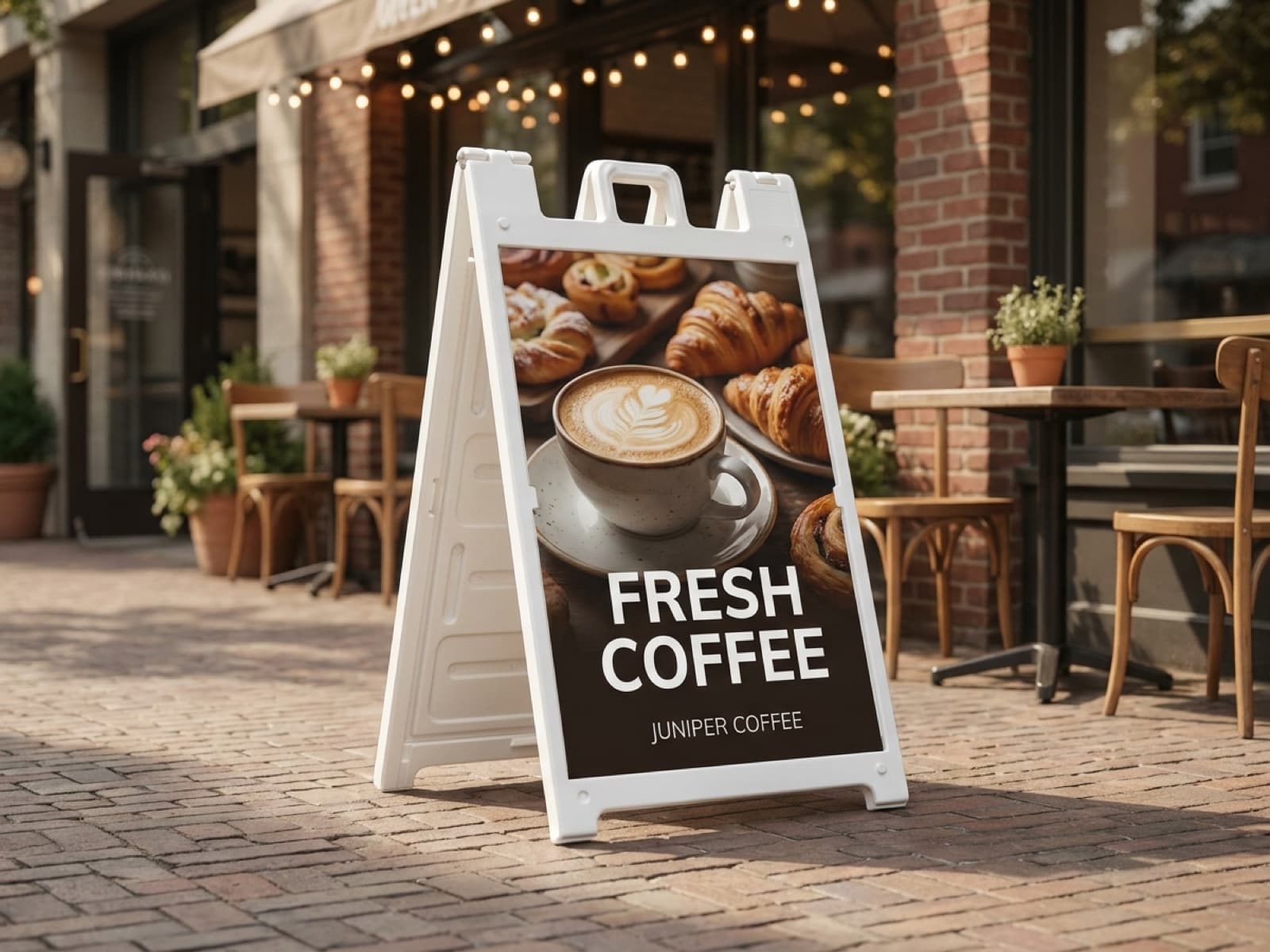
| A-frame sidewalk sign | Sidewalk, curb, entry | Signicade frame, vinyl graphics | $267.49 | 3 business days |
| Window decal | Glass, doors, smooth surfaces | Adhesive vinyl | $13.38 per sq ft | 48 hours |
| Window cling | Glass, seasonal, removable | Static cling film, no adhesive | $10.65 per sq ft | 48 hours |
| Vehicle magnet | Truck and van doors | Heavy-duty magnet sheet | $64.19 | 48 hours |
| Foam board sign | Indoor easels and displays | 3/16 in foam core | $17.11 per sq ft | 3 business days |
| GatorFoam sign | Indoor lobbies, wall mounted | 3/16 in or 1/2 in GatorFoam | $85.59 | 3 business days |
| Wall graphic | Painted indoor walls | Low-tac fabric | $7.22 per sq ft | 48 hours |
| Floor graphic | Indoor floors | UL-certified anti slip vinyl | $8.03 per sq ft | 48 hours |
The pattern in that table is the whole lesson. Everything outdoors is UV printed onto a substrate that does not care about water. Everything indoors gets to be lighter, cheaper and more delicate because nothing is going to rain on it.
What Signs Work Best Inside a Business?
Indoor signage works on a customer who is already inside, so its job is to guide, inform and sell rather than to be seen from a road. That changes the material list completely.
Foam board at $17.11 per square foot is the workhorse: 3/16 inch foam core with paper facing, direct UV printed, light enough to sit on an easel and cheap enough to reprint when the price list changes. It is rated indoor use only, and that rating is not a suggestion. GatorFoam at $85.59 is the step up, extruded polystyrene with a wood fiber veneer that will not dent, warp or bow, which is why it is the board for a lobby sign that stays on the wall for years.
For walls themselves, wall graphics at $7.22 per square foot print on a low-tac fabric that comes off painted drywall without taking the paint with it. Floor graphics at $8.03 per square foot are UL-certified anti slip and handle directional cues and promotional callouts underfoot. On glass, window cling at $10.65 per square foot has no adhesive at all, so it repositions and peels clean, and adhesive vinyl at $13.38 per square foot is what you use when the graphic is meant to stay.
Promotional content that changes every month should not be printed on anything permanent. Posters at $74.89 per 10 on 16pt gloss are the format for that: cheap enough to swap, heavy enough not to curl on a wall. Large format posters at $32.09 each cover 18 x 24 up to 36 x 48 inches on satin poster paper when the wall is bigger than a standard sheet.
Indoor signs do not need UV resistance. They do need to look intentional, because a sloppy sign inside a clean business reads as a clean business that stopped paying attention.
How Long Does an Outdoor Sign Last?
Aluminum is the only one of these with a number attached: .040 aluminum sign panels are guaranteed 5 years or more outdoors and will not rust, which is why they are the substrate for parking, regulatory, address and jobsite signs. Everything else lasts as long as the placement, which is usually shorter than the material.
Coroplast yard signs are UV printed and cured on the press, so color goes down dry and outdoor ready with no lamination step. In practice a yard sign outlasts the listing, the campaign or the job it was printed for. Vinyl banners work the same way, and the weight is the durability dial: 13 oz for a season, 15 oz for a long-term outdoor display, 18 oz for heavy use and the only weight we print double sided.
Adhesive vinyl is the exception where lamination genuinely changes the answer. A gloss or matte overlaminate at $2.66 per square foot adds scuff and UV protection to a decal that lives on a door handled fifty times a day, and it is the cheapest upgrade in this entire post.
Two outdoor signs are not really about weather at all. An A-frame sidewalk sign at $267.49 is a genuine Signicade frame with UV printed adhesive vinyl applied straight to the body, 46 inches tall and 19 pounds, and it lives outdoors during business hours and indoors overnight, which is most of why it lasts. Vehicle magnets at $64.19 do the same trick on a truck door: on for the job, off for the weekend, and no adhesive left behind either way.
Where Should Business Signs Go?
Follow the customer path, in order, and every sign gets a job instead of a wall.
- Identifier sign. They see the building from the road. Aluminum, a building-mount banner or a dimensional storefront sign.
- Promotional sign. A reason to stop: a banner across the facade, an A-frame at the curb, a window decal with today's offer.
- Entry sign. A branded greeting on the glass or the door that confirms they arrived at the right place.
- Wayfinding. Foam board, GatorFoam or vinyl arrows that move people through the space without anyone having to ask.
- Product and service signs. Where the decision actually happens, at the shelf, the counter or the menu.
- Post-sale signs. A review QR code, a return-visit offer, a social handle at the exit.
A storefront with one sign out front is running step one of six. The businesses that get the most out of print are not the ones with the biggest sign, they are the ones that treat signage as a sequence.
What Signage Does a Business Need Outside?
Sun and wind are the two things that decide the outdoor half of the list here, and they pull in different directions. Sun argues for UV printed material and, on decals, for an overlaminate. Wind argues for the sign's construction: hemmed edges and grommets on a banner, a mesh banner rather than solid vinyl on any fence line, and wind slits at $17.11 on a large banner in an exposed spot.
Mesh is the one most people underuse. Its perforation lets roughly 30 percent of the wind pass through instead of catching all of it, which is exactly what a banner on a chain link fence along a busy road needs. It is $64.19, the same price as the solid vinyl it replaces.
Signs are printed in the USA and shipped nationwide for a flat $10 per order. Coroplast yard signs are produced the next business day after proof approval. Banners, foam board, aluminum panels, A-frames and GatorFoam are produced in 3 business days after proof approval. Decals and window film take 48 hours. Build the deadline backward from the production window and add shipping transit.
Can You Use an Indoor Sign Outdoors?
No, and this is the single most expensive mistake in the category. Foam board is paper-faced foam core rated indoor use only. GatorFoam is indoor only. Low-tac wall fabric and anti slip floor vinyl are both indoor products. Put any of them in a parking lot and you are buying the sign twice.
The swap is usually simple. An indoor foam board sign becomes a 4 mm coroplast sign outdoors for less money. An indoor poster on a wall becomes a 13 oz vinyl banner. A paper window sign becomes a cling or a decal. Same message, same artwork file, a substrate that survives.
Sign Mistakes We Catch on Proofs
Four things account for most of the sign files we hold before printing, and none of them are artistic decisions.
A logo pulled off a website onto a big sign. A 400 pixel logo on a 24 x 36 inch panel lands at roughly eleven dots per inch and looks exactly like that from ten feet. Vector art, an AI, EPS or layered PDF, has no resolution to run out of.
A thin border on a banner or a yard sign. A hairline frame makes every small cut or hem shift measurable to the eye. Either make the frame thick enough that a shift does not register, or bleed the background off the edge and skip the outline.
Mismatched color across an order placed in pieces. A banner ordered in March and a yard sign ordered in June from two different files come back as two different reds. Send one artwork package for the whole set and everything matches.
Too many messages on one sign. We see yard signs arrive with a headline, three services, two phone numbers, a website and a QR code. From a moving car that is zero messages. One idea, five to seven words, one way to respond.
What to Send Us
Send a print-ready PDF at full size with 0.125 inch bleed, CMYK, fonts outlined, logos in vector, and every piece of text held well inside the trim. It goes through AI image to print for $14.99 once per item; we check it and send a free digital proof after you order.
Send any image, Canva export, PDF or logo through AI image to print and we make it print ready, covering size, bleed, resolution and color, for $14.99 once per item. If you have no design at all, Design it for me is +$29.99 and a designer builds the sign from scratch with two revisions included. Either way you approve a free digital proof with every order before anything prints, and orders ship for a flat $10 ground shipping to any US address.
Larger architectural work, dimensional storefront lettering and interior sign systems are quoted rather than configured, so send the site details through our contact page or start with the commercial signs overview.
Frequently Asked Questions
It depends on how long the sign stays up. For weeks, use 13 oz scrim vinyl as a banner from $64.19 or 4 mm coroplast as a yard sign from $53.49. For years, use .040 aluminum from $74.89, which will not rust and is guaranteed 5 years or more outdoors. Foam board and paper never belong outside.
Aluminum has an outdoor guarantee of 5 years or more. Coroplast yard signs and vinyl banners are UV printed and hold their color well past the season most placements last. Adhesive vinyl decals last longer with a gloss or matte overlaminate, which adds scuff and UV protection for $2.66 per square foot.
No. Foam board is 3/16 inch foam core with paper facing and is rated indoor use only, and GatorFoam is indoor only as well. Low tack wall fabric and anti slip floor vinyl are both indoor products. Outside, the sign needs coroplast, scrim vinyl, mesh or aluminum, all of them UV printed.
A 12 x 18 in yard sign starts at $53.49, and a vinyl banner starts at $64.19. A .040 aluminum sign is $74.89 at 12 x 18 in, $96.29 at 18 x 24 in and $181.89 at 24 x 36 in. An A-frame sidewalk sign with printed graphics is $267.49. Window cling is $10.65 per square foot and adhesive vinyl is $13.38 per square foot.
Five, in this order: an identifier sign that names the building from the road, a promotional banner or A-frame that gives a reason to stop, a window decal at the entry, wayfinding inside, and product or service signs where the decision happens. One sign out front and nothing else leaves most of the work undone.
A decal is adhesive vinyl that sticks to the glass and is meant to stay. A cling is static cling film with no adhesive at all, so it peels off and repositions without residue, which makes it the right pick for seasonal promotions. Cling is $10.65 per square foot and adhesive vinyl is $13.38 per square foot.
Banners and coroplast signs do not: they are UV printed and cured on the press. Adhesive vinyl graphics benefit from it, and a gloss or matte overlaminate is $2.66 per square foot for scuff and UV protection. One-way window perforated vinyl is also sold laminated, at $16.04 per square foot instead of $13.38.
Related Articles
Business Signs: Choosing the Right Type for Each Job
A 13 oz vinyl banner suits temporary promotions; choose decals for glass, A-frames for [...]
Read More: Business Signs: Choosing the Right Type for Each Job
Small Business Signage: 9 to 18 ft Flags at the Door
Feather flag kits run 9 to 18 ft, and the page opens on the 14 ft kit. Compare heights, bases, [...]
Read More: Small Business Signage: 9 to 18 ft Flags at the Door
Foam Board Sign Benefits: Best Indoor Uses and Limits
Foam board signs are lightweight 3/16 in indoor display panels. Compare 12 x 18 through 24 x 48 [...]
Read More: Foam Board Sign Benefits: Best Indoor Uses and Limits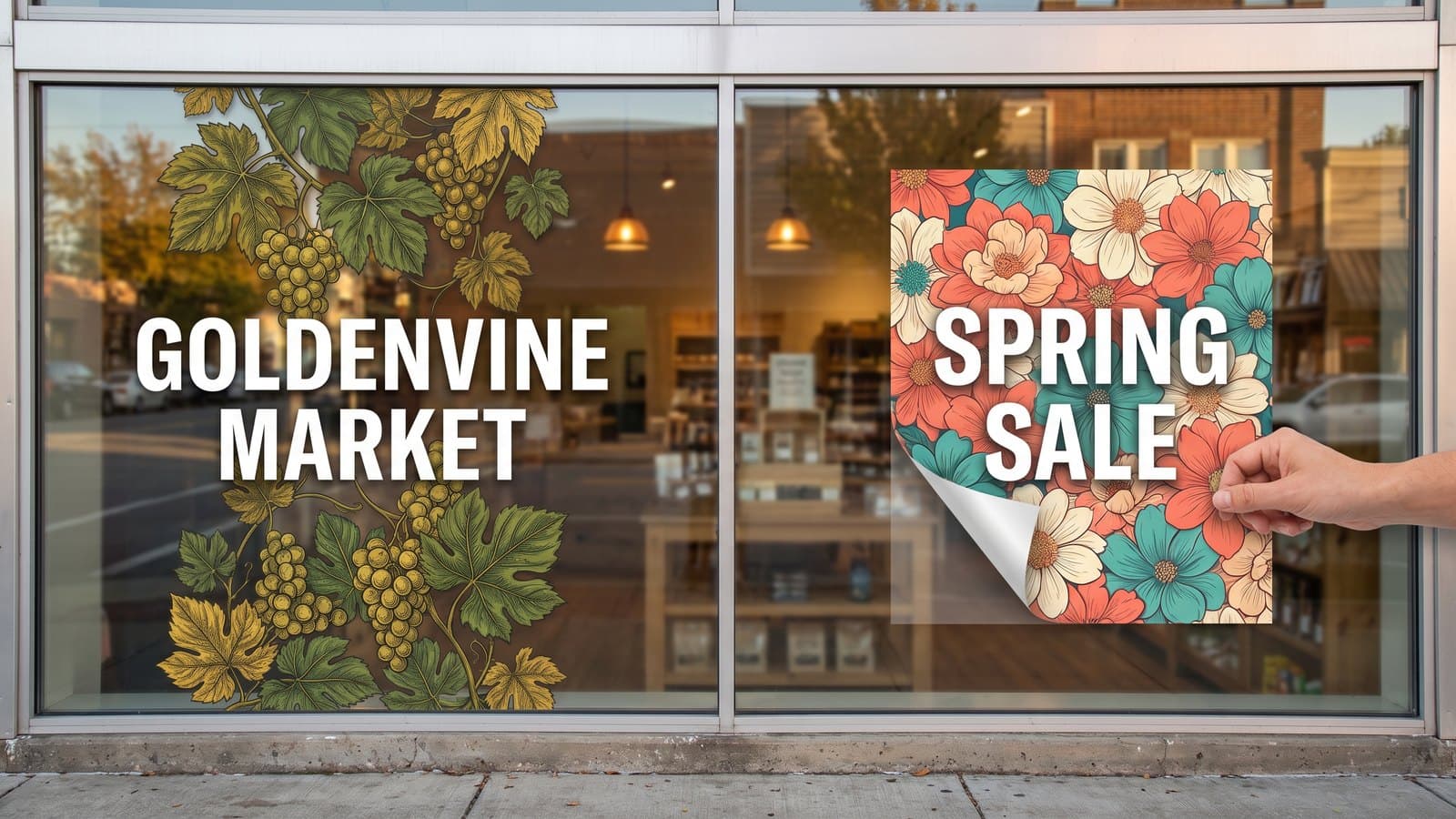
Window Decals vs Window Clings: Which One Lasts Longer
Window decals use adhesive and stay put for years. Window clings use static and peel off clean. [...]
Read More: Window Decals vs Window Clings: Which One Lasts Longer