Window Decals vs Window Clings: Which One Lasts Longer
 Daniel
May 9, 2026Updated October 16, 202610 min read
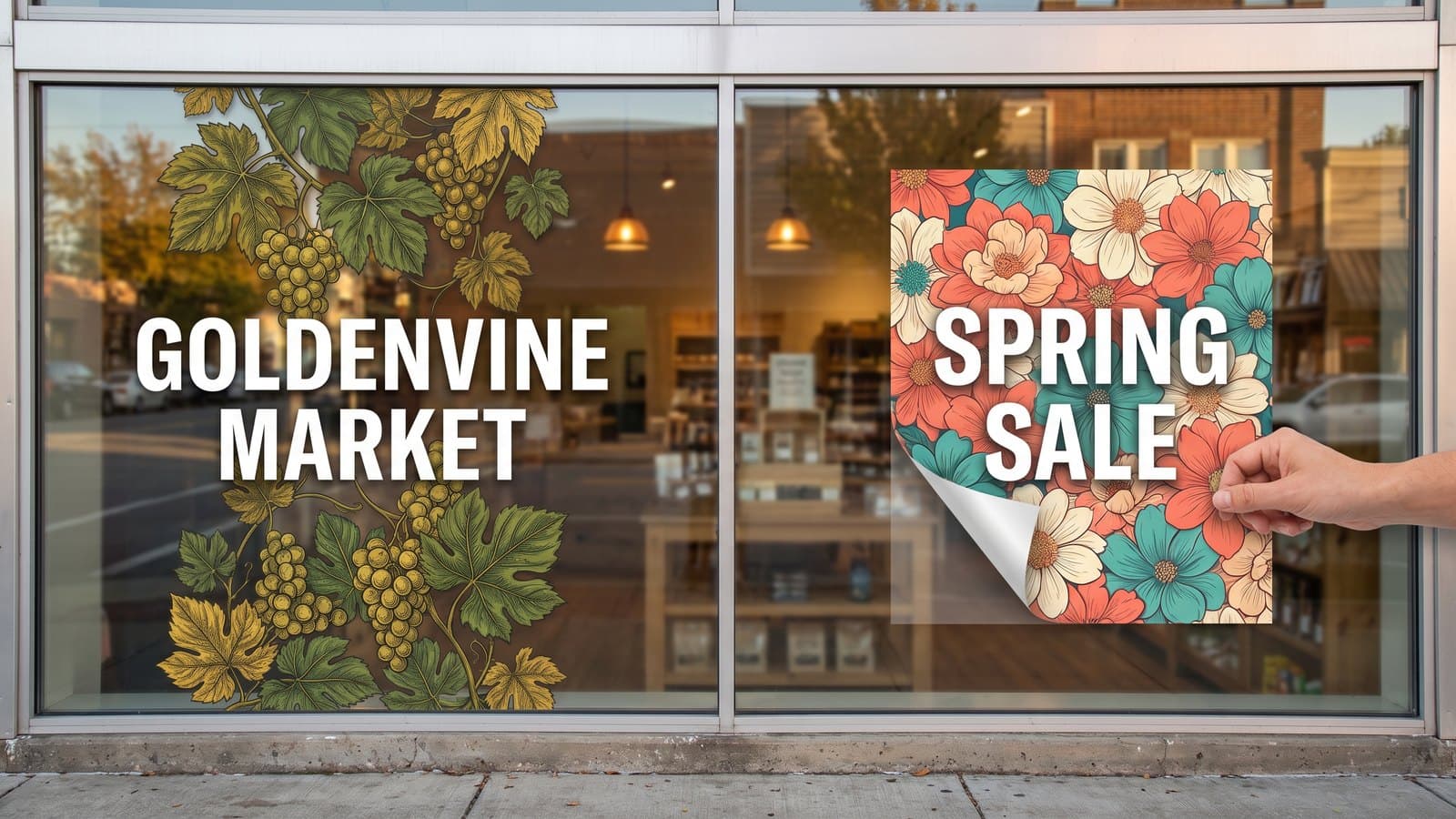
Window Decals vs Window Clings: What Is the Difference?
A 24 x 36 in window cling is $74.89, while a same-size adhesive vinyl decal is $96.29. Choose adhesive vinyl for long-term graphics and static cling for seasonal messages. Both are printed in the USA in 48 hours after artwork approval and ship nationwide for flat $10.
Both products are printed full color on film that goes on glass, and to a customer walking past, the finished result looks identical. The difference is entirely in the back of the material, and it decides everything else: how long the graphic lasts, whether you can move it, and what it costs you to change the message.
| Feature | Window decal | Window cling | One-way vision |
|---|---|---|---|
| Holds on by | Adhesive | Static and surface tension | Adhesive, perforated film |
| Built to stay | A year or more | A season | A year or more |
| Repositionable | No | Yes, many times | No |
| Leaves residue | Sometimes, needs cleanup | Never | Sometimes, needs cleanup |
| Rate per square foot | $13.38 | $10.65 | $13.38, or $16.04 laminated |
| Largest size on the page | 48 x 96 in | 48 x 72 in | 48 x 72 in |
| Production | 48 hours | 48 hours | 48 hours |
| Best for | Logo, name, hours | Sales, holidays, pop-ups | Covering a whole pane |
What Is a Window Decal?
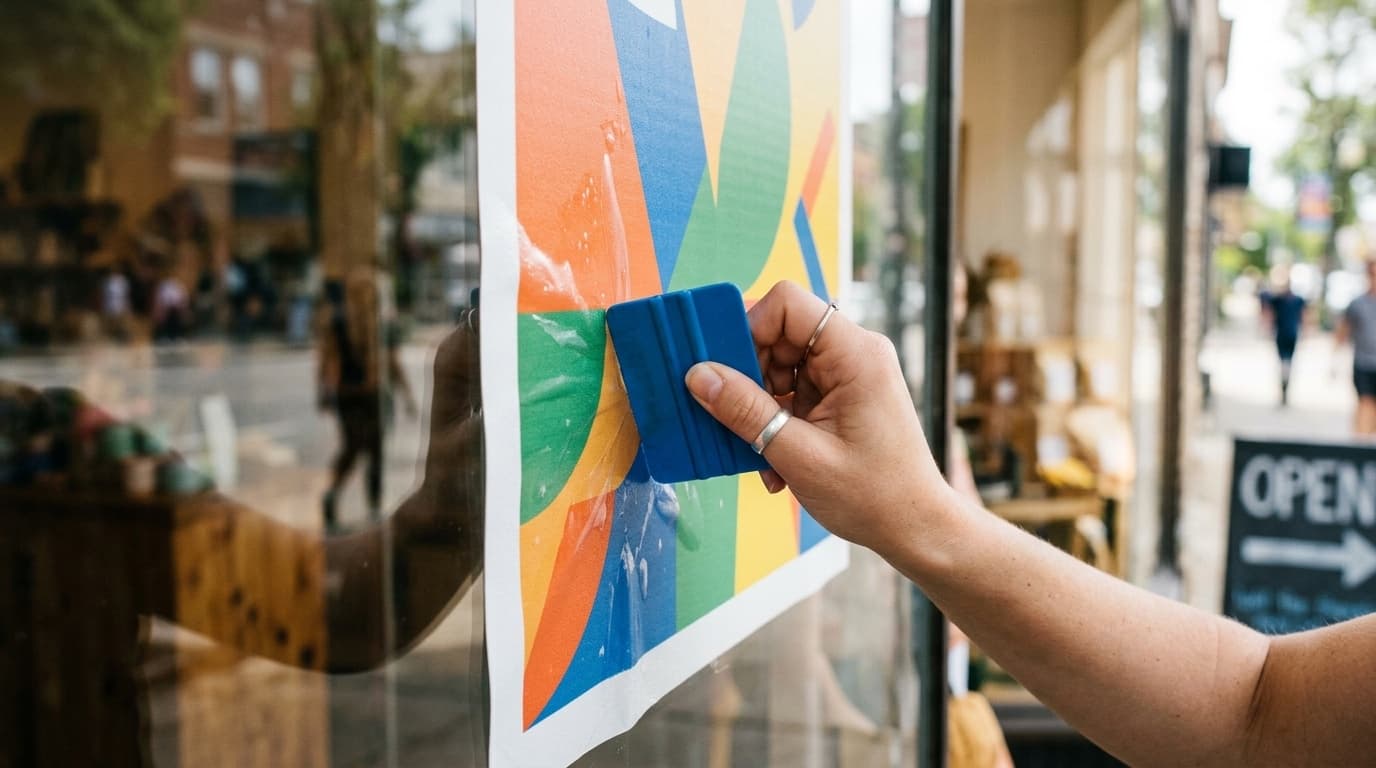
A window decal is adhesive backed vinyl that bonds to glass and stays there. Peel the backing, squeegee it down, and the adhesive grabs the surface. From that point it is part of the window: weather does not lift it, a pressure washer does not take it off, and neither does a customer leaning on the door.
We print decals on 3M adhesive vinyl at $13.38 per square foot for the IJ-35C film, which is the standard choice for glass, walls and smooth surfaces. The IJ-180Cv3 cast wrap film is $18.14 per square foot and is worth it when the surface curves, which on a storefront usually means a column, a door handle recess or a vehicle. A gloss or matte overlaminate adds $2.66 per square foot and buys scuff and UV protection on anything applied to the outside face.
Decals come in three shapes of job. Solid vinyl is a rectangle of printed film. Once weeded and installed, a die-cut decal leaves the graphic alone with no background, with the cut line following the outline of your logo or lettering so the glass shows through around it; for a door that is our glass door decals for business, priced online and shipped. And perforated one way vision covers a full pane while people inside still see out.
Decals ship on the full vinyl sheet with the cut lines plotted. Remove the extra vinyl around your design before applying. Most applications need transfer tape, which is not included.
For vehicle glass, perforated window film is printed and cut to the closest rectangle size for your window. It is not contour cut to the shape of the glass, so trimming to fit and installation are done on the vehicle.
What Is a Window Cling?
A window cling is static film with no adhesive at all. It holds on through static charge and the surface tension between a smooth film and smooth glass, which sounds fragile and is not: a cling pressed flat onto clean glass stays put for a season without a single sticky edge.
The whole product exists for one reason, and that is change. A cling comes off by hand in one piece, leaves nothing behind, and goes back up somewhere else. A restaurant that swaps a window message four times a year prints four clings once and cycles them, which is a different way of buying signage than printing a new decal each time.
Static cling film is $10.65 per square foot, the cheapest way to put a full color graphic on glass, and it is available up to a 48 x 72 inch pane. The trade is durability. A cling is not built for a year of sun and weather, and it does not want to be washed. It is a season, and it is honest about that.
Which One Should You Choose?
Choose decals for anything that is still true next year, and clings for anything with a date on it. That is the rule, and the rest is detail.
Print window decals for: your logo and business name on the door, hours of operation, a phone number or website, privacy frost on a conference room, a full pane covered in one way vision, address numbering, and anything a franchise or brand standard requires to look identical across locations.
Print window clings for: seasonal sales, holiday graphics, weekly or monthly promotions, pop-up and market stall signage, event graphics for a church festival or a school fundraiser, open house notices that come down clean, and anything you want to test before you commit to a permanent version.
If a message changes more than twice a year, the cling is cheaper even before you count the labor of removal. If it changes less than once a year, the decal looks better longer and holds up to washing.
Window Decal
- Sticks by
- Adhesive vinyl
- Bonds to the glass
- Comes off
- Heat and patience
- Not reusable
- Pick it for
- Logo, name, hours
- Year round branding
Window Cling
- Sticks by
- Static and surface tension
- No adhesive at all
- Comes off
- By hand, no residue
- Reusable if stored flat
- Pick it for
- Sales and holidays
- Messages that change
One-Way Vision
- Sticks by
- Adhesive, perforated
- Graphic out, view in
- Comes off
- Heat and patience
- Not reusable
- Pick it for
- Whole pane coverage
- Storefront and vehicle glass
What Do Window Graphics Cost?
Everything on glass is priced by the square foot, so the cost is set by the pane, not by the design. Measure the glass, multiply, and you have the number before you talk to anyone.
A 24 x 36 inch graphic is 6 square feet. As a finished order line, before the artwork option, it is $74.89 as a cling, $96.29 as an adhesive decal, and $96.29 as one way vision. A full storefront pane at 48 x 72 inches is 24 square feet: $267.49 as a cling and $331.69 as an adhesive decal. Adhesive vinyl goes up to a 48 x 96 inch panel, which is how a wall sized graphic gets ordered, in panels rather than one impossible sheet.
Production is 48 hours once you approve your free digital proof included with every order, and shipping is a flat $10 per order to any US address. Send any image, Canva export, PDF or logo through AI image to print and we make it print ready, covering size, bleed, resolution and color, for $14.99 once per item. If there is no design yet, Design it for me is +$29.99 and a designer builds it with two revisions included.
Inside Mount or Outside Mount?
Mount inside unless the window interior is dark or crowded, in which case mount outside. Inside mounting puts the glass between your graphic and the weather, so nothing fades, nothing peels at a corner, and nobody picks at it from the sidewalk.
Outside mounting wins on color. With nothing between the viewer and the printed film, a photo reads richer and a dark background reads deeper. It also wins when the inside of the window is stacked with product, a display, or a backlit cooler, because an inside mounted graphic competes with all of it.
The practical consequence is in the artwork. An inside mounted graphic is viewed through the glass, so the file has to be mirrored before it prints. Say which way the graphic is going up when you order, because a beautifully printed backward logo is the one mistake nobody can fix after the fact.
How Should Window Graphics Be Designed?
Design for the sidewalk, not the screen. Someone reads a storefront window from eight to fifteen feet away while walking, which is a different job from a poster on a wall.
- Body copy no smaller than 2 inches tall. Hours, a phone number, a service list: if it is under two inches, it is decoration.
- Solid color behind text. Whatever is inside your store is the background of your window graphic. A headline over clear film sits on top of shelves, staff and a cooler, and disappears.
- Vector art for die cuts. A cut line follows a path, and a path only exists in vector files. Send an AI, EPS or layered PDF for anything cut to shape.
- Expect one way vision to soften detail. The film is perforated, so hairline rules, small type and fine texture lose crispness. Design it bold.
- Leave the glass some breathing room. A pane covered corner to corner reads as a wall. Most storefronts look better with a graphic band and clear glass above and below it.
How Do Climate and Sun Affect Window Graphics?
Direct sun and hot glass are hard on window film, and installation conditions can affect whether a graphic stays flat or starts to curl.
Install on glass that is clean, dry and cool. On hot days, work earlier in the day rather than on a pane heated by afternoon sun. Clean with a glass cleaner and a lint free cloth, avoid products that leave a film, and dry the surface completely.
Sun exposure also helps decide the material. A cling on a sun-exposed pane may need reseating more often than an adhesive decal. If that pane carries a logo and hours, use a decal and reserve the cling for a seasonal message. The product page offers gloss or matte overlaminate at $2.66 per square foot for added scuff and UV protection on outside-mounted adhesive vinyl.
What We See on Window Graphic Proofs
Three things account for most of the window files we hold before printing, and all three come from the same place: the pane got measured after the artwork was built instead of before.
A design built to an aspect ratio instead of a window. Someone lays out a beautiful square graphic, then the actual pane is 30 x 54 inches, and now the layout has to be stretched or padded. Measure first, build to that size, and the design fits the glass instead of the other way round.
No mirror note on an inside mount. Half of the orders that need mirroring do not say so, so we ask. When nobody answers before the proof deadline, the safe assumption is outside mount, and that is how a backward logo happens. One line on the order prevents it.
A logo with no vector version, on a die cut order. Cutting to shape needs a path. A PNG with a transparent background looks like a die cut on screen and gives the cutter nothing to follow. If the vector file is gone, say so and we will price rebuilding the path rather than guessing at it.
What to Send Us
Send print ready artwork built to the exact finished dimensions, CMYK, 150 dpi at full size, fonts outlined, logos in vector, and a note saying inside mount or outside mount. It goes through AI image to print for $14.99 once per item; we check it and send a free digital proof after you order.
Measure the glass itself, not the frame, and measure twice: a pane that is 47.5 inches wide is not a 48 inch pane, and half an inch of clear glass along one edge is visible from across the street. If you are unsure, send a photo of the storefront with a tape measure held across the pane and we will work the size out with you.
Everything is printed in the USA and ships nationwide, with flat $10 ground shipping to any US address. If the same promotion needs to live on the floor as well as the glass, the material and the rules are different, and we covered them in five uses for floor decals.
Frequently Asked Questions
A window decal bonds to glass with adhesive for a year or more, while a window cling has no adhesive. The cling holds on static and surface tension, lifts off by hand with no residue, and can be repositioned as many times as you like. Everything else follows from that.
Static cling film is $10.65 per square foot, so a 24 x 36 inch cling is 6 square feet of film and $74.89 as a finished order line, before the artwork option you pick. Adhesive vinyl is $13.38 per square foot, which puts the same size at $96.29. Both are priced off the finished dimensions, so measuring the pane is how you get a real number before you order.
They work, with two conditions. Apply to glass that is clean, dry and not baking, which in practice means early morning rather than the middle of an August afternoon. And expect a cling on a west facing pane in full sun to need reseating more often than the same cling on a shaded north window. For sun exposed glass that has to hold for a year, use an adhesive decal instead.
Yes. A cling lifted carefully and stored flat, printed face up, with a sheet of backing paper or wax paper against it, will go back on the glass next season. What ruins them is rolling them tight or stacking them face to face in a hot storeroom. Clings that live in a box between holidays are the main reason businesses buy them instead of decals.
Inside mounting protects the graphic from weather, pressure washing and anyone with a key, and it is the default for most storefronts. Outside mounting gives better color and contrast because nothing is between the viewer and the ink, and it is the right call when the interior of the window is crowded or dark. Tell us which one when you order, because the artwork has to be mirrored for inside mounting.
One way vision window film is $13.38 per square foot, or $16.04 with a gloss laminate for extra durability. It is perforated adhesive film with a printed graphic on the outside face and a black backing on the inside. From the sidewalk it reads as a full graphic. From inside, daylight comes through the perforations and staff can see out.
Production is 48 hours once you approve the free digital proof included with every order, on clings, adhesive vinyl and one way vision alike. Shipping is a flat $10 per order to any US address. The part that moves the timeline is measurement: a pane measured wrong is a reprint, and no production time can save you from that.
Related Articles
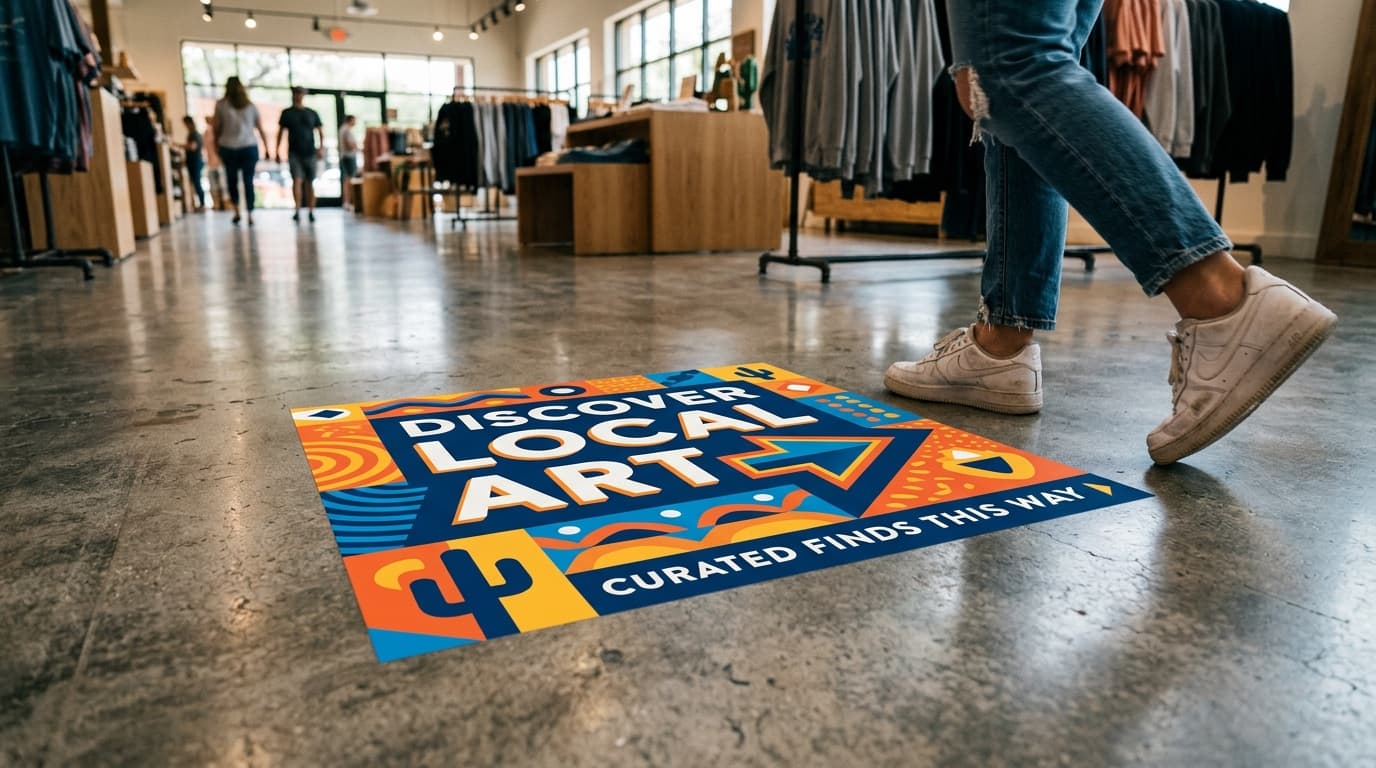
Floor Decal Uses: 5 Ways Businesses Guide and Sell
Five floor decal uses are wayfinding, queue markers, sales, booth branding, and welcome [...]
Read More: Floor Decal Uses: 5 Ways Businesses Guide and Sell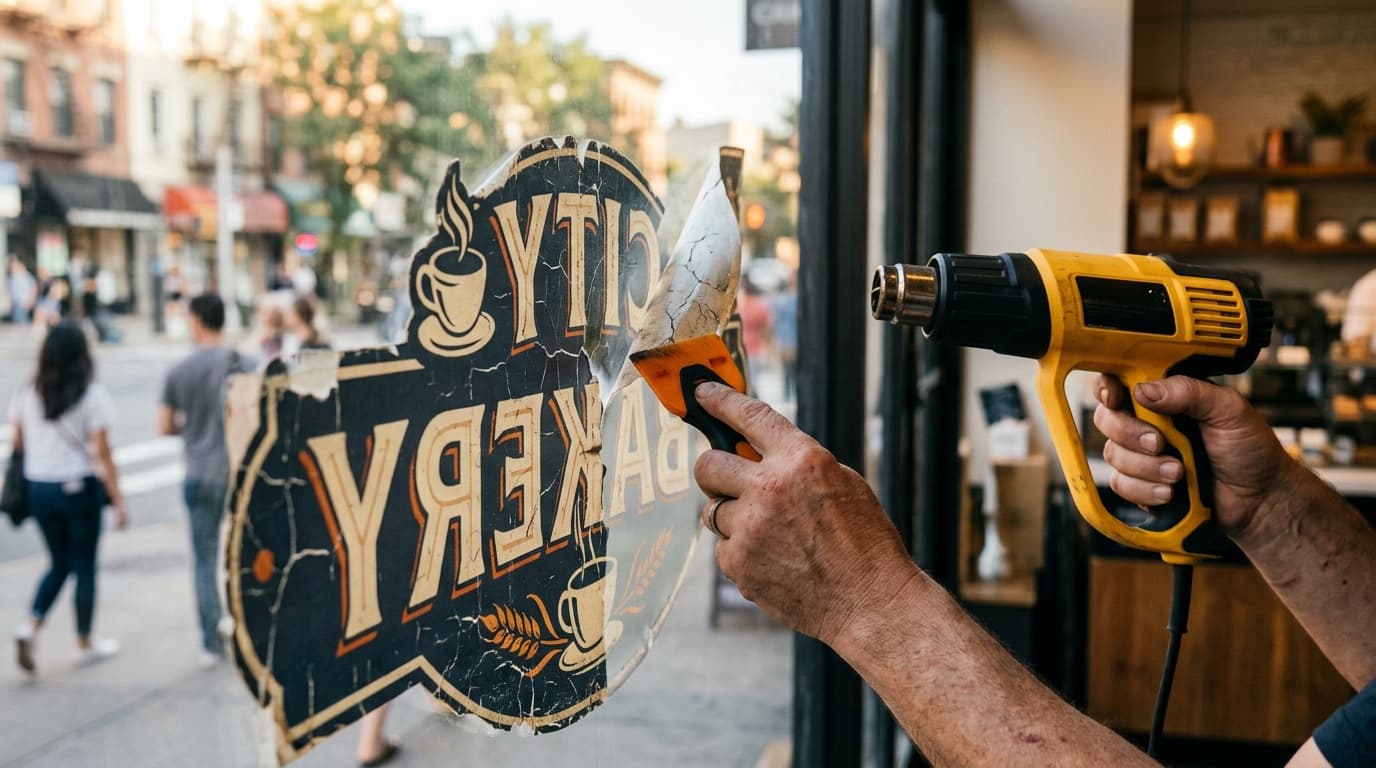
How to Remove Stickers and Decals Without Damage, by Surface
To remove a sticker or decal, compare 4 surface types: glass, paint, walls and plastic. Use [...]
Read More: How to Remove Stickers and Decals Without Damage, by Surface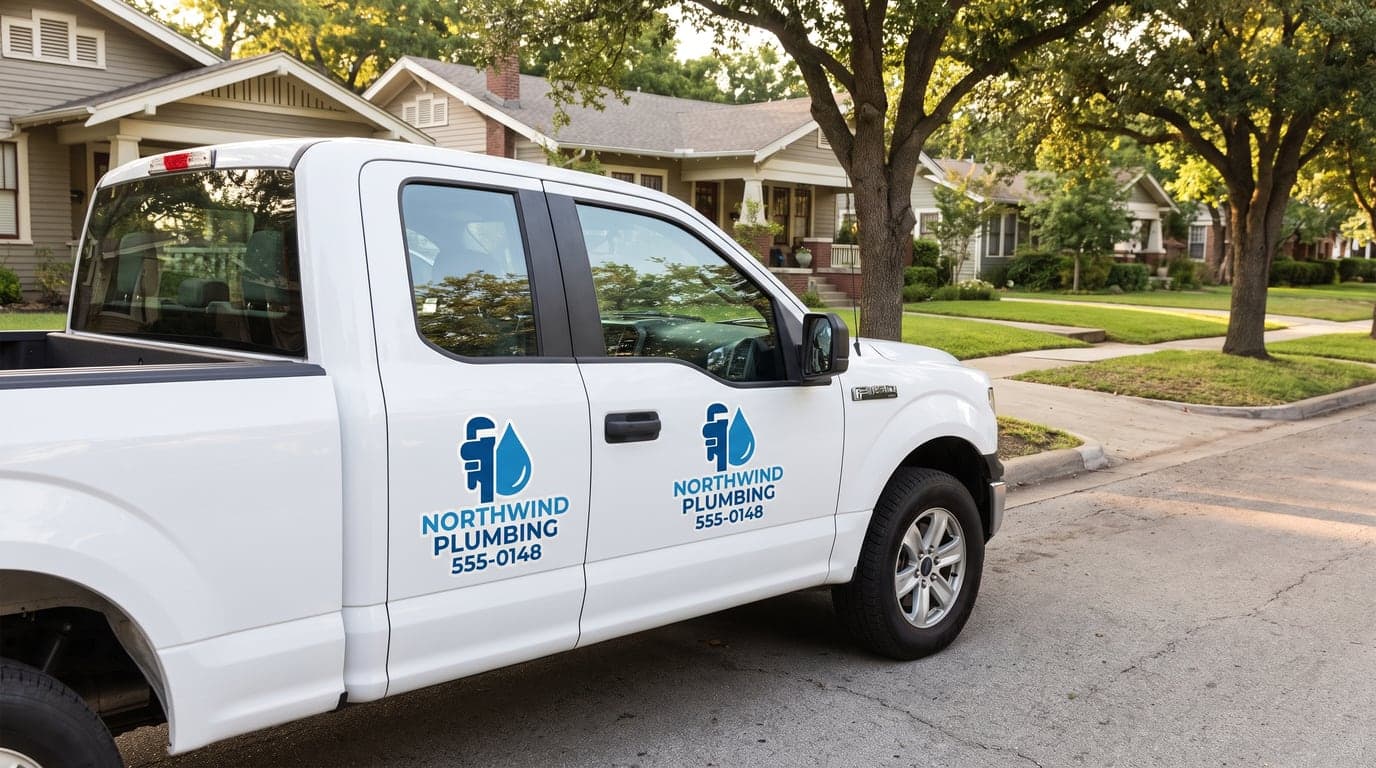
Car Door Decals: Pair Sizes and Prices for Work Trucks
Car door decals come as a pair in four sizes, from 12 by 12 in to 24 by 24 in, on 3M cast vinyl [...]
Read More: Car Door Decals: Pair Sizes and Prices for Work Trucks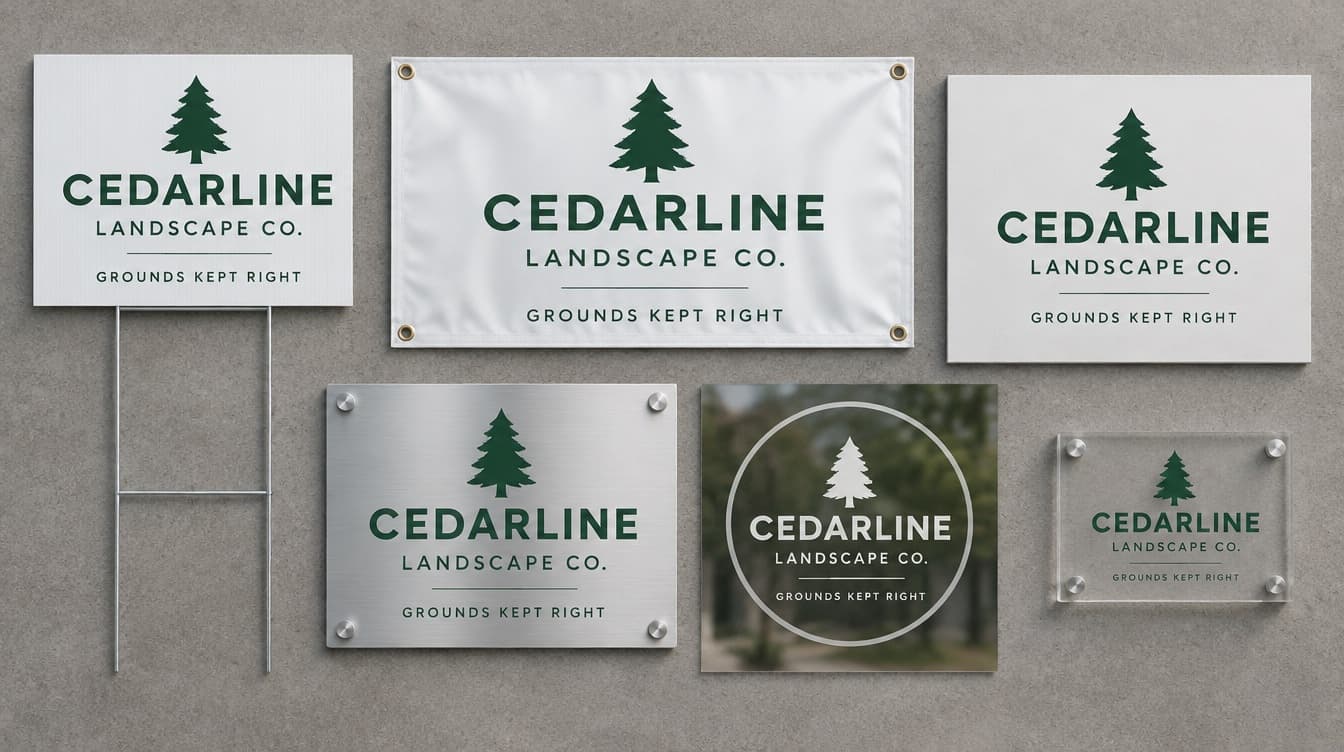
Business Signs: Choosing the Right Type for Each Job
A 13 oz vinyl banner suits temporary promotions; choose decals for glass, A-frames for [...]
Read More: Business Signs: Choosing the Right Type for Each Job