Real Estate Postcards: Sizes, Prices and First Runs
 Tomas Amaya
April 1, 2026Updated October 29, 20269 min read
What should your first real estate postcard accomplish?
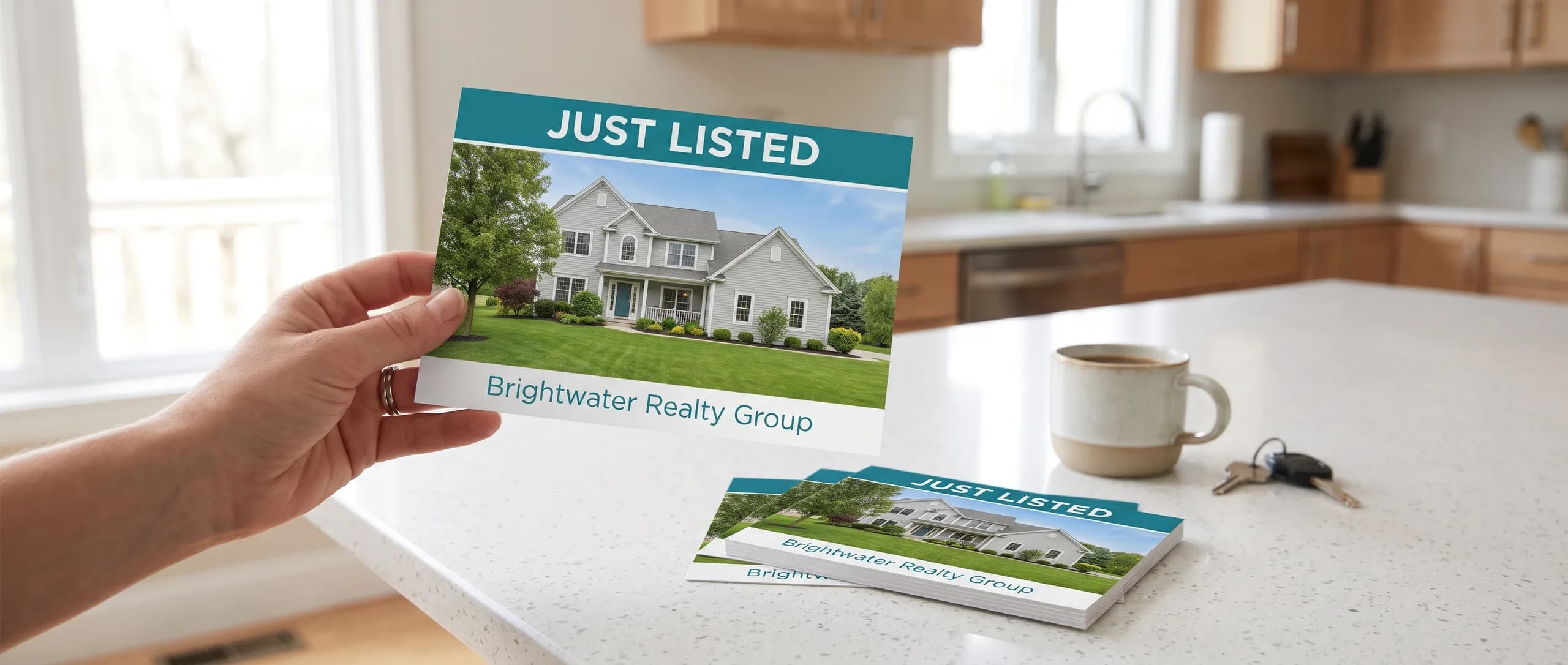
Real estate postcards work best with one purpose: announce a listing, share a sale, invite a visit or explain a market update. Inline Graphics prints 250 double-sided 4x6 in 16pt Gloss postcards for $106.99 in 48 hours after artwork approval. They are printed in the USA with flat $10 ground shipping per product nationwide; mailing is separate.
Decide what the reader should do next, then pick the photo and headline that support it. A listing announcement can point to property details. An invitation can ask someone to attend an open house. A market update can offer a useful explanation and a way to request a conversation.
Trying to attract buyers, recruit sellers, announce an event and explain financing on the same small card creates competing priorities. Keep the card's main job clear enough that a reader can identify it without turning the piece over several times.
Postcards belong in a broader plan alongside the real estate signs collection and other print marketing materials. Give each piece a specific role so the campaign carries one consistent message across different settings.
Which real estate postcard should you send?
Choose the postcard type from the news you can accurately share and the audience it serves. These are general campaign practices, not promises of a particular number of calls or appointments.
When does a market update make sense?
A market update suits readers who want useful context before deciding whether to move. Explain one relevant change or comparison, name the data source and identify the period and geographic area covered. If you cannot verify the numbers, use a qualitative explanation instead of printing an estimate as fact.
Keep the analysis readable. A small chart with clear labels can explain more than several paragraphs of commentary, but the figures must be traceable. Offer one follow-up action, such as requesting a discussion about the reader's property.
What should a just sold card communicate?
A just sold card should communicate a completed transaction accurately and connect that news to a useful next step. Verify which property images and transaction details you are authorized to publish. Keep your role in the sale clear rather than implying work you did not perform.
Avoid unsupported claims about selling above asking price, beating the market or producing the same result for every homeowner. A confirmed sale announcement and a clear invitation to talk are enough. A testimonial belongs on the card only when it is real and approved for use.
What makes an open house invitation useful?
An open house invitation needs the property address, event date, start and end times, and a place to find current details. Use the main image to help recipients recognize the property when they arrive.
Leave room in the schedule for printing, shipping, addressing and postal delivery before the event. If the date changes easily, keep the current event details on the linked page too. Do not place an order so late that the invitation has little useful life after arrival.
What belongs on a just listed card?
A just listed card should identify the property and make it easy to view the current listing. Lead with a strong exterior or interior image, the address and a small set of verified features. Include the price only when it is current and approved for the advertising.
Use the reverse for supporting details and one response path. Sending the reader to a current listing page gives you room for the full photo set and updates without squeezing every property detail onto the card.
How do you use postcards to farm a neighborhood?
Farming a neighborhood means maintaining a planned series of relevant messages for a defined area. It is general marketing practice, not a claim that repetition guarantees listings. Choose an area you can serve and a schedule you can maintain.
Rotate useful subjects rather than resending the same sales pitch. Keep the agent identity and contact path consistent, but update each mailing's information. Treat each design as its own print run; a pack price does not cover several different announcements divided among the cards.
What goes on each side of a real estate postcard?
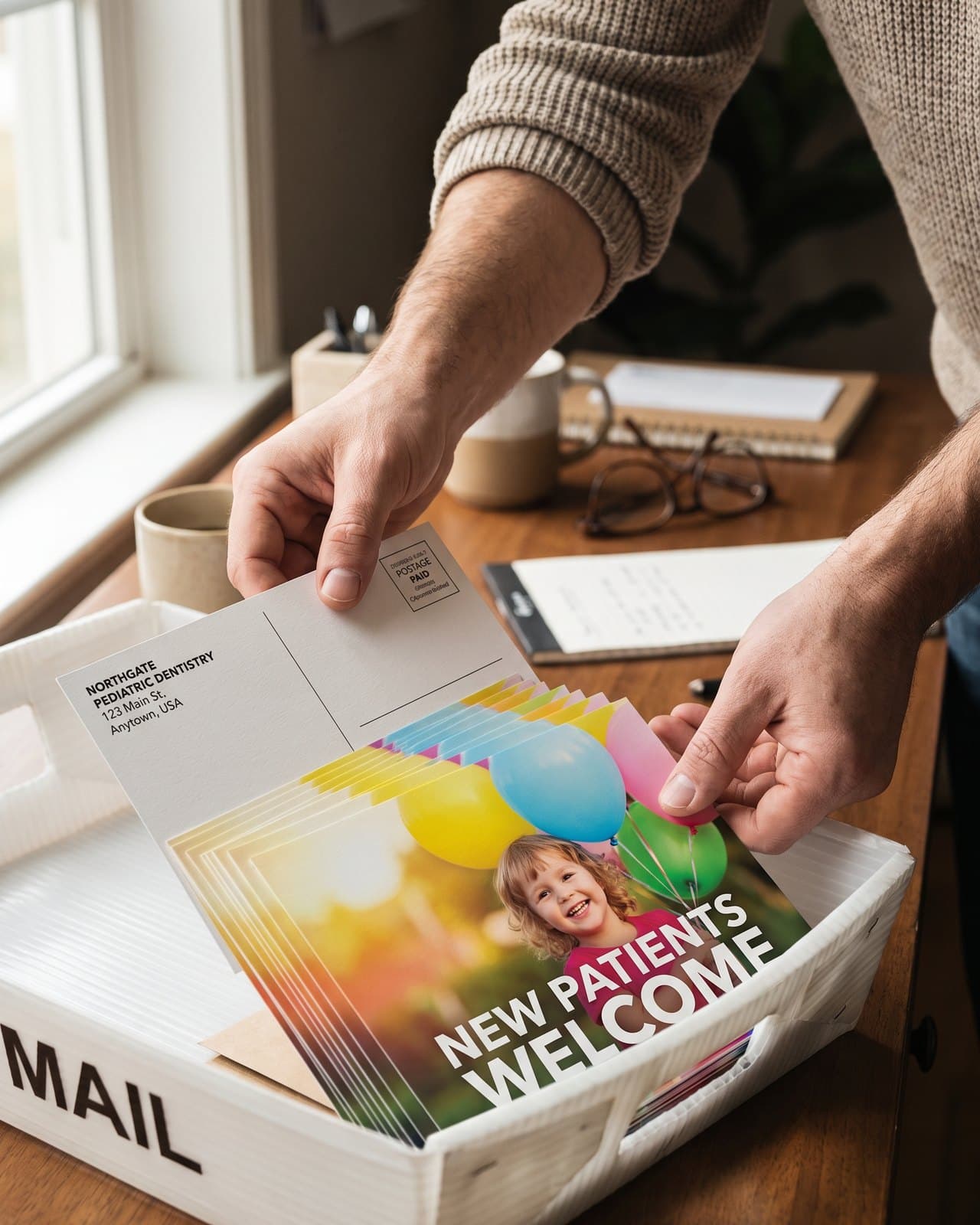
Use the front for the main property image or message and the back for supporting information, agent details and mailing space. Both sides print in full color, so there is no extra side charge for using the reverse.
On the front, establish a readable hierarchy: announcement first, property or topic second, next action third. A large photograph can do much of the work. Keep small type out of busy image areas, and use a solid background behind essential details when needed.
On the back, keep the contact details together. Include the broker and other identifiers required for your advertising, but check the applicable requirements rather than guessing them. Before approval, ask your broker to review the piece and check relevant city, county, state, MLS and HOA rules. Requirements vary.
Reserve the address and postage area before adding the final marketing copy. USPS Postal Explorer's layout guidance explains the need for clear address and postal marking space. Keep a QR code and its caption in the message area, away from the planned labels and postage.
Which postcard size fits your postage plan?
4x6 in is the listed choice that fits retail postcard dimensions; 5x7 and 6x9 in need letter postage in an ordinary retail stamped mailing when prepared to letter standards. Check the current rates and preparation requirements with USPS First-Class Mail. Commercial mailing eligibility is a separate question for USPS.
A 4x6 in card works for one announcement and one response path. A 5x7 in card provides more space for the property image and supporting copy. A 6x9 in card can accommodate a broader market explanation or more photography, but it should still have one main purpose.
Choose a larger size when the information benefits from the room. Do not increase the format simply to fit a long agent biography. The postcard size comparison helps separate layout needs from postal classification.
Should you start with 250 or 500 postcards?
Start with 250 when you have one focused message and a modest, counted audience; select 500 when the distribution plan can use the whole run. Count the mailing list and any open house or office handouts separately before choosing.
A dated listing or event card can become obsolete quickly. An evergreen introduction may remain useful longer, but it still needs a planned destination. Keep only a reasonable reserve for follow-up use instead of treating unused cards as a successful campaign.
How much do real estate postcards cost to print?
250 double-sided 4x6 in Standard 16pt Gloss real estate postcards cost $106.99. Every configuration below uses the same stock and full-color printing on both faces.
| Real estate postcard configuration | Print price |
|---|---|
| 100 cards, 4x6 in, double-sided, Standard 16pt Gloss | $74.89 |
| 250 cards, 4x6 in, double-sided, Standard 16pt Gloss | $106.99 |
| 500 cards, 4x6 in, double-sided, Standard 16pt Gloss | $149.79 |
| 100 cards, 5x7 in, double-sided, Standard 16pt Gloss | $85.59 |
| 250 cards, 5x7 in, double-sided, Standard 16pt Gloss | $139.09 |
| 500 cards, 5x7 in, double-sided, Standard 16pt Gloss | $203.29 |
| 100 cards, 6x9 in, double-sided, Standard 16pt Gloss | $106.99 |
| 250 cards, 6x9 in, double-sided, Standard 16pt Gloss | $171.19 |
| 500 cards, 6x9 in, double-sided, Standard 16pt Gloss | $278.19 |
Configure the size and run on the custom postcards product page. The listed maximum is 500 cards; ask for a quote for larger runs. Artwork preparation, shipping, addressing and postage are outside these print totals.
There is no production setup fee. Your existing file, photo or AI-generated artwork is prepared for $14.99 per item. "Design it for me" is +$29.99 with two revisions, free when the item itself is $499 or more. The free digital proof follows the order.
How do postcards pair with door hangers and yard signs?
Use postcards for an addressed mailing or handout, door hangers for a permitted door route, and yard signs to identify a property or direct event visitors. The pieces can share an image and headline while giving readers information suited to each format.
Compare door hangers versus postcards when deciding who will handle delivery and what that work will cost. For an event, the open house sign placement guide helps plan directionals and the property sign. A postcard invitation creates awareness; a clear sign helps the visitor find the house.
Check permission and placement rules before distributing or installing anything. Inline Graphics does not distribute door hangers, provide canvassing, or sell real estate sign frames, hanging posts or rider hooks.
What should you check before approving the run?
Review property facts, campaign timing, both printed faces and the response path before approving the digital proof. Extend backgrounds 0.125 in beyond the trim and keep text at least 0.25 in inside the trim on each face.
Production takes 48 hours after artwork approval. Weekday approval before 12 PM Central lets production start the next business day; after-noon or weekend approval counts from the next business day. Ground transit takes about 3 business days and costs flat $10 per product nationwide. Mailing the individual cards takes additional preparation and delivery time.
We print and ship the cards to you. We do not supply mailing, addressing, variable data, postage, mailing lists or EDDM setup. After sending the campaign, record the date, quantity and inquiries yourself. Use those observations to plan the next run without assuming a response rate.
Need real estate postcards or other custom printing? Inline Graphics helps businesses, churches, schools, and event organizers across the country design and print cards, banners, signs, decals, displays, and marketing materials that get noticed. Contact us today for a quote.
Frequently Asked Questions
250 cards is a practical first run when you have a counted audience and one message. Choose 500 when your mailing list and planned handouts can use the larger run while the details remain current. These are planning recommendations, not response guarantees.
500 double-sided 4x6 in Standard 16pt Gloss postcards cost $149.79. Artwork preparation, flat $10 ground shipping per product and any mailing expenses are separate.
Our 4x6 in cards fit retail postcard size and thickness limits. For ordinary stamped mail, 5x7 and 6x9 in cards use letter postage when prepared to letter standards. Ask USPS separately about commercial mailing eligibility.
Use a property image you are authorized to use, an accurate sale announcement and one next step for homeowners. Include only verified transaction details approved for publication. Do not invent a sale price, days on market or testimonial.
No. Both faces print in full color at the listed price on Standard 16pt Gloss. Use the reverse for supporting details, agent identification and the mailing area rather than crowding the photograph.
No. Inline Graphics prints the shared design and ships the cards to you. We do not provide mailing, recipient addressing, variable data, postage, mailing lists or EDDM setup.
No verified response rate or lead guarantee comes with the printing. Record what you send and the inquiries it produces, then compare your own results and complete campaign costs before increasing the run.
Related Articles
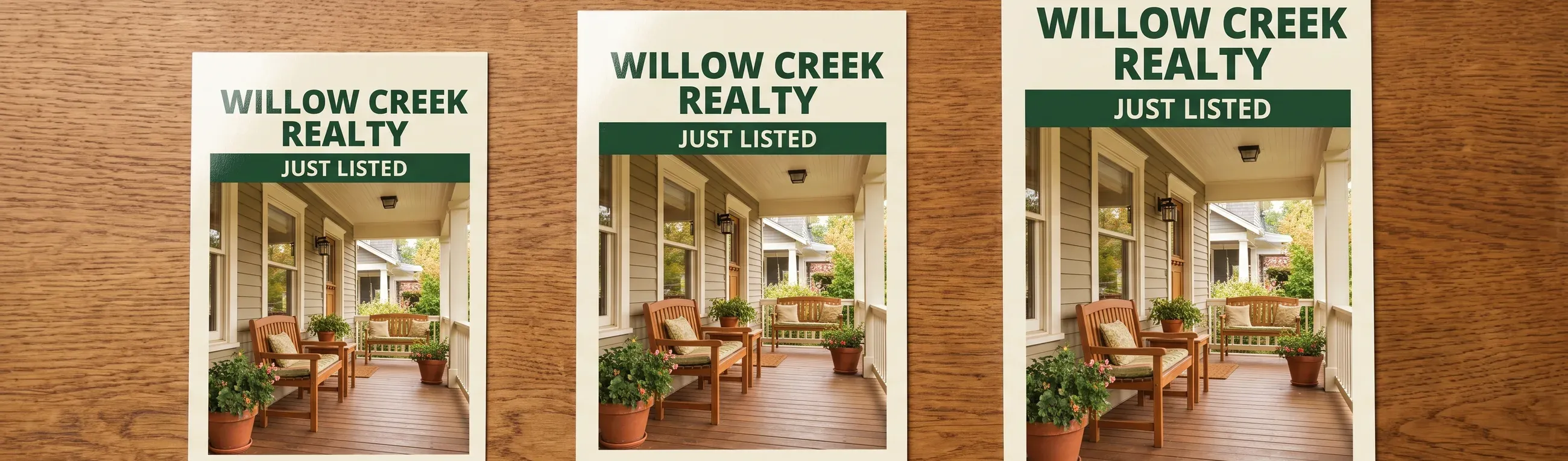
Postcard Sizes in Inches and Pixels: 4x6, 5x7, 6x9 Chart
Standard postcard sizes are 4x6, 5x7 and 6x9 in. A 4x6 card is 1200 x 1800 pixels at 300 dpi. [...]
Read More: Postcard Sizes in Inches and Pixels: 4x6, 5x7, 6x9 Chart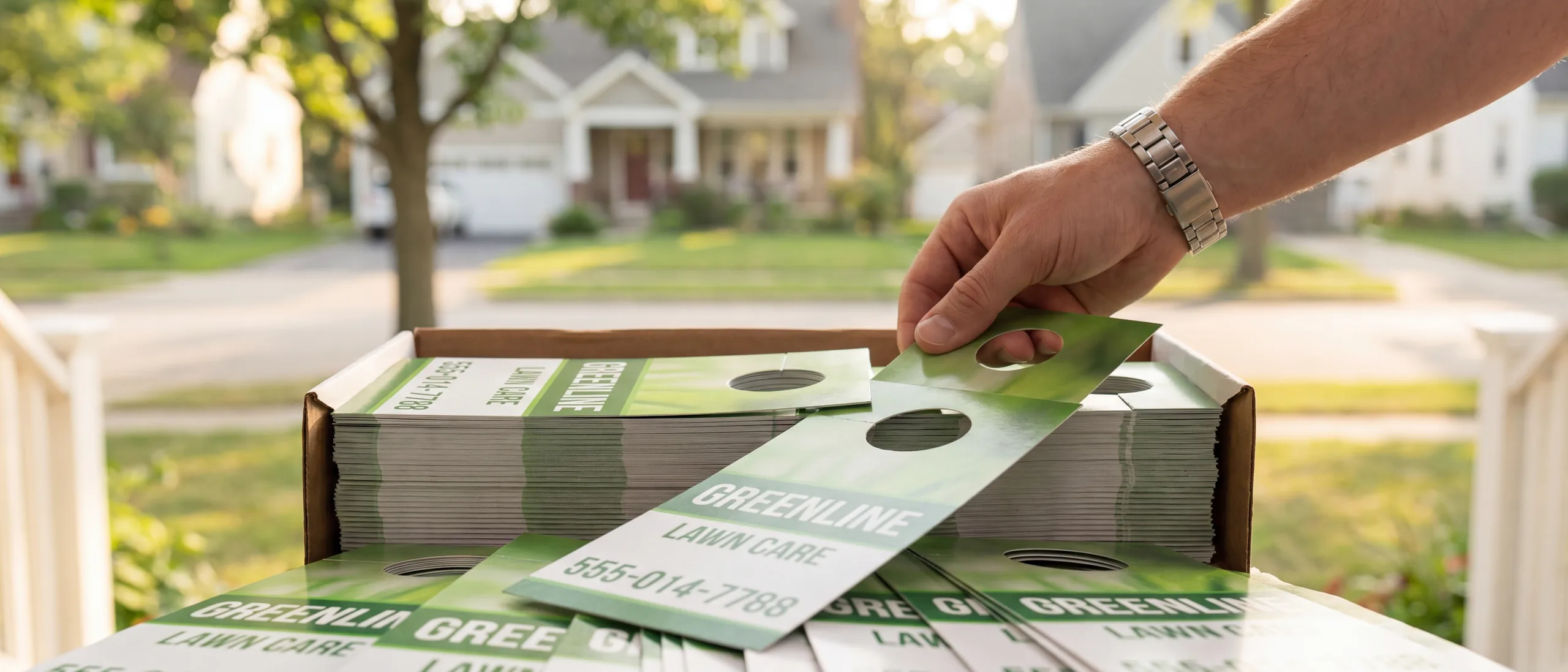
Door Hangers vs Postcards: Which Should You Print First?
250 3.5 x 8.5 inch door hangers cost $246.09; 250 4 x 6 inch postcards cost $106.99. Compare [...]
Read More: Door Hangers vs Postcards: Which Should You Print First?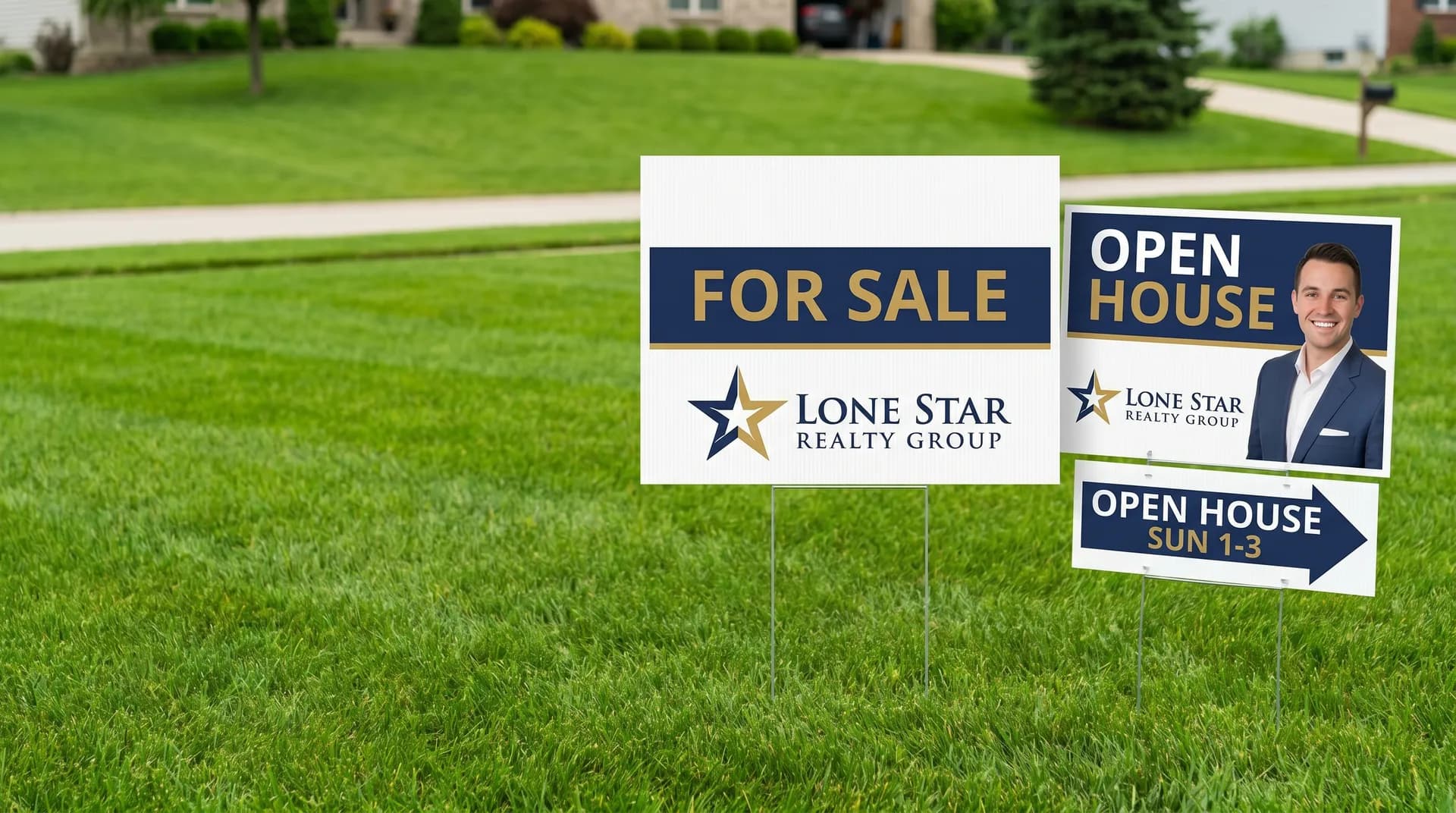
How Many Open House Signs Do I Need, and Where to Place Them
You need one open house sign for the house and one per turn. A 10-sign 18 x 24 in double-sided [...]
Read More: How Many Open House Signs Do I Need, and Where to Place Them
Campaign Door Hangers and Push Cards That Voters Keep
Campaign door hangers start at $246.09 for 250 at 3.5 x 8.5 in, double sided with a UV gloss [...]
Read More: Campaign Door Hangers and Push Cards That Voters Keep