Postcard Sizes: 4x6, 5x7, 6x9, Bleed and USPS Rules
Tomas Amaya
September 16, 2026Updated September 18, 202611 min read
What Are the Standard Postcard Sizes?
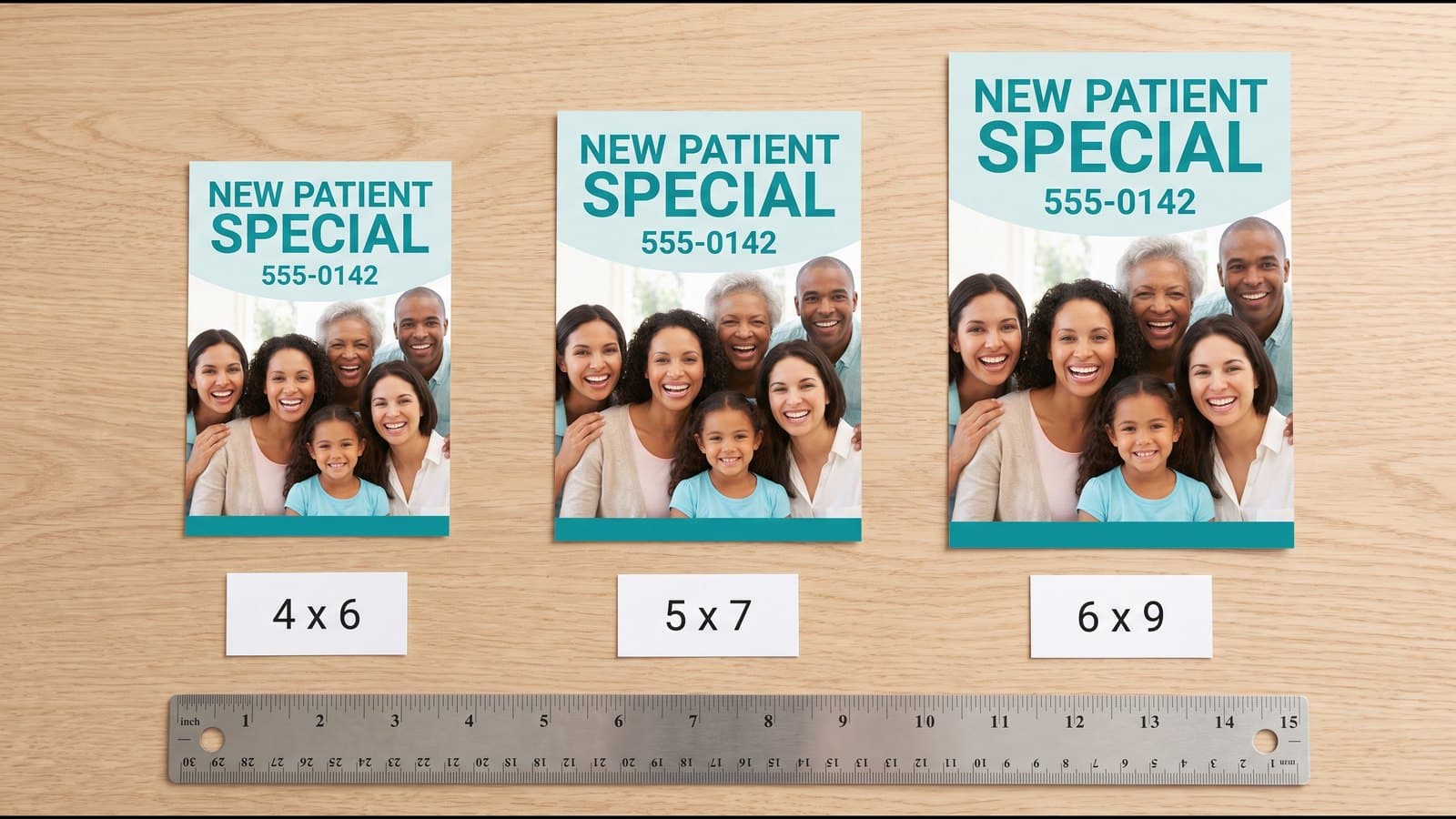
Standard postcard sizes in the United States are 4 x 6, 5 x 7 and 6 x 9 inches. Only a card no larger than 4.25 x 6 inches mails at the USPS postcard rate. A 4 x 6 is 1200 x 1800 pixels at 300 dpi. Add 0.125 inch bleed and hold text 0.25 inch inside the trim.
Size and postage are one decision on a postcard, which is what makes it different from every other printed piece. Trim is the finished card. Bleed is the larger file you send. The safe zone is where your offer, your phone number and your QR code are allowed to live.
The jump that costs money is small. A 4.25 x 6 card and a 5 x 7 card feel like neighbors in a hand, and the Postal Service prices them as different products. Everything below is the full range people order, with the postage class each size falls into.
| Postcard size (trim) | Millimeters | Centimeters | Pixels at 300 dpi | Bleed file (inches) | USPS class at this size |
|---|---|---|---|---|---|
| 4 x 6 in | 102 x 152 | 10.2 x 15.2 | 1200 x 1800 | 4.25 x 6.25 | Postcard rate |
| 4.25 x 6 in | 108 x 152 | 10.8 x 15.2 | 1275 x 1800 | 4.5 x 6.25 | Postcard rate, the largest that qualifies |
| 5 x 7 in | 127 x 178 | 12.7 x 17.8 | 1500 x 2100 | 5.25 x 7.25 | Letter rate |
| 5.5 x 8.5 in | 140 x 216 | 14 x 21.6 | 1650 x 2550 | 5.75 x 8.75 | Letter rate |
| 6 x 9 in | 152 x 229 | 15.2 x 22.9 | 1800 x 2700 | 6.25 x 9.25 | Letter rate |
| 6 x 11 in | 152 x 279 | 15.2 x 27.9 | 1800 x 3300 | 6.25 x 11.25 | Letter rate |
| 6.5 x 9 in | 165 x 229 | 16.5 x 22.9 | 1950 x 2700 | 6.75 x 9.25 | Flat rate, over the letter height limit |
| 8.5 x 11 in | 216 x 279 | 21.6 x 27.9 | 2550 x 3300 | 8.75 x 11.25 | Flat rate |
What Size Postcard Mails at the USPS Postcard Rate?
A piece mails at the USPS postcard rate when it is rectangular, at least 3.5 x 5 inches, no more than 4.25 x 6 inches, and between 0.007 and 0.016 inch thick. Miss any one of those four and it does not qualify, whatever you call it.
Letter rate. Anything over the postcard maximum still mails as a letter as long as it stays rectangular and inside 6.125 x 11.5 inches and 0.25 inch thick. A 6 x 9 card is a letter. So is a 5 x 7.
Flat rate. Past 6.125 inches tall or 11.5 inches long the piece becomes a flat, which costs more but gives you the whole 6.5 x 9 or 8.5 x 11 canvas.
Two details catch people out. Square cards, and rounded corners past a certain radius, can draw a nonmachinable surcharge. And thickness is a real limit, not a formality: at 0.016 inch, the 16pt cardstock we print on sits right at the top of the postcard range, which is exactly where you want it for a card that has to survive a mail sort. Postal rules and prices change, so confirm them with USPS before a large mailing, especially near a threshold.
What Is Bleed on a Postcard?
Bleed is the 0.125 inch band of artwork that runs past the trim line and gets cut away, which is 3 mm on all four sides. It turns a 4 x 6 card into a 4.25 x 6.25 inch file, and it exists because paper and blades both move a little.
Cards are not trimmed one at a time. They print many up on a large sheet, the sheets are stacked, and the stack goes through the cutter. That is why the cut is accurate rather than perfect, and why a background that stops exactly at 4 x 6 can come back with a white hairline down one edge. Push the background out into the bleed and the same shift cuts artwork instead of paper.
Design Guidelines for Postcard Artwork
You can upload your own artwork or we can build it for you. Either way the file has to respect three lines, and this is what each one is for.
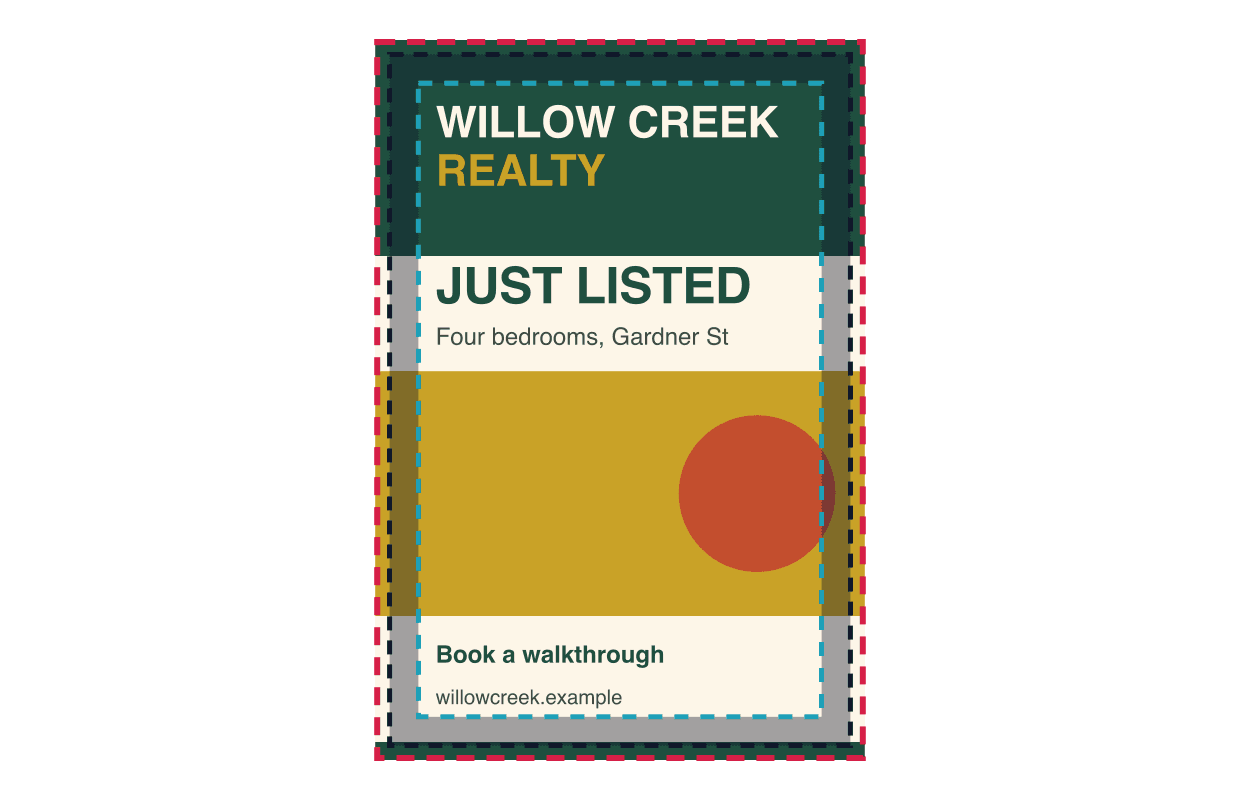
- Bleed area
- 4.25 x 6.25 in
- Trim line (actual size)
- 4 x 6 in
- Safe printing area
- 3.5 x 5.5 in
Bleed area: 4.25 x 6.25 in If your card has a background color, a photo or a bar of brand color along an edge, it has to extend past the trim on all four sides. That extra 0.125 inch is what gets cut away, and it is the only reason your card comes back without a white sliver on one edge.
Actual size: 4 x 6 in This is where the blade lands and what lands in the mailbox. It is also the size the postage rule is written around, so on a mailer it is the one number you cannot quietly round up.
Safe printing area: 3.5 x 5.5 in Everything that has to survive the cut lives inside this box: your offer, your deadline, your phone number, your QR code. Hold text 0.25 inch in from the trim on every side.
Postcard size in pixels: 1200 x 1800 pixels If you or your designer work in pixels, that is a 4 x 6 at 300 dpi. The full bleed file is 1275 x 1875 pixels and the safe area is 1050 x 1650 pixels. These are the industry standard 0.125 inch bleed numbers, so a file built to them prints correctly at any printer, not just at ours.
How Do You Lay Out the Address Side?
The address side adds a constraint no other printed piece has. Reserve the right side of the address panel for the mailing address and the indicia or stamp, and leave the bottom 0.625 inch free of artwork so the Postal Service can print a barcode there.
Keep the background light behind the address block. A dark photo under an address is the most common reason a mailer gets rejected or surcharged, because a scanner has to read printed characters off it at speed. Design that side as a layout with a hole in it, not a full bleed image with text floated on top.
The left third of the address side is yours, and it is the part most people waste. A short reminder of the offer, the deadline and a map or a service list all fit there without touching the address panel.
Which Postcard Size Should I Use?
4 x 6 is the default, and the only one that mails at the postcard rate. Use it for reminders, appointment cards, seasonal offers and anything where volume is high and the message is one line.
5 x 7 is the upgrade that still feels personal. It stands out in a stack of 4 x 6 cards and holds a photograph worth looking at. It mails as a letter.
6 x 9 is the attention size. Nearly twice the face of a 4 x 6, it does not get lost in a handful of mail, and it has room for an offer plus a map or a service list.
5.5 x 8.5 is a half sheet that doubles as a rack insert, a counter handout and a mailer, one file doing two jobs. 6.5 x 9 and 8.5 x 11 mail as flats, so they usually end up as handouts and counter pieces instead.
Plenty of postcards never touch a mailbox at all. They go in a bag at checkout, on a table at a show, or in a welcome packet. When that is the plan, ignore the postage thresholds entirely and pick the size that reads best in a hand, usually 5 x 7 or 6 x 9. Deciding what to print alongside them is its own question, and we worked through it in how to choose marketing materials for any event.
How Many Pixels Is a 4 x 6 Postcard?
A 4 x 6 postcard is 1200 x 1800 pixels at 300 dpi. Pixels only mean something once you attach a resolution, and print resolution on a piece read in a hand is 300 dpi, not the 72 dpi a screen works in.
Here is the trap. A card that looks fine on screen at 72 dpi is only 288 x 432 pixels, roughly a quarter of the detail a press needs in each direction. Printed at card size it goes soft, and small type goes fuzzy first. Vector art, an AI or EPS or layered PDF, has no resolution to run out of and is always the better send. The full ladder is in the size cards at the bottom of this page.
What Do Postcards Cost to Print?
Our custom postcards print on 16pt gloss cardstock, which measures 0.016 inch and sits at the top of the USPS postcard thickness range, double sided at no extra cost, in the three sizes people actually order. A 4 x 6 is $74.89 for 100, $106.99 for 250 and $149.79 for 500. A 5 x 7 is $85.59 for 100, $139.09 for 250 and $203.29 for 500. A 6 x 9 is $106.99 for 100, $171.19 for 250 and $278.19 for 500. Production is about 48 hours once you approve the free digital proof.
For a run longer than 500, or for a matte, writable surface, the same postcard sizes print on our flyer stocks in packs up to 2,500. For a size, stock or finish outside both lists, including 4.25 x 6 cut to the postcard maximum and rounded corners, send the details through custom orders. The rest of the range, including rack cards and brochures, sits on the marketing prints hub.
We print and ship the cards, not the mailing itself, so plan on posting them yourself or handing them to a mail house. Everything is printed in the USA, every order includes a free digital proof, and shipping is a flat $10 ground to any US address.
Mistakes We Catch on Postcard Proofs
Four things account for nearly every postcard file we send back, and three of the four only happen on postcards.
A dark photo running under the address block. This is the one that costs real money, because it passes our press and fails at the post office. If the address side is a full bleed sunset, the address goes on top of it, the scanner struggles, and the piece gets handled by hand or sent back. We flag it on every proof where the address panel is not light and clear.
Artwork in the bottom 0.625 inch of the address side. That strip belongs to the barcode. A logo tucked into the bottom corner looks tidy and is in the way.
A card built one sided when the back is going in the mail anyway. Both faces cost the same on our 16pt stock, so a blank back on a mailer is paid space nobody used. We ask before we print it.
Text sitting on the trim line. A phone number or a deadline that ends an eighth of an inch from the edge reads fine on screen and gets shaved on a real stack. This is the single most common reason we hold a proof on any product, not just cards.
What to Send Us
A print ready PDF at 4.25 x 6.25 inches, CMYK, 300 dpi, fonts outlined or embedded, all text inside the safe zone, and both sides as separate pages. That file goes straight to press.
Here is the short version as a checklist:
- Document built at the bleed size, not the trim size
- 300 dpi, CMYK, photos checked at final size
- Text and logos 0.25 inch inside the trim
- Address side laid out with the right panel and the bottom 0.625 inch clear
- Both sides as separate pages in one print ready PDF, fonts outlined
There is no setup fee. Upload any image or file and we make it print ready: size, bleed, resolution and color. If you have no design at all, Design it for me is +$32.10 and a designer builds the card from scratch with two revisions included.
Our Postcard Size Visual Guide
Four sizes, the same three lines on each, with every number in millimeters, inches and pixels at 300 dpi. Swipe through them and build to the one you need. The wall version of the same message is covered in poster sizes, the vinyl version in banner sizes, and the same bleed and safe zone rules at pocket scale in standard business card size.
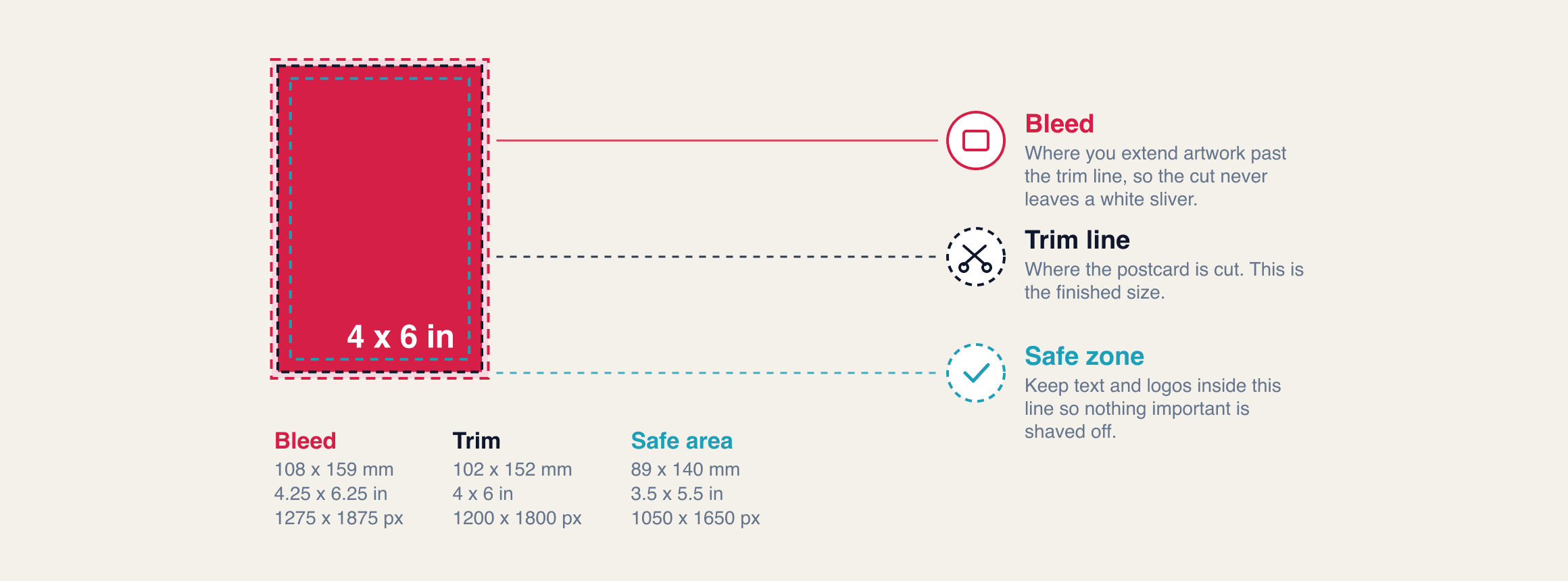
4 x 6
- Bleed
- 108 x 159 mm
- 4.25 x 6.25 in
- 1275 x 1875 px at 300 dpi
- Trim
- 102 x 152 mm
- 4 x 6 in
- 1200 x 1800 px at 300 dpi
- Safe area
- 89 x 140 mm
- 3.5 x 5.5 in
- 1050 x 1650 px at 300 dpi
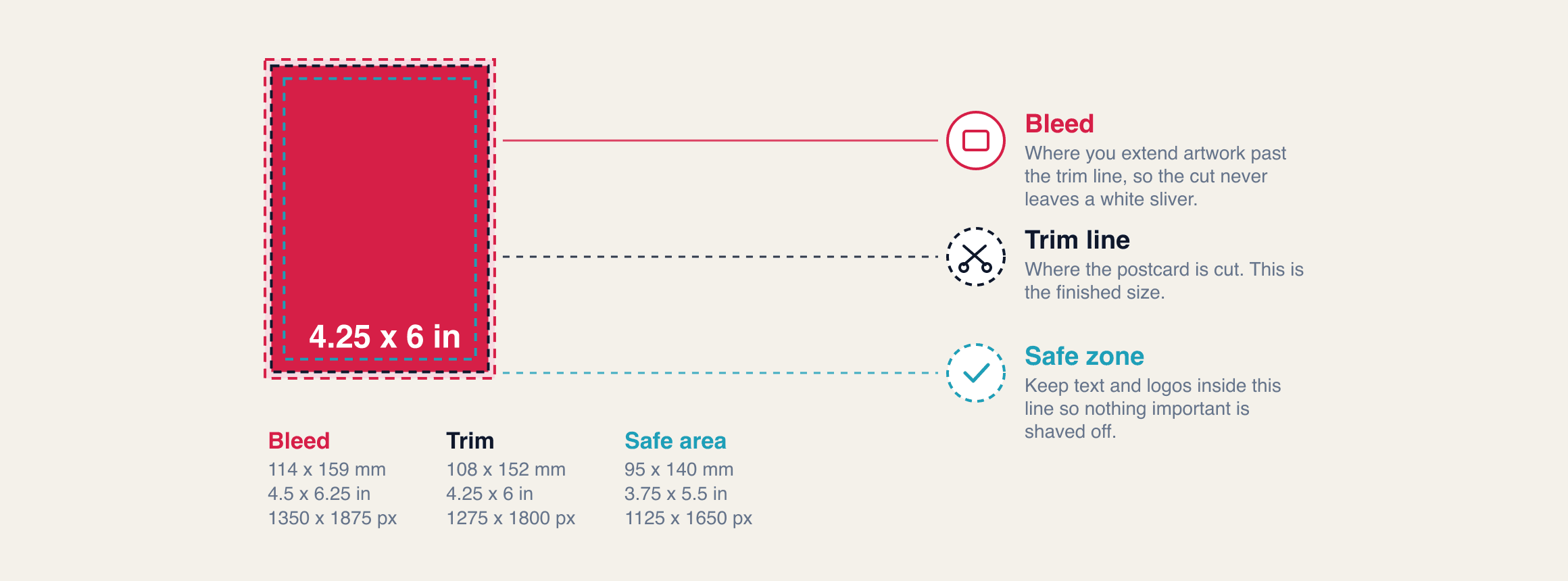
4.25 x 6
- Bleed
- 114 x 159 mm
- 4.5 x 6.25 in
- 1350 x 1875 px at 300 dpi
- Trim
- 108 x 152 mm
- 4.25 x 6 in
- 1275 x 1800 px at 300 dpi
- Safe area
- 95 x 140 mm
- 3.75 x 5.5 in
- 1125 x 1650 px at 300 dpi
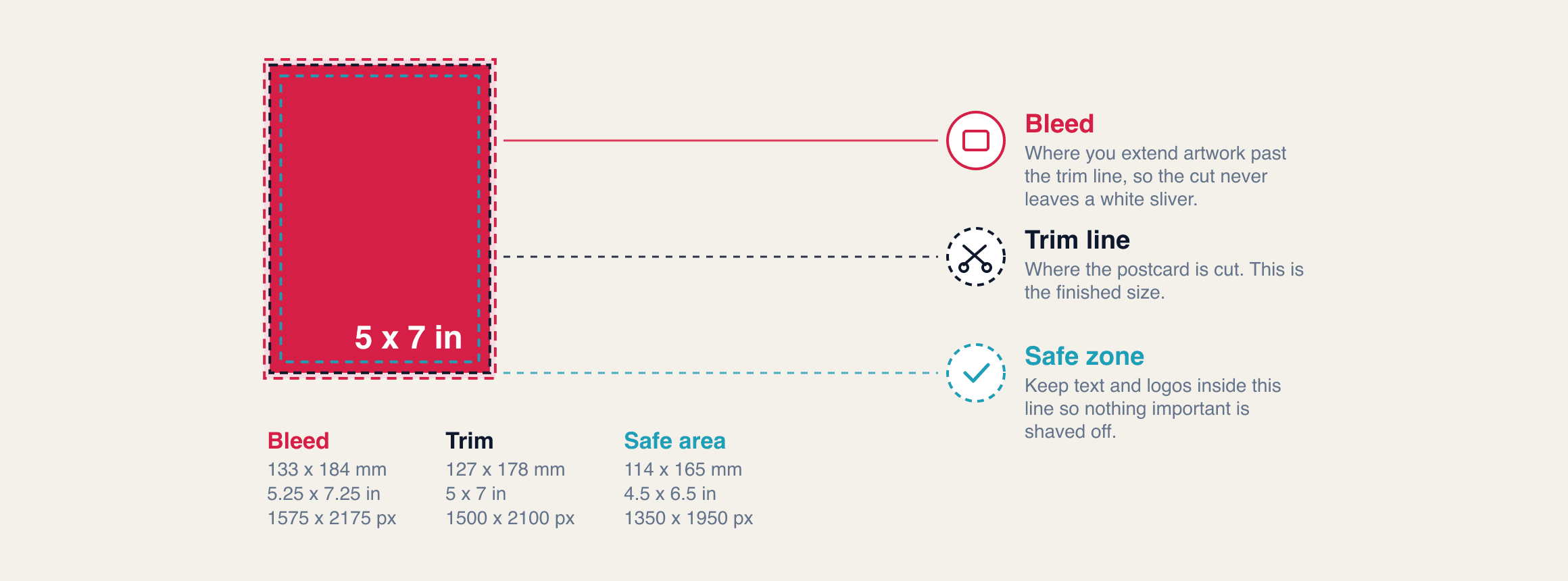
5 x 7
- Bleed
- 133 x 184 mm
- 5.25 x 7.25 in
- 1575 x 2175 px at 300 dpi
- Trim
- 127 x 178 mm
- 5 x 7 in
- 1500 x 2100 px at 300 dpi
- Safe area
- 114 x 165 mm
- 4.5 x 6.5 in
- 1350 x 1950 px at 300 dpi
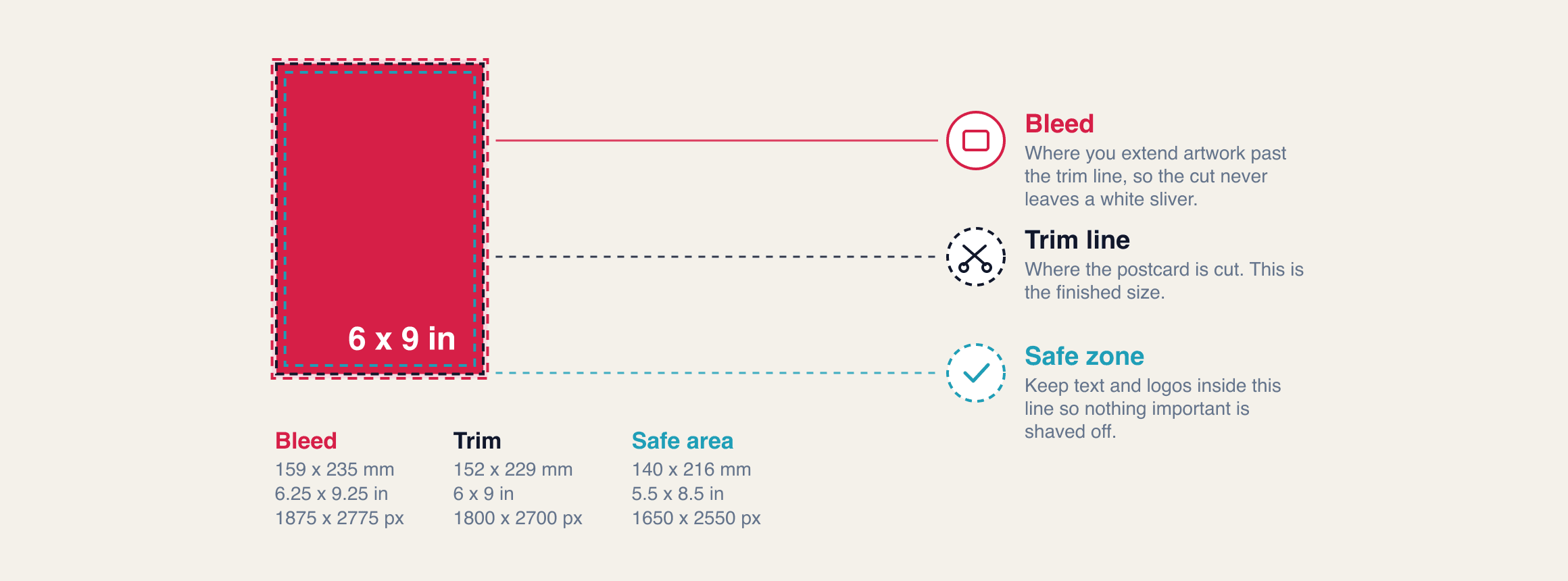
6 x 9
- Bleed
- 159 x 235 mm
- 6.25 x 9.25 in
- 1875 x 2775 px at 300 dpi
- Trim
- 152 x 229 mm
- 6 x 9 in
- 1800 x 2700 px at 300 dpi
- Safe area
- 140 x 216 mm
- 5.5 x 8.5 in
- 1650 x 2550 px at 300 dpi
Card 1 / 4
Found a size you like? Get started now.
Frequently Asked Questions
The standard postcard size is 4 x 6 inches, which is 102 x 152 mm. It is the cheapest size to print in volume and the only common size that qualifies for the USPS postcard rate. Build the file at 4.25 x 6.25 inches so it carries bleed, and keep text inside 3.5 x 5.5 inches.
The largest piece that mails at the USPS postcard rate is 4.25 x 6 inches, with a minimum of 3.5 x 5 inches and a thickness between 0.007 and 0.016 inch. Anything larger mails at letter prices. Postal rules change, so confirm them with USPS before a large mailing.
A 4 x 6 postcard is 1200 x 1800 pixels at 300 dpi, which is the trim size. The file you send should be 1275 x 1875 pixels so it carries bleed, and every piece of text belongs inside the 1050 x 1650 pixel safe area. Pixels mean nothing without a resolution attached.
A postcard can be printed square, but square pieces usually draw a nonmachinable surcharge, so they cost more to mail than a rectangular card of similar size. If the cards are being handed out rather than mailed, the shape costs you nothing extra and a 5 x 5 reads well on a counter.
Yes. Both faces are trimmed in the same pass, so both need 0.125 inch of bleed and text held 0.25 inch inside the trim. On a 4 x 6 that means two pages at 4.25 x 6.25 inches. The address side needs the same bleed even though most of it is deliberately left empty.
A 6 x 9 postcard is the hardest to ignore in a handful of mail, and a 4 x 6 is the cheapest to print and to mail. If the offer is one line and the list is long, 4 x 6 wins on volume. If the list is small, 6 x 9 earns its postage.
Related Articles
Poster Sizes: 11x17, 18x24, 24x36, Bleed and Pixels
Standard poster sizes are 11 x 17, 18 x 24 and 24 x 36 inches. Get bleed, safe zones, pixel [...]
Read More: Poster Sizes: 11x17, 18x24, 24x36, Bleed and Pixels
Door Hanger Sizes: 3.5x8.5 and 4.25x11 in, Die Cut Rules
Standard door hanger sizes are 3.5 x 8.5 and 4.25 x 11 inches. Get the die cut keep-out, bleed, [...]
Read More: Door Hanger Sizes: 3.5x8.5 and 4.25x11 in, Die Cut Rules
Banner Sizes: 2x4, 3x6, 4x8, 6x10 Feet and Letter Height
Standard banner sizes are 2 x 4, 3 x 6, 4 x 8 and 6 x 10 feet. Get the letter height rule, hem [...]
Read More: Banner Sizes: 2x4, 3x6, 4x8, 6x10 Feet and Letter Height
Standard Business Card Size: 3.5 x 2 in, Bleed and Pixels
The standard business card size is 3.5 x 2 in, 1050 x 600 pixels at 300 dpi. Bleed and safe [...]
Read More: Standard Business Card Size: 3.5 x 2 in, Bleed and Pixels