Door Hanger Sizes: 3.5x8.5 and 4.25x11 in, Die Cut Rules
Tomas Amaya
September 16, 2026Updated September 18, 20269 min read
What Are the Standard Door Hanger Sizes?
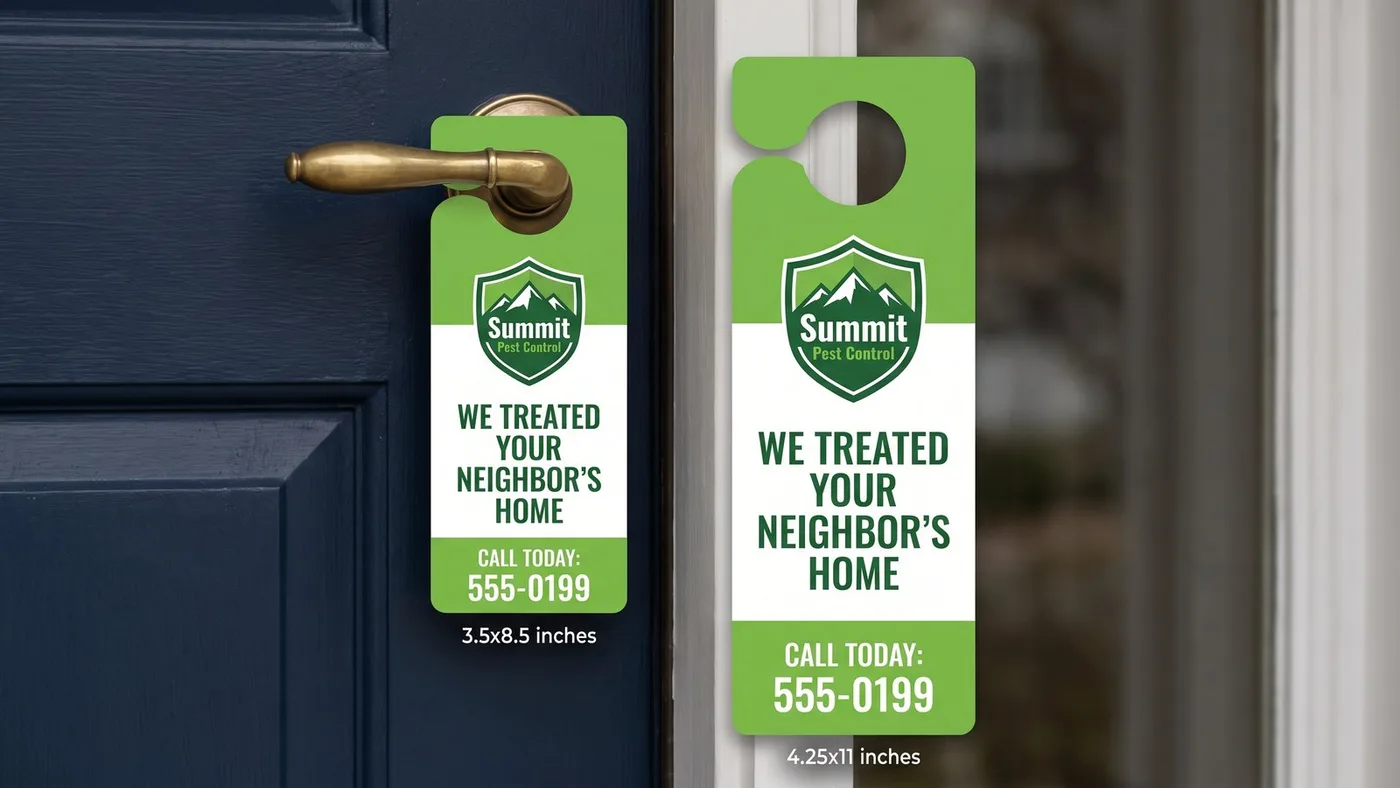
The standard door hanger sizes are 3.5 x 8.5 inches and 4.25 x 11 inches. Add 0.125 inch of bleed on all four sides, hold text 0.25 inch inside the trim, and keep everything you care about below the die cut, which takes the top 2 inches of the piece.
A door hanger is the only printed piece where a hole in the artwork is part of the spec, and that hole is what makes the size question different from every other size question. Here is the full range, with the two we print in stock at the top.
| Size (in) | Millimeters | Pixels at 300 dpi | Bleed file (in) | Usable panel below the die cut | Availability |
|---|---|---|---|---|---|
| 3.5 x 8.5 | 89 x 216 | 1050 x 2550 | 3.75 x 8.75 | About 3.5 x 6.5 | In stock, $246.09 for 250 |
| 4.25 x 11 | 108 x 279 | 1275 x 3300 | 4.5 x 11.25 | About 4.25 x 9 | In stock, $385.19 for 250 |
| 4 x 9 | 102 x 229 | 1200 x 2700 | 4.25 x 9.25 | About 4 x 7 | Custom quote |
| 4.25 x 14 | 108 x 356 | 1275 x 4200 | 4.5 x 14.25 | About 4.25 x 12 | Custom quote |
| 5 x 11 | 127 x 279 | 1500 x 3300 | 5.25 x 11.25 | About 5 x 9 | Custom quote |
The usable panel column is the number most templates leave out and most designers discover too late. On a 3.5 x 8.5 hanger the die cut takes roughly two of the eight and a half inches, which leaves you a panel about the size of a postcard, not the size of the piece you ordered.
Our door hangers print on cover stock with a UV gloss coating, full color on both sides, with a handle slot in every hanger at no extra charge and 3 to 5 business day production once your artwork is approved. Anything on the custom quote rows, including tear-off perforations, goes through custom orders.
How Big Is the Hole in a Door Hanger?
The hole in a door hanger is a circle between 1.25 and 1.75 inches across, set roughly half an inch down from the top edge, with a narrow slot running up from it to that edge. The hole clears the knob and the slot lets the piece slide on.
Three rules follow from that, and all three are size rules in disguise.
Nothing important goes in the top two inches. Not the logo, not the headline, not a phone number. Background color and pattern belong there and are usually better than white, because that band is what a homeowner sees first while the piece is still hanging on the knob.
Keep art a quarter inch clear of the cut edge. A die has the same tolerance a trim blade does. Text ringing the hole looks centered on some pieces in the run and crooked on others.
Get the die line before you design. Every printer's die is slightly different in diameter and placement. Ask for the template as a layer in your working file, design to it, then remove or hide that layer before you export. Designing to a generic template you found online and hoping it matches is the most expensive shortcut in this product.
If the hangers are going on lever handles rather than round knobs, which is common on apartment doors and newer construction, a taller slot matters more than a wider hole. Say so when you order.
Which Door Hanger Size Fits Which Job?
3.5 x 8.5 is the route size. Cheapest per piece, lightest to carry in volume, and it fits in one hand while the other hand works the door. Lawn care, pest control, plumbing, roofing, window cleaning and restaurant delivery menus all live here. The panel is small, so the message has to be one offer and one number.
4.25 x 11 is the offer size. Half again as wide and a third taller, which is enough room for a headline, a photo, a service list and a coupon without crowding. It is also noticeably harder to ignore on a door, which is the whole point. Real estate farming, campaign drops, home services with a seasonal promotion and church invitations all do better at this size.
4.25 x 14 is the tear-off format. It exists so you can put a perforated coupon along the bottom. The homeowner keeps a magnet-sized offer and the rest goes in the recycling. Worth the custom quote only if you are actually going to add the perforation.
The honest way to choose: if you are dropping a whole neighborhood and the message is one line, use the small size and put the savings into more doors. If you are trying to win a specific street with a real offer, use the large one.
What Bleed and Safe Zone Does a Door Hanger Need?
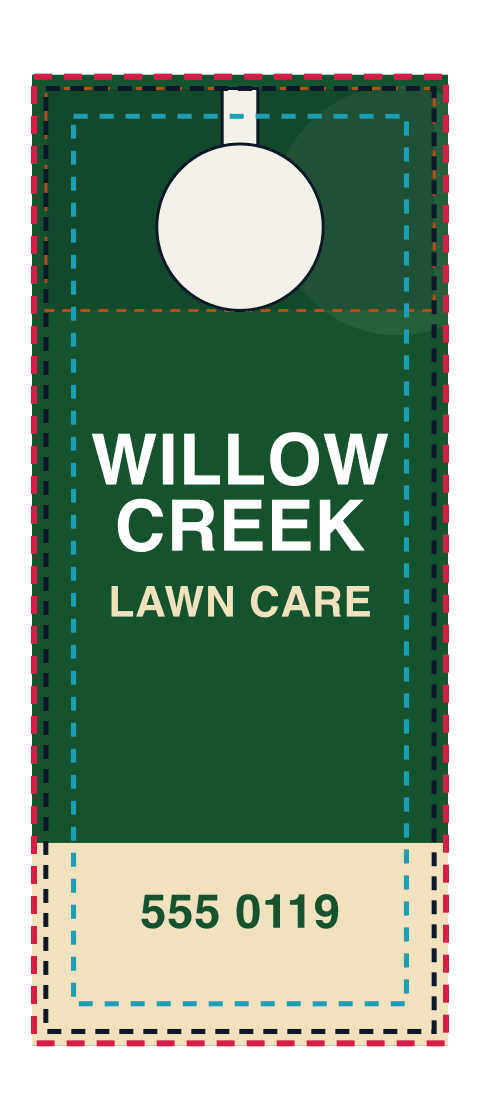
A door hanger needs 0.125 inch of bleed on all four sides and a 0.25 inch safe margin inside the trim, plus a 2 inch keep-out band under the die cut. Four lines, not three, and the fourth is the one that catches people.
- Bleed area
- 3.75 x 8.75 in
- Trim line (actual size)
- 3.5 x 8.5 in
- Safe area
- 3 x 8 in
- Die cut keep-out
- top 2 in
Bleed area: 3.75 x 8.75 in Any background color, photo or band of brand color has to run past the trim on every side, the curved top included. That extra eighth of an inch is what gets cut away, and it is the only reason your hanger comes back without a white sliver on one edge.
Trim line (actual size): 3.5 x 8.5 in Where the die lands and what the homeowner holds. It is the number on the order and the number the pack price is quoted against.
Safe area: 3 x 8 in Every word, logo, QR code and phone number lives inside this box. A quarter inch in from the cut on all four sides is the whole ask.
Die cut keep-out: the top 2 in Color may run under the hole and the slit. Text may not. The die is the least forgiving cut on the piece because it is a shaped blade rather than a straight one, so give it the full two inches and stop trying to reclaim half of them.
Should Door Hangers Print on Both Sides?
Yes. Door hangers print double sided on our stock at no extra charge, and a one-sided hanger throws away half the impressions you paid for. The homeowner sees one face on the knob and the other face as they pull it off.
The split that works: the front carries the offer and the deadline, the back carries the detail, the service list, the license or insurance line, a map and a QR code. If you are running a route across several weeks, keep the back constant and change only the front. The design cost stays down and the reprint is faster.
Door Hanger Sizes Shown to Scale
Three sizes, the same four guides on each, with every number in millimeters, inches and pixels at 300 dpi. Swipe through them and build to the one you need.
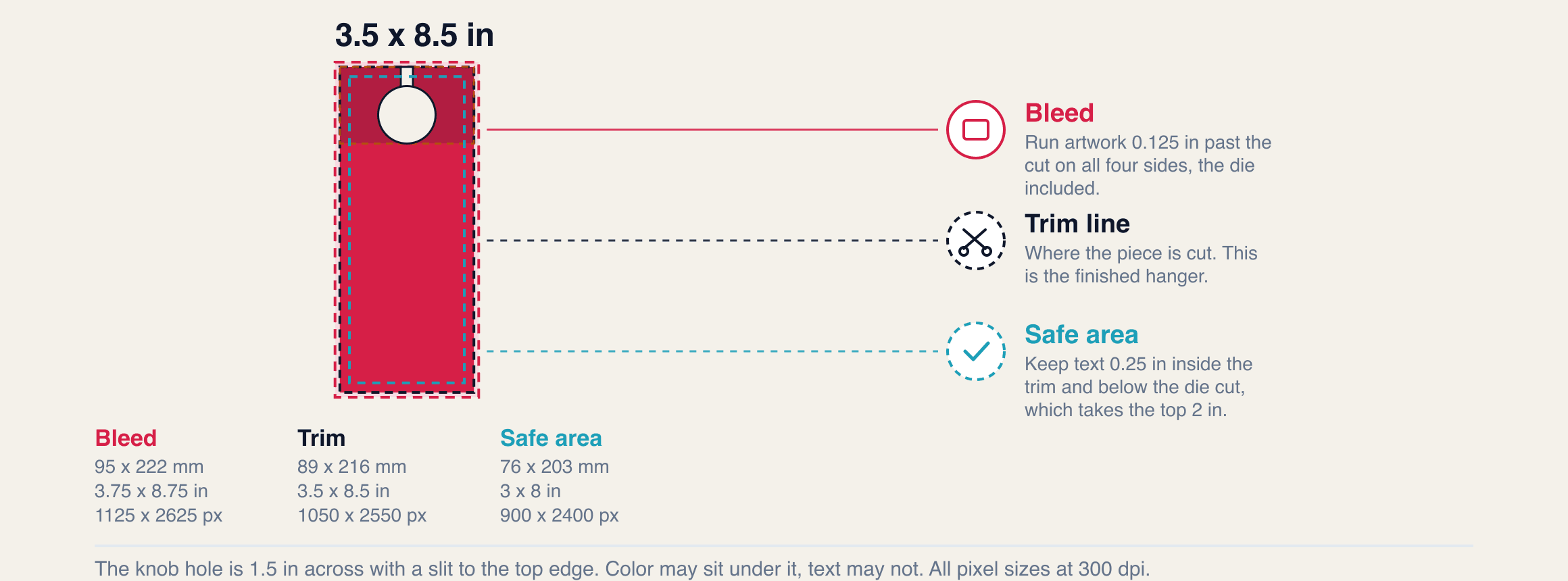
3.5 x 8.5 in, the route size
- Bleed
- 95 x 222 mm
- 3.75 x 8.75 in
- 1125 x 2625 px
- Trim
- 89 x 216 mm
- 3.5 x 8.5 in
- 1050 x 2550 px
- Safe area
- 76 x 203 mm
- 3 x 8 in
- 900 x 2400 px
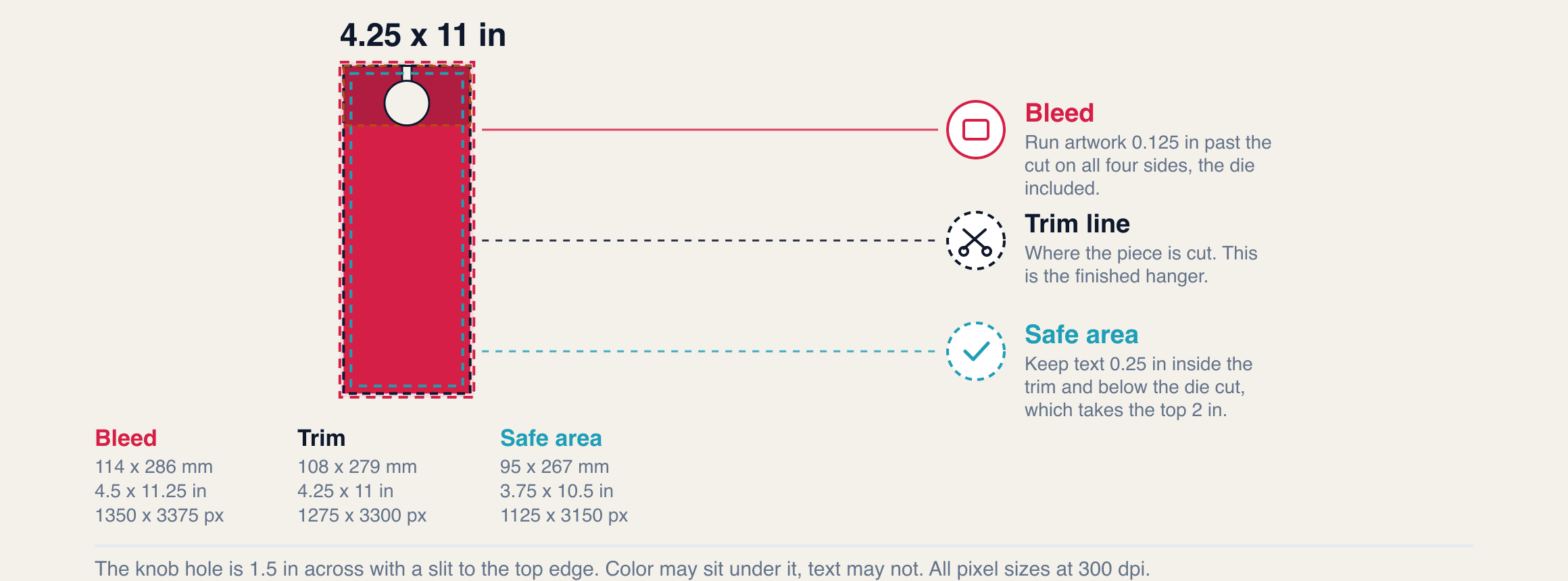
4.25 x 11 in, the offer size
- Bleed
- 114 x 286 mm
- 4.5 x 11.25 in
- 1350 x 3375 px
- Trim
- 108 x 279 mm
- 4.25 x 11 in
- 1275 x 3300 px
- Safe area
- 95 x 267 mm
- 3.75 x 10.5 in
- 1125 x 3150 px
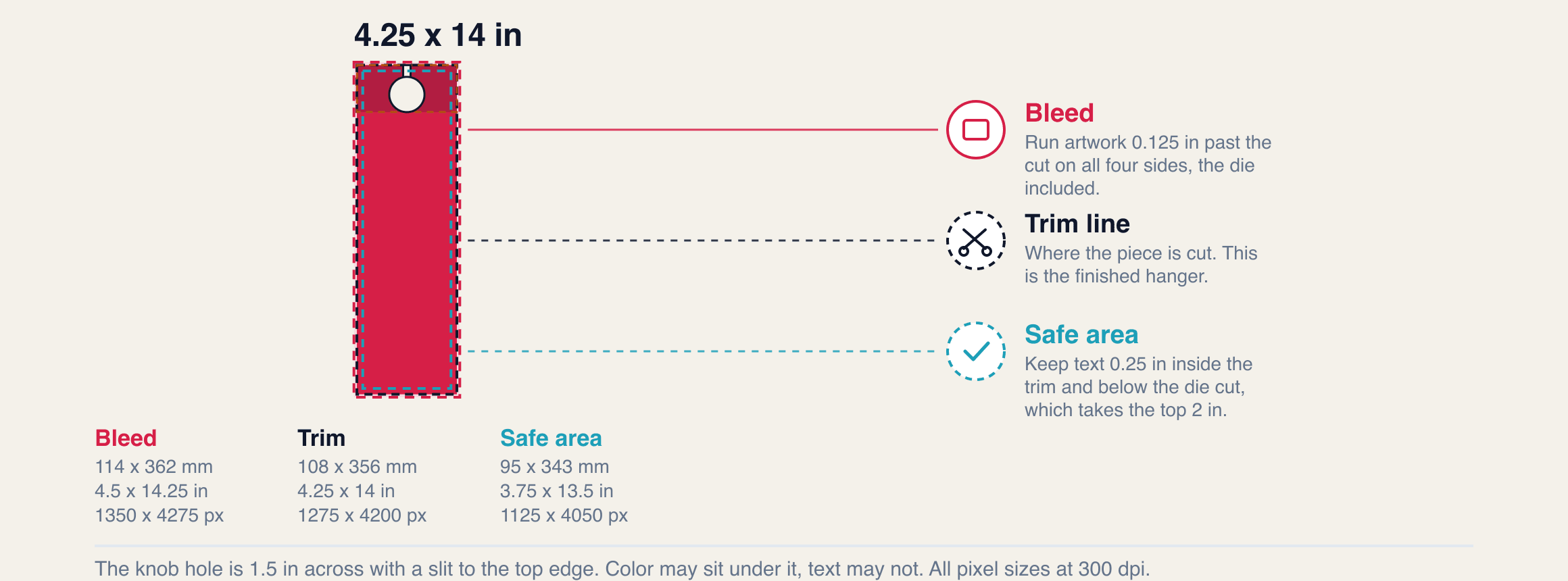
4.25 x 14 in, with a tear-off
- Bleed
- 114 x 362 mm
- 4.5 x 14.25 in
- 1350 x 4275 px
- Trim
- 108 x 356 mm
- 4.25 x 14 in
- 1275 x 4200 px
- Safe area
- 95 x 343 mm
- 3.75 x 13.5 in
- 1125 x 4050 px
Card 1 / 3
Mistakes We Catch on Door Hanger Proofs
Four things account for nearly every door hanger file we hold, and all four come back to the die.
A logo centered in the top third. The designer builds on a plain rectangle, centers the brand block, and the die cuts a hole straight through it. This is the single most common reason we send a door hanger proof back, and it is always the same fix: everything moves down below the two inch line.
A slit that runs through a word. The slot is only about a quarter inch wide, so it looks harmless until it lands in the middle of a headline. Treat the slit as a vertical exclusion running the full height of the keep-out band, not just as a thin line.
A white background with no bleed. On a white piece the missing bleed is invisible on screen and obvious in a stack, because the shear leaves a hairline of raw stock along one edge that does not match the coated face. Build at 3.75 x 8.75 and it never comes up.
A 150 dpi file at hand-held size. A yard sign can live at 150 dpi because nobody reads it from two feet away. A door hanger is read at arm's length, so small type at 150 dpi goes soft. Build at 300 dpi, or send vector.
What It Costs and What to Send Us
At 3.5 x 8.5, packs run $246.09 for 250, $267.49 for 500, $331.69 for 1,000, $513.59 for 2,500, $973.69 for 5,000 and $1,658.49 for 10,000. At 4.25 x 11, they run $385.19 for 250, $406.59 for 500, $438.69 for 1,000, $652.69 for 2,500, $1,080.69 for 5,000 and $2,043.69 for 10,000.
Look at the shape of those ladders before you order. Going from 250 to 1,000 small hangers costs $85.60 more and gets you 750 more doors, because the setup is the same work whether we print 250 or 10,000. Ordering twice is the expensive way to run a route.
Send a print ready PDF at the bleed size, CMYK, 300 dpi, fonts outlined, both sides as separate pages, and every word inside the safe area. There is no setup fee. Upload any image or file and we make it print ready: size, bleed, resolution and color. If you have no design at all, Design it for me is +$32.10 on an item under $499 and free at $499 or more, which includes 2,500 of the 3.5 x 8.5 at $513.59 and every larger pack, with two revisions included. You approve a free digital proof before anything prints, and every order is printed in the USA and shipped anywhere in the country for a flat $10.
The rest of the range, including the flyers that ride in the same route bag, sits on the marketing prints hub. For the sign that holds the corner while the route runs, see yard sign sizes; for the wall version of the same offer, see poster sizes; for the card you leave behind after the estimate, see standard business card size; and for what to print alongside a route drop, see how to choose marketing materials for any event.
Know the size you need? Get started now.

Frequently Asked Questions
The standard door hanger size is 3.5 x 8.5 inches. It is the size most route-based service businesses use, it fits comfortably in one hand while the other hand works the door, and it is the cheapest per piece in volume at $246.09 for 250 or $331.69 for 1,000.
The hole in a door hanger is usually a circle between 1.25 and 1.75 inches across, with a narrow slit running from the hole to the top edge, set roughly half an inch down. Dies vary from printer to printer, so ask for the exact die line before you start designing.
You can print on all of it, but plan on losing the top 2 inches to the die cut. On a 3.5 x 8.5 hanger that leaves a usable panel of about 3.5 x 6.5 inches, and on a 4.25 x 11 it leaves about 4.25 x 9. Color belongs in that top band, words do not.
A 3.5 x 8.5 inch door hanger is 1050 x 2550 pixels at 300 dpi, and the file with bleed is 1125 x 2625 pixels. A 4.25 x 11 hanger is 1275 x 3300 pixels, or 1350 x 3375 with bleed. Door hangers are read in the hand, so 300 dpi is the right resolution.
Yes, and on our stock the second side costs nothing extra, so there is no reason to leave it blank. The homeowner sees one face on the knob and the other as they pull it off, which is two impressions for the price of one. Put the offer on the front and the detail on the back.
Yes, as a custom quote. A tear-off needs a perforation added to the die, which is why the 4.25 x 14 size sits outside our standard list. Send the quantity, the size and where you want the perforation through custom orders and we will price it and send the die line back.
Related Articles
Postcard Sizes: 4x6, 5x7, 6x9, Bleed and USPS Rules
Standard postcard sizes are 4 x 6, 5 x 7 and 6 x 9 inches, and only 4.25 x 6 or smaller mails [...]
Read More: Postcard Sizes: 4x6, 5x7, 6x9, Bleed and USPS Rules
Poster Sizes: 11x17, 18x24, 24x36, Bleed and Pixels
Standard poster sizes are 11 x 17, 18 x 24 and 24 x 36 inches. Get bleed, safe zones, pixel [...]
Read More: Poster Sizes: 11x17, 18x24, 24x36, Bleed and Pixels
Yard Sign Sizes: 12x18 to 36x24 in, Bleed and Stakes
Standard yard sign sizes are 12x18, 18x24, 24x24 and 36x24 inches. Get letter height by [...]
Read More: Yard Sign Sizes: 12x18 to 36x24 in, Bleed and Stakes
Standard Business Card Size: 3.5 x 2 in, Bleed and Pixels
The standard business card size is 3.5 x 2 in, 1050 x 600 pixels at 300 dpi. Bleed and safe [...]
Read More: Standard Business Card Size: 3.5 x 2 in, Bleed and Pixels