Trifold Brochure vs Bifold: Dimensions and Panel Planning
 Jean
August 7, 2026Updated October 18, 20268 min read
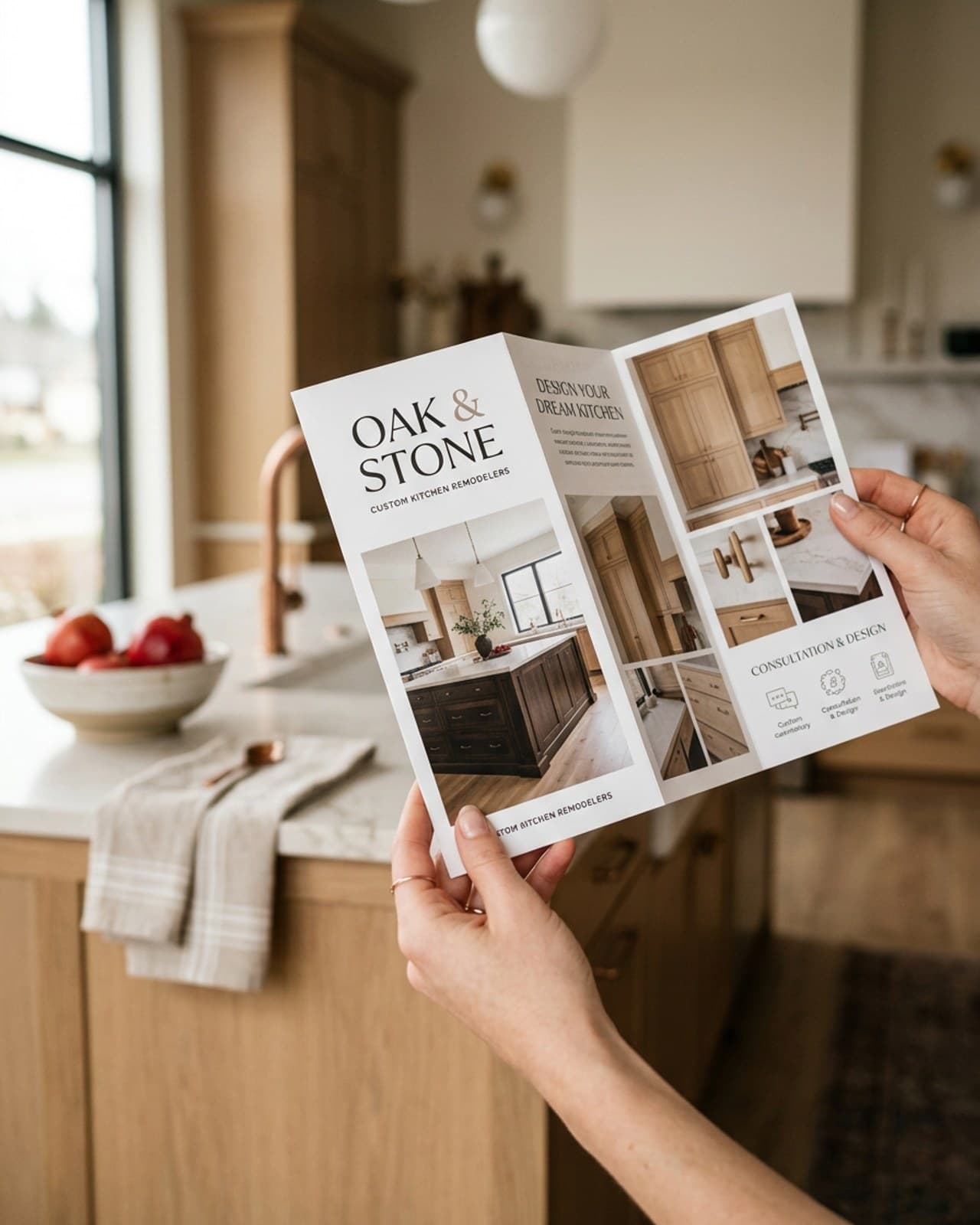

Should You Choose a Trifold Brochure or a Bifold?
An 8.5 x 11 trifold brochure creates six printed panels, while the same sheet in a half-fold creates four. At Inline Graphics, 250 brochures in either 8.5 x 11 fold, on 70# text stock with full color on both sides, cost $246.09, with flat $10 ground shipping to any US address.
Choose a trifold when the message benefits from several short sections, or choose a bifold when two broad inside panels should work together as one spread. The fold controls pacing and panel width. It does not create more paper or more printable area.
Inline Graphics calls the bifold option a Half-Fold on the custom brochure product page. The sold formats are 8.5 x 11 Half-Fold, 8.5 x 11 Tri-Fold, and 8.5 x 14 Tri-Fold. All three use 70# text stock with full-color printing on both sides.
| Sold format | Printed panels | Approximate finished size |
|---|---|---|
| 8.5 x 11 Half-Fold | 4 | 5.5 x 8.5 in |
| 8.5 x 11 Tri-Fold | 6 | 3.67 x 8.5 in |
| 8.5 x 14 Tri-Fold | 6 | 4.67 x 8.5 in |
The trifold widths are nominal. A tuck panel may be slightly narrower than the other panels so the piece closes without buckling. Confirm the panel widths for the chosen format during file setup and on the digital proof instead of treating the sheet as exact thirds.
How Does Each Fold Divide the Printed Sheet?
The main difference is the panel plan: a trifold has six narrow printed panels, while a bifold or half-fold has four wide printed panels. Both 8.5 x 11 choices use the same amount of paper.
A half-fold opens like a short booklet. The front and back panels handle the introduction and close, while the two interior panels can act as a single 11 x 8.5 inch spread. That wide view gives a large photograph, chart, floor plan, or paired comparison room to breathe.
A trifold creates a sequence of smaller surfaces. The cover can state the promise, the first reveal can orient the reader, and the interior can separate three related ideas. The back can carry contact details and a next step. Six panels do not mean the brochure holds more content automatically. They mean the same sheet is divided into smaller reading units.
The fold also changes what a reader sees at one time. A half-fold exposes the full inside spread immediately after opening. A trifold reveals part of the message first, then the rest as the second fold opens. That makes ordering the information especially important.
Which Jobs Fit a Trifold Brochure Best?
A trifold brochure fits a message that can be divided into several compact, clearly labeled sections. It works well when the reader should scan one topic at a time.
The format can organize a contractor's service categories, a clinic's appointment information, a church program, a nonprofit overview, or a conference handout. Each panel needs one clear responsibility. A heading, a short explanation, and one supporting visual will usually scan better than a panel carrying several unrelated points.
An 8.5 x 11 trifold finishes at about 3.67 x 8.5 inches. Its slim shape can fit a typical 4-inch literature rack and a #10 envelope, but the holder or envelope should still be measured before a campaign is planned. The 8.5 x 14 trifold provides wider nominal panels at about 4.67 x 8.5 inches. That added width helps when the copy cannot be reduced without losing useful detail.
Use the animated brochure fold walkthrough to see how the panel faces change as a brochure closes. The animation is more useful than a flat sketch when deciding where the cover, tuck panel, and inside sequence belong.
Which Jobs Fit a Bifold Brochure Best?
A bifold brochure fits a focused message that needs larger visual areas or a broad interior spread. Inline Graphics sells this structure as the 8.5 x 11 Half-Fold.
The finished 5.5 x 8.5 inch piece gives each printed panel more width than an 8.5 x 11 trifold. That room suits a product comparison, a real estate presentation, a simple event program, a menu with a few sections, or a portfolio built around strong images. The interior can also support a diagram or timeline that would feel cramped across three narrow columns.
Four panels force useful editing. The cover earns attention, the interior explains the main idea, and the back supplies the response path. If the message requires five or six separate categories, the half-fold can become dense. In that case, a trifold may provide a cleaner structure even though it does not provide more total sheet area.
How Much Do Trifold and Half-Fold Brochures Cost?
On an 8.5 x 11 sheet, the trifold and the half-fold cost the same: $246.09 for 250 and $460.09 for 2,500, on 70# Text Stock printed full color on both sides. The 8.5 x 14 trifold has its own ladder, starting at $331.69 for 250.
| 8.5 x 11 quantity | Total price |
|---|---|
| 250 | $246.09 |
| 500 | $256.79 |
| 750 | $267.49 |
| 1,000 | $278.19 |
| 2,500 | $460.09 |
| 8.5 x 14 quantity | Total price |
|---|---|
| 250 | $331.69 |
| 500 | $417.29 |
| 750 | $449.39 |
| 1,000 | $470.79 |
| 1,500 | $620.59 |
| 2,000 | $674.09 |
| 2,500 | $706.19 |
So the fold itself never changes the price on a letter sheet; the choice between trifold and half-fold can be made purely on layout. The sheet size does change it. A letter-size total should not be applied to an 8.5 x 14 order, and the 1,500 and 2,000 packs are sold only on the 8.5 x 14 trifold.
Brochures are printed in the USA, with production taking 3 to 5 business days after artwork approval. Transit comes after production. Ground shipping is a flat $10 per order to any US address, and a free digital proof is sent after the order is placed and before printing begins.
How Should You Set Up Trifold or Half-Fold Artwork?
Upload your layout in any accepted file type (PDF, AI, PSD, EPS, JPG, PNG, SVG, TIFF, WEBP or HEIC, including a Canva export or a phone photo), and Inline Graphics prepares the size, bleed, resolution, and color through AI image to print for $14.99 once per item after you order. Confirm the exact panel widths on the free digital proof because a trifold tuck panel may be narrower.
Create an outside spread and an inside spread. Label the cover, back, tuck panel, and interior positions by their folded role. Keep important text, logos, faces, and QR codes away from folds and trimmed edges. A background may continue through a fold, but essential details should stay clear of the crease.
Review your file at actual size, then make a paper mockup. The digital file confirms image quality and alignment. The folded mockup confirms what appears first, what is hidden, and whether the reading sequence feels natural. Inline Graphics sends the free digital proof after ordering, and production begins only after artwork approval.
Brochures are one part of the wider print marketing collection. If your project needs a fold outside the three sold configurations, use the custom quote contact page rather than forcing the artwork into an unsuitable format.
How Do You Make the Final Fold Decision?
Make the final decision by matching the number of message sections to the available panel widths. Choose the structure before final copy or design work begins.
Start with a content inventory. Count the distinct ideas that deserve their own space. Then mark the largest visual and the primary call to action. If a wide interior image or a simple two-part explanation leads the piece, the half-fold is usually the cleaner choice. If the message needs several short categories and a paced reveal, the trifold usually organizes it better.
Do not treat more folds as more capacity. Every extra crease reduces usable width within each panel and adds another boundary the layout must respect. A concise brochure with comfortable spacing is easier to scan than a six-panel piece filled edge to edge.
Need brochures or other custom printing? Inline Graphics helps businesses, churches, schools, and event organizers across the country design and print cards, banners, signs, decals, displays, and marketing materials that get noticed. Contact us today for a quote.
Frequently Asked Questions
Yes. Bifold commonly means the sheet is folded once, creating four printed panels. Inline Graphics names this sold option Half-Fold in the brochure configurator, so that is the label to choose when ordering.
A trifold brochure has six printed panels, three on each side of the sheet. The closing or tuck panel is commonly narrower than an exact third, so use the template for the selected format rather than dividing the width evenly.
An 8.5 x 11 trifold finishes at approximately 3.67 x 8.5 inches. That width is nominal because the panel that tucks inside may be slightly narrower for a clean fold.
An 8.5 x 11 half-fold brochure finishes at 5.5 x 8.5 inches. Its four printed panels are wider than the six panels on the trifold version of the same sheet.
250 8.5 x 11 Half-Fold brochures on 70# Text Stock, printed full color on both sides, cost $246.09, and 1,000 cost $278.19. Production takes 3 to 5 business days after artwork approval, followed by transit.
250 8.5 x 11 Tri-Fold brochures cost $246.09, the same as the half-fold, and 250 8.5 x 14 Tri-Fold brochures cost $331.69. Both are on 70# Text Stock, printed full color on both sides.
No. An 8.5 x 11 trifold and an 8.5 x 11 half-fold begin with the same sheet area. The trifold divides that area into six narrower printed panels, while the half-fold divides it into four wider panels.
Related Articles
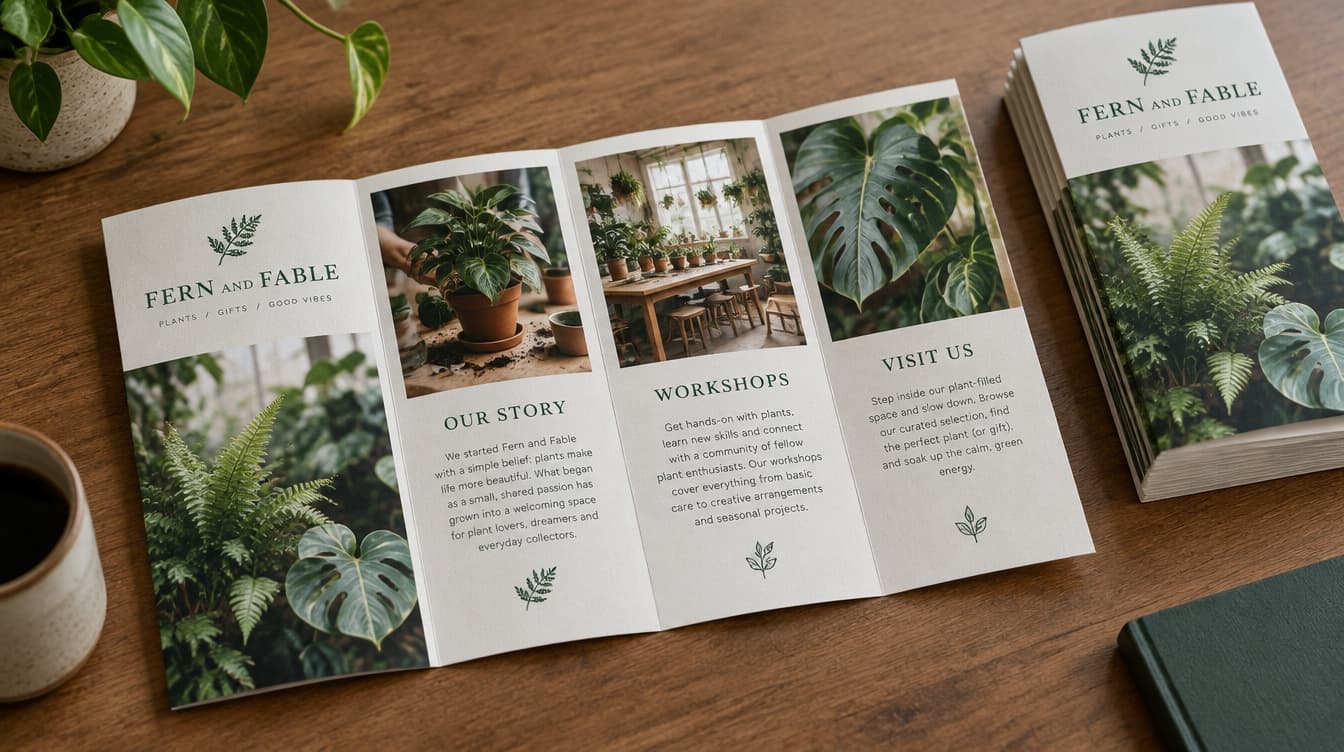
How to Make a Brochure: A Professional Print Guide
An 8.5 x 11 in brochure can use a half-fold or tri-fold, while 8.5 x 14 in supports a tri-fold. [...]
Read More: How to Make a Brochure: A Professional Print Guide
Brochure Sizes: Flat Sheets and Finished Dimensions Guide
8.5 x 11 and 8.5 x 14 are the sold flat brochure sizes; finished widths run from 3.67 to 5.5 [...]
Read More: Brochure Sizes: Flat Sheets and Finished Dimensions Guide
Door Hangers vs Postcards: Which Should You Print First?
250 3.5 x 8.5 inch door hangers cost $246.09; 250 4 x 6 inch postcards cost $106.99. Compare [...]
Read More: Door Hangers vs Postcards: Which Should You Print First?