Canopy Tents for Open Houses: Sizes, Branding, Cost
 Tomas Amaya
April 12, 2026Updated October 16, 20269 min read
Why Do Canopy Tents Work for an Open House?
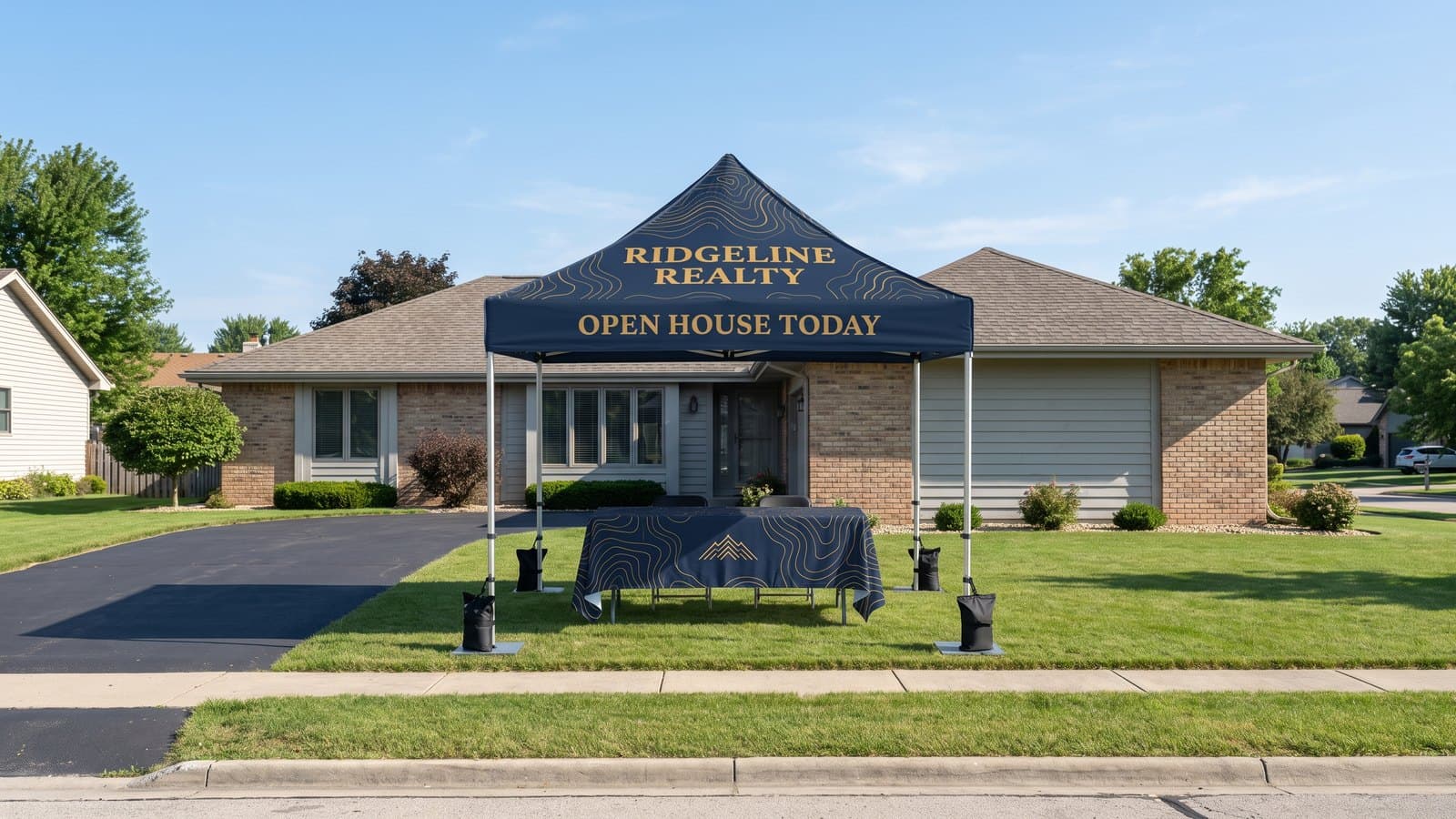
A branded 10 x 10 canopy tent makes an open house visible from the street. A logo kit with the included V6 frame is $759.69, while a full-color V6 canopy is $973.69. Each is printed in the USA in 3 to 4 business days after artwork approval and ships nationwide for a flat $10.
Three things a lawn sign cannot do. A tent is tall enough to clear parked cars, it is a block of brand color in a street of beige houses, and it reads as a staffed event rather than a door that might be open. A driver deciding whether to slow down is answering one question, and a tent answers it from farther away.
The shade is not a side benefit either. An open house lives or dies on whether a stranger is willing to stand still and talk, and standing still in an open driveway in July is a lot to ask without a roof.
| What you order | Size | Best for | Starts at | Ready in |
|---|---|---|---|---|
| 10x10 logo kit, V6 frame | 10 x 10 ft | One agent, one listing | $759.69 | 3-4 business days |
| 10x10 full color canopy, V6 frame | 10 x 10 ft | Most open houses | $973.69 | 3-4 business days |
| 10x15 event tent | 10 x 15 ft | Team setups with refreshments | $1,390.99 | 3-4 business days |
| 10x20 event tent | 10 x 20 ft | Listing launches, multi-agent events | $1,615.69 | 3-4 business days |
| Full back wall | 113 x 78 in | Photo backdrop, wind block | $385.19 | 3-4 business days |
| Half wall | Counter height | Branding across the table front | $278.19 | 3-4 business days |
| Tent flag kit | Clamps to a frame leg | Height above the canopy | $224.69 | 3-4 business days |
What Size Canopy Tent Do You Need for an Open House?
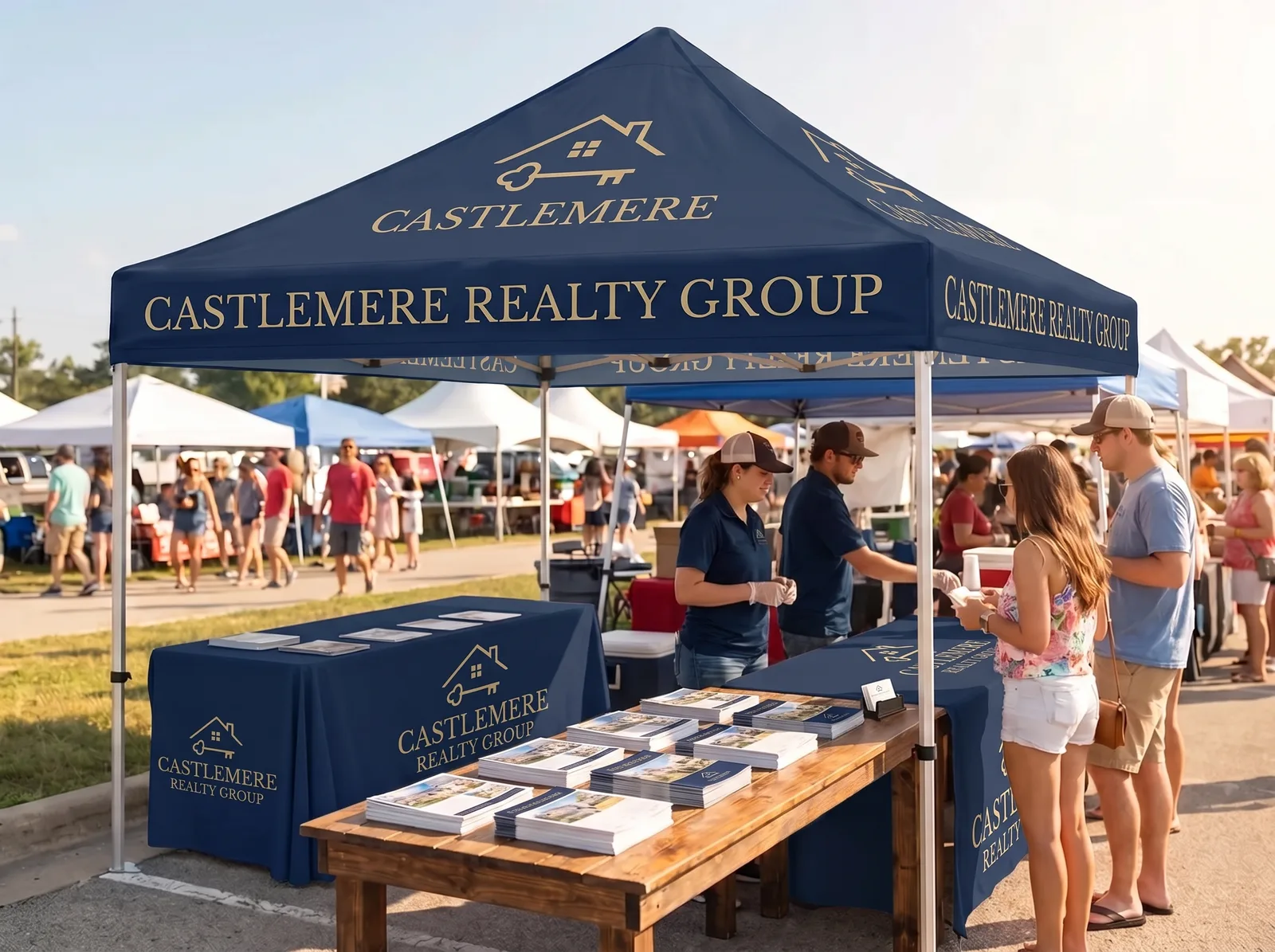
Start with a 10 x 10, then measure the driveway and preserve a clear path to the front door. The footprint can hold a folding table with two or three people working behind it, and the whole setup travels in one carry bag between listings.
The 10x10 event tent comes two ways. The logo kit at $759.69 is a solid canopy in white, black, green, red or blue with your logo printed on it in one color, and it is the honest choice for an agent who wants presence without a design project. The full color canopy at $973.69 prints seam to seam across all four peaks and valances, and that is the version that photographs well and reads as a brand rather than a tent with a sticker on it.
The 10x15 at $1,390.99 and the 10x20 at $1,615.69 are event footprints rather than driveway footprints. They earn their price at a listing launch, a new construction weekend or a brokerage-wide open house where several agents are working one curb. On a normal Sunday afternoon they are more tent than the lot can hold.
All three print on 6 oz weatherproof polyester at 600 x 600 denier with a tool-free pop-up frame and telescoping legs, and ropes, stakes and a carry bag are in the price. Frame upgrades are a 10 x 10 option: five tiers from the included V6 value frame up to a lifetime-warranty V3, compared side by side on the canopy tent frames page. A tent that goes up forty weekends a year is a different purchase than a tent that goes up four times.
What Should Be Printed on an Open House Tent?
Split the message by distance. The canopy top is read from a moving car, so it carries the brand mark and the team name and nothing else. The valance, the band around the lower edge of the canopy, is read at eye level by someone standing ten feet away, so it carries the agent name, a phone number and one call to action.
That split is the whole design brief. Almost every tent we hold on proof has it backwards: a phone number printed across the peak where nobody can read it, and an empty valance at the exact height where people are looking.
A few rules that survive contact with a real driveway:
- Top: logo and brand name, large, in two colors. It also has to work from above, because that is the view in an aerial listing photo.
- Valance: name, phone, and one line such as Open House Today. One line, not three.
- Walls: a listing photo or a Now Showing graphic on the back wall, which is also where people will stand to be photographed.
- Color: match your brokerage palette exactly rather than approximately. Send the color values with the artwork and we hold the file until they match the proof.
Skip multiple listings, second phone numbers and social handles. A tent that tries to say five things says none of them at 25 miles an hour.
How Do You Anchor a Canopy Tent?
Weight every leg, every time, before anything else goes under the tent. This is the one step that decides whether the tent is still standing at four o'clock.
Sandbags are the answer on a driveway, a sidewalk or any hard surface where a stake will not go in, and they are an option on the 10 x 10 order. Ground stakes ship with every tent and handle grass. An unweighted tent in an open front yard is the failure we hear about, and it is never the fabric that fails: it is a gust crossing an open lot with nothing in front of it, catching a canopy that has become a very effective sail.
Two practical habits. Put the weight on before the table, the sign rider and the box of flyers, because once the tent is loaded nobody wants to lift a leg to thread a bag. And if a storm is genuinely coming, take the tent down rather than trusting it. Canopy fabric is weatherproof, but nothing about a pop-up frame is built to argue with a front.
What Else Belongs at the Curb?
The tent is the destination. Everything else is the path to it, and each piece works at a different distance.
- Directional yard signs at the cross streets. An 18 x 24 in yard sign is $53.49, a wire H-stake is $3.00 more, and double sided is the right call on a corner where traffic passes in both directions.
- A tent flag kit at $224.69, which clamps onto the tent's own hex frame legs with an engineered hex clamp and adds height above the canopy without a second base on the ground.
- A standalone feather flag from $203.29 in sizes from 9 to 18 feet, on a ground stake in the lawn or a cross base on the driveway.
- An A-frame sign at $267.49 by the front door, which is the last piece of signage before someone walks in.
- A printed table cover at $213.99 for the 6 ft table under the tent, so the table is branded instead of draped in a bedsheet.
Ordering those as one artwork package matters more than ordering them at once. Four pieces built from four different files over three months come back as four slightly different versions of your brand color.
How Long Does a Custom Canopy Tent Take to Print?
The base canopy configurations listed here are ready in 3 to 4 business days after artwork approval. The 10 x 10 base uses the included V6 frame, while upgraded 10 x 10 frame tiers take about 2 weeks after artwork approval. Production does not start before approval, and transit time comes after the stated production window.
The part that actually sets the schedule is artwork. A vector logo in an AI, EPS or layered PDF file drops straight into the canopy template. A logo pulled off a website, or a brokerage file nobody can find the original of, adds a round of proofing before the clock starts. Either way, send what you have through AI image to print and we make it print ready. On a canopy order that $14.99 fee is waived. On a tent package design is already included in the price, and on a tent bought on its own, Design it for me is free at $499 or more, which every 10 x 10, 10 x 15 and 10 x 20 tent clears, and below that line it is +$29.99, for a designer to build it from scratch with two revisions.
What We See on Canopy Tent Proofs
Four things account for most of the tent files we hold, and none of them are taste.
A logo sized for a business card on a 10 foot canopy. A 600 pixel logo across a canopy peak is a handful of dots per inch, and dye sublimation is honest about it. Vector art has no resolution to run out of.
Contact details on the peak. The top of a canopy is seen from a car and from above. A phone number up there is decoration. It belongs on the valance, where a person reads it standing still.
Artwork built to the flat rectangle. A canopy is four triangular peaks with valances hanging off them, not a poster. Copy centered in a flat file lands across a seam or bends over the peak edge. Once you order, we lay every file into the real template and send a proof showing exactly where each line falls, which is the point of the proof.
A back wall designed as a photo backdrop with text in the bottom foot. The lower band of a back wall is behind a table, a case or a person for the entire event. Put the message at eye height and let the bottom carry color.
What to Send Us
Send vector artwork, an AI, EPS or layered PDF, with fonts outlined, logos in vector and your exact brand color values noted. Dye sublimation prints the file it is given, so a clean vector file is the difference between a canopy that looks printed and one that looks photographed.
You approve a free digital proof after ordering and before anything prints. Each tent ships nationwide for a flat $10 to any US address. If the open house is really a whole booth, the tent packages bundle the same 10 x 10 canopy with a printed table cover, walls and flags by tier, and every package ships for the same flat $10.
Frequently Asked Questions
The usual starting point for an open house is a 10 x 10 ft tent. Measure the driveway and preserve clear access to the entrance before ordering. The footprint can hold a folding table and two or three people and packs into one carry bag. The 10 x 15 and 10 x 20 sizes suit larger listing launches and team events.
$759.69 buys a 10 x 10 logo kit with one solid canopy color and a printed logo. A full-color 10 x 10 canopy is $973.69, a 10 x 15 is $1,390.99, and a 10 x 20 is $1,615.69. All include the frame, ropes, stakes, and a carry bag.
Put the brand mark on the canopy top and the details on the valance. The top is read from a car at distance, so it carries a logo and a name and nothing else. The valance is the band around the lower edge, read at eye level from ten feet, so it carries the agent name, a phone number and one call to action.
Production takes 3 to 4 business days after artwork approval for the base configurations listed here. The 10 x 10 base uses the included V6 frame, while upgraded 10 x 10 frame tiers take about 2 weeks. Add transit after production and count backward from the approval date.
4 weighted legs are the starting point for a 10 x 10 tent. Add sandbags on a driveway or another hard surface where stakes cannot go in, and use the included ground stakes on grass. Take the tent down when a storm is coming instead of trusting weights against severe weather.
$385.19 buys a single-sided 113 x 78 inch full back wall for a 10 ft tent. A counter-height half wall is $278.19 single sided or $438.69 double sided. The full wall attaches with sewn-in velcro loops, reaches to within 4 inches of the floor, and can serve as a photo backdrop.
$53.49 buys an 18 x 24 inch yard sign, or it is $56.49 with a wire H-stake. Yard signs and directionals bring a driver from the cross street to the block, while the tent confirms that they found the open house. The two pieces work at different distances.
Related Articles
Best Canopy Tent for Farmers Market Vendors: Frame Guide
The best 10 ft x 10 ft canopy frame matches setup frequency and carrying needs. Compare 5 [...]
Read More: Best Canopy Tent for Farmers Market Vendors: Frame Guide
Heavy Duty Canopy Tent Wind: Frames, Bags and Stakes
No canopy frame publishes a wind-speed rating, and wind damage is excluded on all 5 tiers. What [...]
Read More: Heavy Duty Canopy Tent Wind: Frames, Bags and Stakes
How to Install a 10x10 Canopy Tent: The Setup Order
A 10 x 10 canopy sets up in 5 steps: top on, frame open, legs out, then stakes or weight on all [...]
Read More: How to Install a 10x10 Canopy Tent: The Setup Order
Lifetime Warranty Canopy Tent: When the V3 Pays Off
Only the V3 carries a lifetime term, covering defects in materials and workmanship. The other 4 [...]
Read More: Lifetime Warranty Canopy Tent: When the V3 Pays Off