A-Frame Sign Sizes: 24 x 36 in Graphic and Frame Specs
Tomas Amaya
September 16, 2026Updated September 18, 20268 min read


What Is the Standard A-Frame Sign Size?
The standard a-frame sign size is a 24 x 36 inch graphic panel on each face, and the frame around it stands 46 inches high, 25 inches wide and 3 inches deep at about 19 pounds. The common step down is 22 x 28 inches, and small frames take 18 x 24.
That gap between the graphic size and the frame size is where most of the confusion lives. You are buying a 46 inch object in order to show a 36 inch picture, and the numbers on the box are not the numbers on the artboard. Here is how the two relate.
| Graphic size (in) | Millimeters | Pixels at 150 dpi | Reads from | Frames that take it |
|---|---|---|---|---|
| 24 x 36 | 610 x 914 | 3600 x 5400 | 30 to 40 ft | Standard Signicade, Deluxe Signicade |
| 22 x 28 | 559 x 711 | 3300 x 4200 | 25 to 35 ft | SimpoSign II |
| 24 x 24 | 610 x 610 | 3600 x 3600 | 25 to 30 ft | Square frames, not a size we stock |
| 18 x 24 | 457 x 610 | 2700 x 3600 | 20 to 25 ft | Small and indoor frames, not a size we stock |
The three frames we sell cover the top two rows, and every one of them goes into production the next business day once your proof is approved. If you already own a frame that takes one of the bottom two sizes, we can print the coroplast panel for it through the any-size coroplast sign, which prices by the square foot.
Standard Signicade takes 24 x 36 inch graphics, printed on adhesive vinyl that applies directly to the white frame face rather than dropping in as a board. The frame is 46 inches high, 25 inches wide, 3 inches deep and 19 pounds. It is $267.49 with a graphic on one face and $288.89 with graphics on both. Replacement vinyl is $74.89 for one face or $96.29 for the pair.
Deluxe Signicade takes the same 24 x 36 panel, but as a drop-in coroplast insert that slides into a recess, so you can swap the message without touching the frame. Available in a black or a white frame at $374.49 with one insert and $406.59 with two, with replacement inserts at $85.59 and $106.99.
SimpoSign II is the lightweight frame and takes 22 x 28 inch coroplast inserts. It is $278.19 with one insert and $299.59 with two, and replacement inserts run $74.89 and $96.29.
Why Is the Frame Bigger Than the Graphic?
An a-frame is two panels hinged at the top, so the printed area is never the footprint. Three numbers decide whether a sign fits the space you have.
Standing height decides whether the sign reads over parked cars and pedestrians. A standard Signicade at 46 inches is just under four feet, which clears a sidewalk crowd and stays under most awnings.
Open footprint decides whether you are blocking the walkway. The legs splay when the sign opens, so a frame 25 inches wide sits on a base noticeably deeper than its folded 3 inches. Many cities require a minimum clear path on a public sidewalk, often around 4 feet, so measure the walkway before you buy rather than after.
Weight decides whether the sign is still there in the morning. Nineteen pounds resists a breeze and is still light enough for a staff member to set out each day. Lighter frames need ballast, which is what the water-fillable base on many models is for.
Which A-Frame Size Reads From How Far?
Sidewalk signs are read close, which is exactly why people over-design them. The same rule applies here as anywhere else: about one inch of capital letter height for every ten feet of reading distance.
A pedestrian reads your sign from 15 to 25 feet, which means headline letters of about 2 to 2.5 inches. On a 24 x 36 panel that is roughly a fifteenth of the panel height, so a three line message in 2.5 inch type takes up less than a third of the board. You have more room than you think, and the most effective sidewalk sign on any block is usually the emptiest one.
Drivers are a different problem. A car passing at 25 miles an hour is 35 to 40 feet away and moving, so you need 4 inch letters and about four words. At that point a 24 x 36 panel is the minimum, and a yard sign or a banner is often the better buy because it can be bigger for less money.
The practical split: a-frames are for people on foot who are already close enough to walk in. Do not ask one to do a road sign's job.
What Bleed and Safe Area Does an A-Frame Insert Need?
An a-frame insert needs 0.125 inch of bleed on all four sides and a full 1 inch safe margin inside the panel edge, because the frame lip covers the outer half inch of the graphic once it is fitted. That last part is what makes a-frames different from every other flat print.
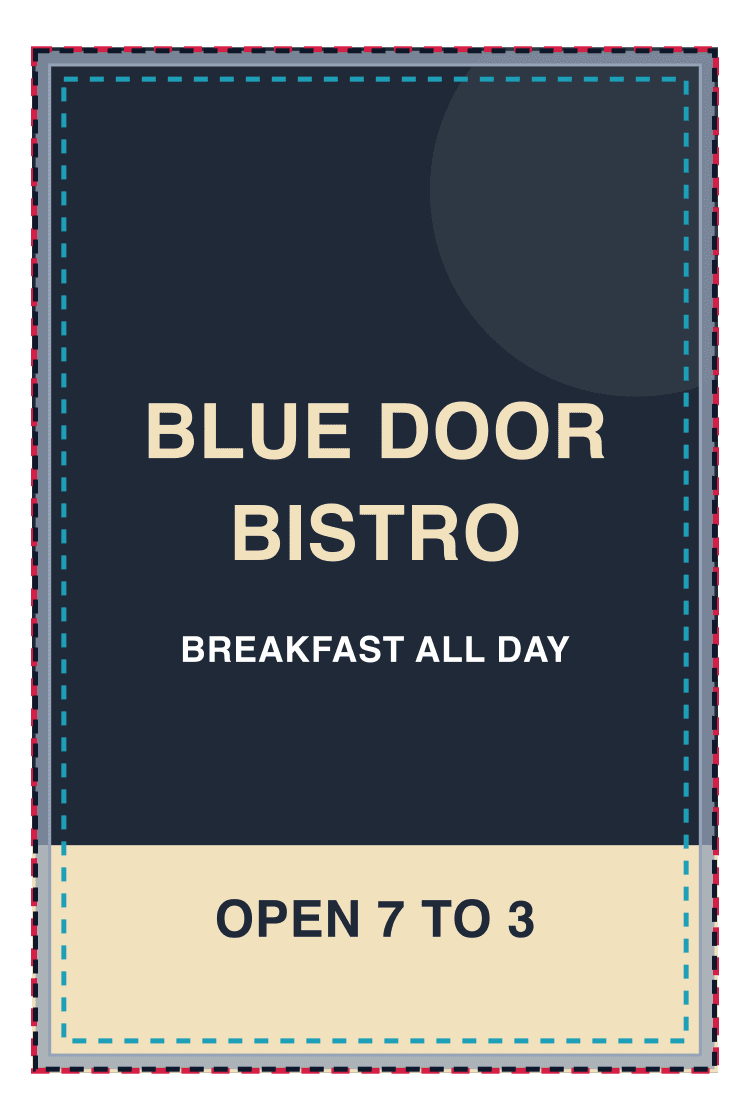
- Bleed area
- 24.25 x 36.25 in
- Insert size (what we print)
- 24 x 36 in
- Frame lip
- outer 0.5 in
- Safe area
- 22 x 34 in
Bleed area: 24.25 x 36.25 in Background color and photography run past the panel edge on all four sides. On a drop-in insert the bleed also protects you against the small tolerance in the retaining channel.
Insert size (what we print): 24 x 36 in The panel we cut and the panel the frame is built for. This is the number on the order, and it is the number a replacement insert has to match years from now.
Frame lip: the outer 0.5 in The molded channel that holds the panel covers about half an inch all the way round. Anything you place there is printed, paid for and never seen, and a design laid out edge to edge loses its outer ring to the frame rather than to the trim.
Safe area: 22 x 34 in Headline, offer, phone number, QR code: all of it a full inch inside the panel edge. That is double the usual margin, and it is the single easiest way to make a sidewalk sign look deliberate instead of cropped.
Should You Buy One Face or Two?
Buy two. A sidewalk sign sits perpendicular to the walkway, which means people approach it from both directions and half of them see the back. On a single-face frame, half your foot traffic meets a blank panel.
The second face is the cheapest upgrade on the board: $21.40 on a Standard Signicade, $32.10 on a Deluxe and $21.40 on a SimpoSign II. Print both.
Message changes are the other reason to choose a drop-in insert frame over adhesive vinyl. A cafe running a different special every week is buying inserts, not frames, at $96.29 to $106.99 a pair. An adhesive vinyl frame is the better buy when the message is going to sit for a year, because the graphic is bonded to the frame face and there is no channel edge in the way. There is more on making a sidewalk sign earn its spot in sandwich board signs that pull foot traffic.
A-Frame Insert Sizes Shown to Scale
Three panel sizes, the same four guides on each, with every number in millimeters, inches and pixels at 150 dpi. Swipe through them and build to the one your frame takes.
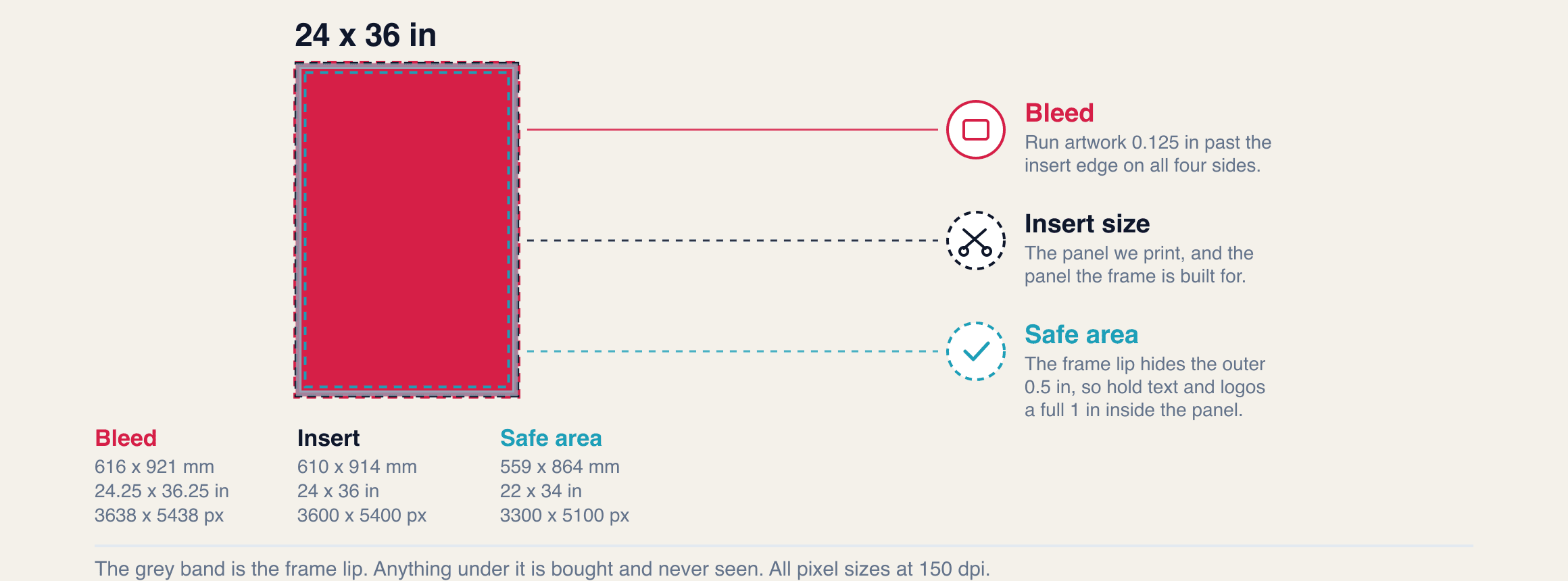
24 x 36 in, the standard panel
- Bleed
- 616 x 921 mm
- 24.25 x 36.25 in
- 3638 x 5438 px
- Insert
- 610 x 914 mm
- 24 x 36 in
- 3600 x 5400 px
- Safe area
- 559 x 864 mm
- 22 x 34 in
- 3300 x 5100 px
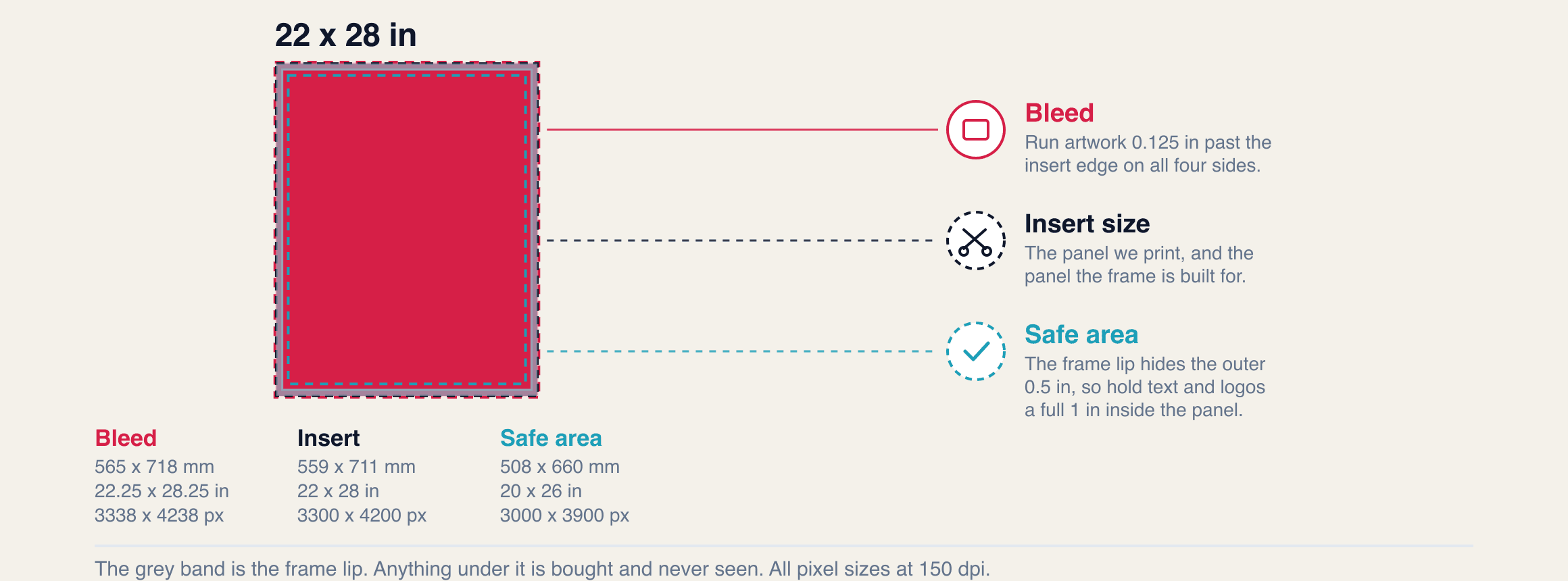
22 x 28 in, the lightweight panel
- Bleed
- 565 x 718 mm
- 22.25 x 28.25 in
- 3338 x 4238 px
- Insert
- 559 x 711 mm
- 22 x 28 in
- 3300 x 4200 px
- Safe area
- 508 x 660 mm
- 20 x 26 in
- 3000 x 3900 px
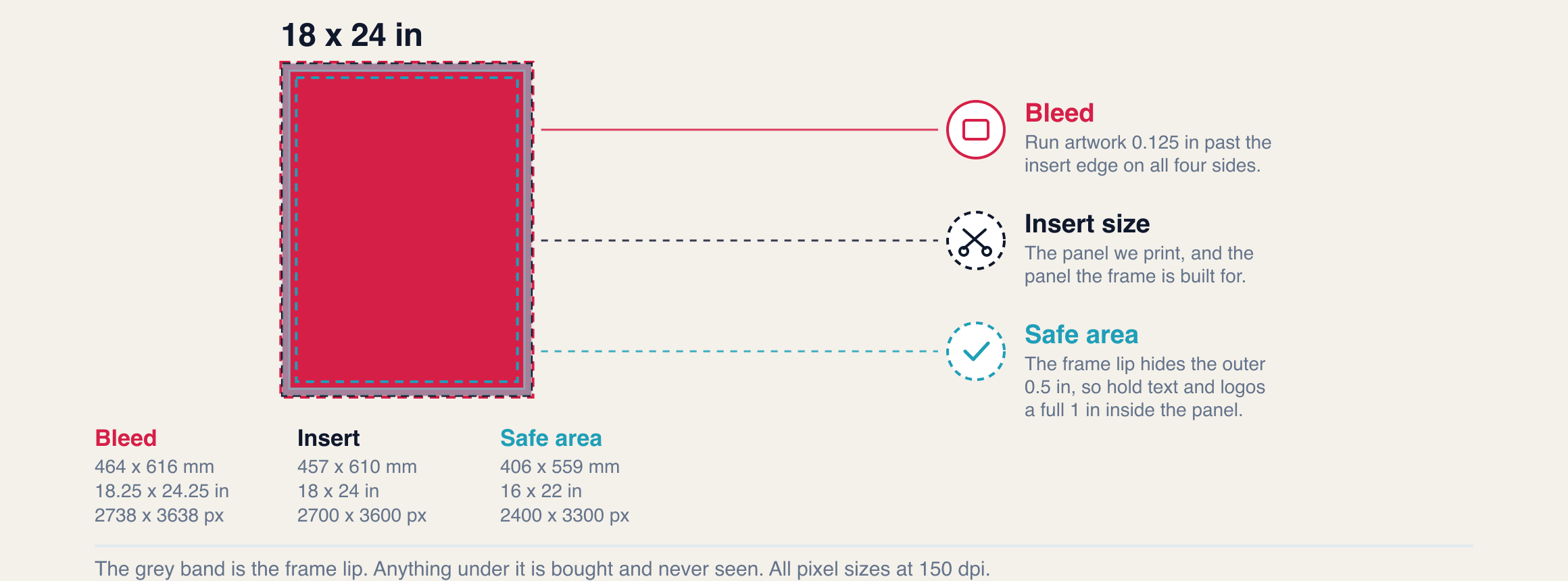
18 x 24 in, small frames
- Bleed
- 464 x 616 mm
- 18.25 x 24.25 in
- 2738 x 3638 px
- Insert
- 457 x 610 mm
- 18 x 24 in
- 2700 x 3600 px
- Safe area
- 406 x 559 mm
- 16 x 22 in
- 2400 x 3300 px
Card 1 / 3
Mistakes We Catch on A-Frame Proofs
Four things account for nearly every a-frame file we hold, and three of them are the frame lip doing its quiet work.
A border that follows the panel edge. A one inch keyline drawn at the panel edge comes back as a half inch keyline, because the lip eats the rest of it. Borders and a-frames are a bad combination. If you want the design to feel framed, build the border two inches in and let the background bleed.
Artwork sized to the frame rather than the panel. Somebody measures the 46 inch frame, builds a 46 inch file, and the design arrives ten inches too tall. The frame is the furniture, the insert is the print. Order to the insert size.
A logo pushed into the top corner. The top of an a-frame panel sits at eye level and slightly tilted away from the viewer, so the top inch is the least readable real estate on the sign. Put the offer in the middle third, where a pedestrian actually looks.
One face ordered for a two-way sidewalk. Not a file problem, but the one we ask about most on a proof. If the sign is going on a public walkway, we will ask whether you want the second face before it prints, because it is a great deal harder to add later.
What to Send Us
Send a print ready PDF at the insert size with 0.125 inch bleed, CMYK, 150 dpi at full size, fonts outlined, logos in vector, and every word a full inch inside the panel edge. Both adhesive vinyl and drop-in coroplast want the same file.
There is no setup fee. Upload any image or file and we make it print ready: size, bleed, resolution and color. If you want a designer to build the panel from scratch, Design it for me is +$32.10 with two revisions included. Every order includes a free digital proof, and frames are printed in the USA and shipped anywhere in the country for a flat $10. The rest of the rigid range sits on the signs and boards hub.
Know which frame you want? Get started now.


Frequently Asked Questions
The standard a-frame sign size is a 24 x 36 inch graphic on each face. That is the panel a classic Signicade frame is built around, and it is the size most replacement inserts and downloadable templates assume. The lighter frames step down to a 22 x 28 inch panel instead.
A standard Signicade stands 46 inches high, 25 inches wide and 3 inches deep folded, and weighs about 19 pounds. That height clears a sidewalk crowd and stays under most awnings, and the weight is enough to resist a breeze without ballast. Lighter frames run shorter and need weighting.
Sandwich board and a-frame describe the same thing, so in practice a sandwich board is a 24 x 36 inch panel on each face, or 22 x 28 inches on the lighter frames. The frame itself is taller and wider than the panel, usually about 46 inches high and 25 inches wide.
A 24 x 36 inch a-frame insert is 3600 x 5400 pixels at 150 dpi, and the file with bleed is 3638 x 5438 pixels. A 22 x 28 insert is 3300 x 4200 pixels and an 18 x 24 is 2700 x 3600. Sidewalk signs are read from 15 feet or more, so 150 dpi at full size is plenty.
Yes. Drop-in frames take replacement coroplast inserts at $74.89 to $85.59 for one or $96.29 to $106.99 for a pair, and the adhesive vinyl frame takes replacement graphics at $74.89 for one or $96.29 for a pair. If the message changes weekly you want a drop-in frame. If it is going to sit for a year, adhesive vinyl on the frame face is the cleaner look.
Two, in almost every case. A sidewalk sign sits perpendicular to the walkway, so people approach it from both directions and half of them meet the back. The second face costs $21.40 on a Standard Signicade, $32.10 on a Deluxe and $21.40 on a SimpoSign II, which is the cheapest upgrade on the board.
Related Articles
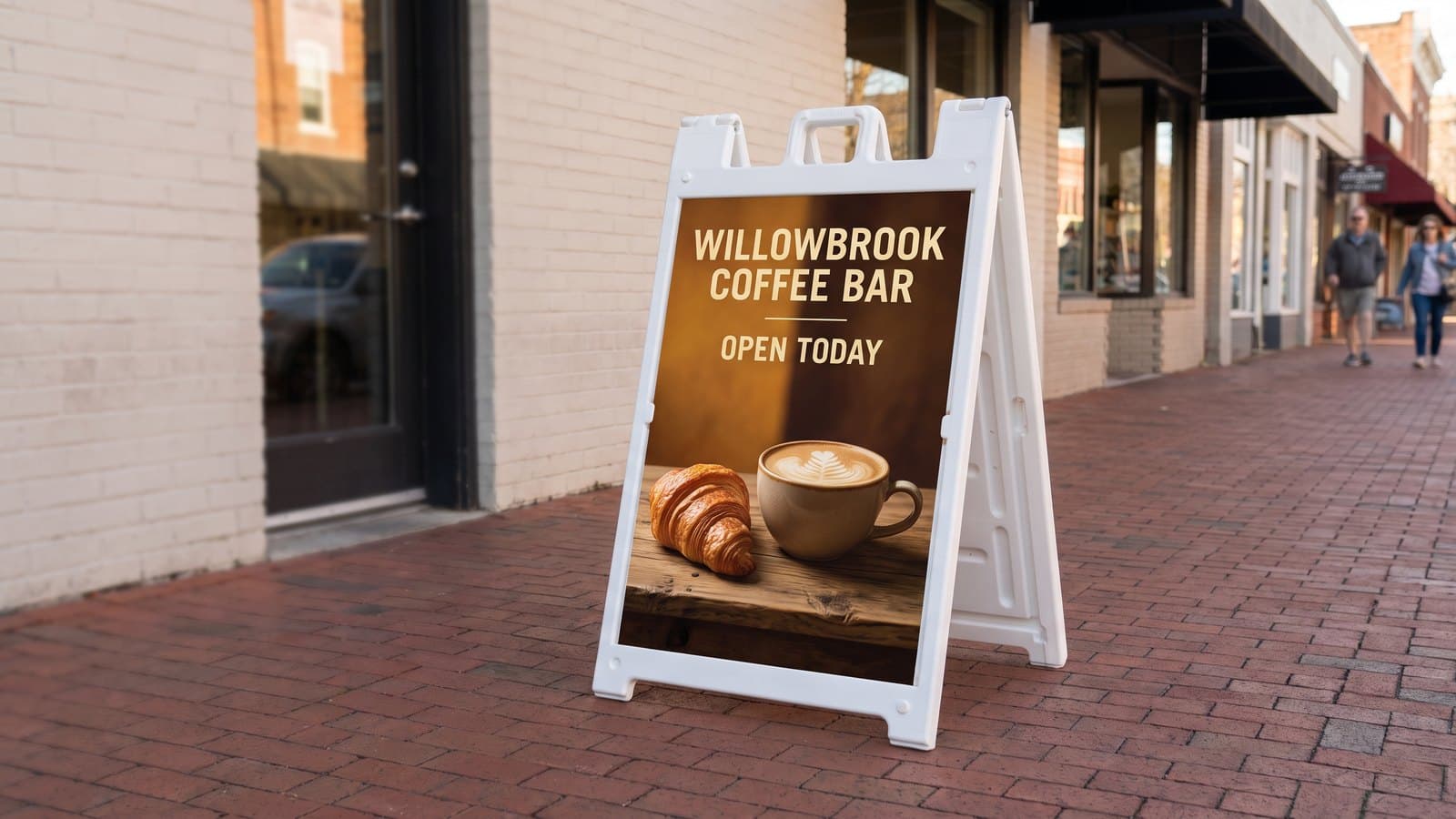
Sandwich Board Signs: Where to Put Them and What to Say
A sandwich board works when it sits 5 to 10 ft ahead of the door with one message in 3 inch [...]
Read More: Sandwich Board Signs: Where to Put Them and What to Say
Wind Resistant Sidewalk Sign: Is a 19 lb A-Frame One?
A sidewalk A-frame is 46 by 25 by 3 inches and 19 lb, with one 24 by 36 inch vinyl graphic. [...]
Read More: Wind Resistant Sidewalk Sign: Is a 19 lb A-Frame One?
Yard Sign Sizes: 12x18 to 36x24 in, Bleed and Stakes
Standard yard sign sizes are 12x18, 18x24, 24x24 and 36x24 inches. Get letter height by [...]
Read More: Yard Sign Sizes: 12x18 to 36x24 in, Bleed and Stakes
Banner Sizes: 2x4, 3x6, 4x8, 6x10 Feet and Letter Height
Standard banner sizes are 2 x 4, 3 x 6, 4 x 8 and 6 x 10 feet. Get the letter height rule, hem [...]
Read More: Banner Sizes: 2x4, 3x6, 4x8, 6x10 Feet and Letter Height