Sandwich Board Signs: Where to Put Them and What to Say
 Daniel
May 24, 2026Updated October 19, 20269 min read
Where Should a Sandwich Board Go?
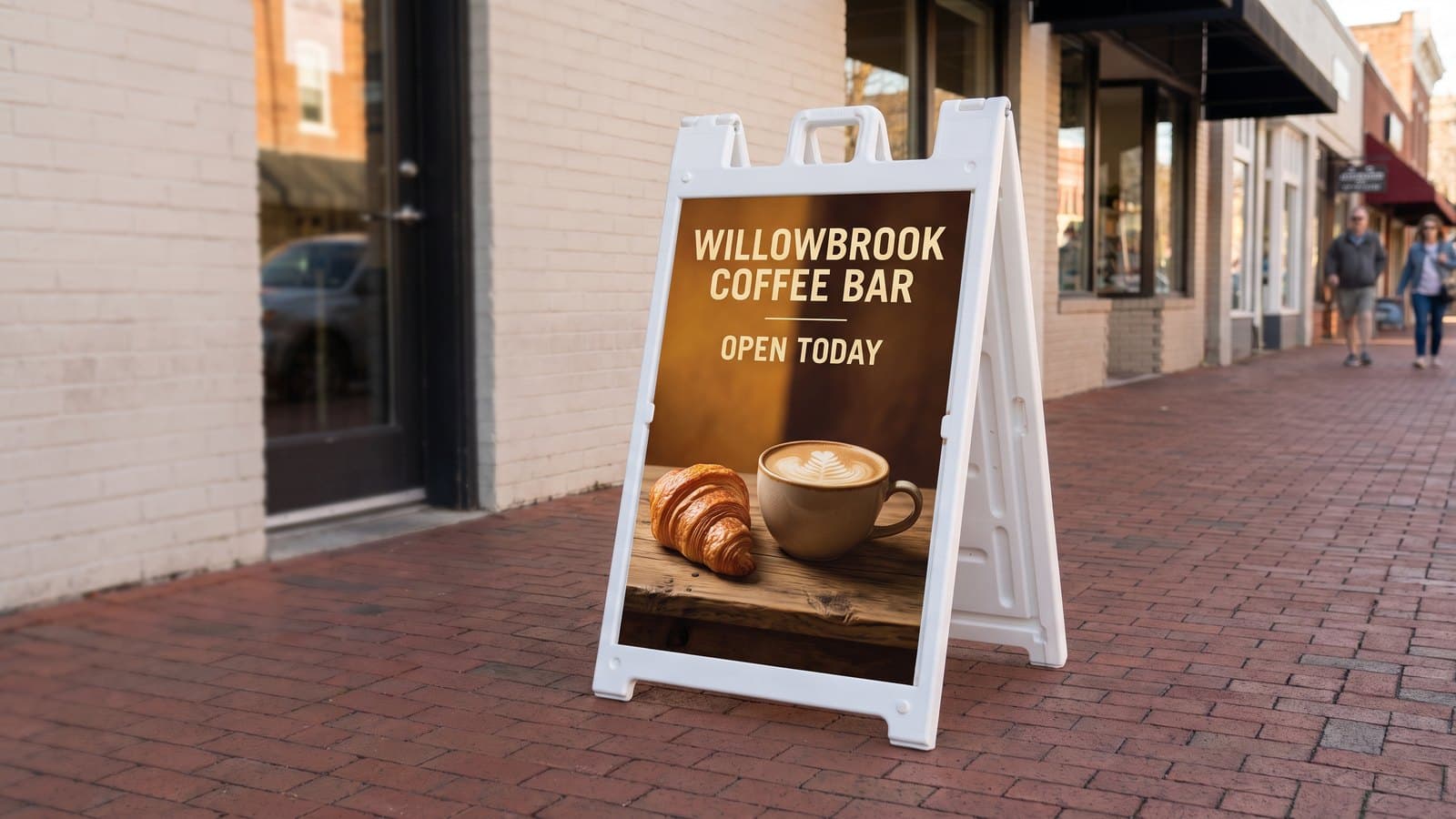
A sandwich board earns its spot when it sits 5 to 10 feet ahead of your door, turned to face the busiest direction of foot traffic, and carries one message in letters at least 3 inches tall. Print both faces, because half the sidewalk approaches from the other side.
Placement decides more than design does. The same board that gets read a hundred times a day at the right spot on the sidewalk gets walked past at the wrong one, because a pedestrian only reads what enters their path naturally.
| Placement | Why it works | Watch for |
|---|---|---|
| 5 to 10 ft before the door, facing the busiest direction | Reader has time to slow down and still turn in | Keep about 4 ft of clear walking path |
| At a corner where two walkways meet | Two streams of traffic, one sign | Sight lines for drivers turning in |
| Near a parking lot exit or path back to the cars | Catches people on the return walk | Wind exposure in open lots |
| Outside a shared entrance or strip center | Tells passersby you exist behind that door | Landlord and center sign rules |
| Beside a queue or patio | Reads while people are standing still | Do not block the queue |
Angle matters as much as distance. A board set square to the building is read edge on by everyone walking toward it, which is close to invisible. Turn it about thirty degrees toward the oncoming traffic and the front face meets people flat.
What Is a Sandwich Board Sign?
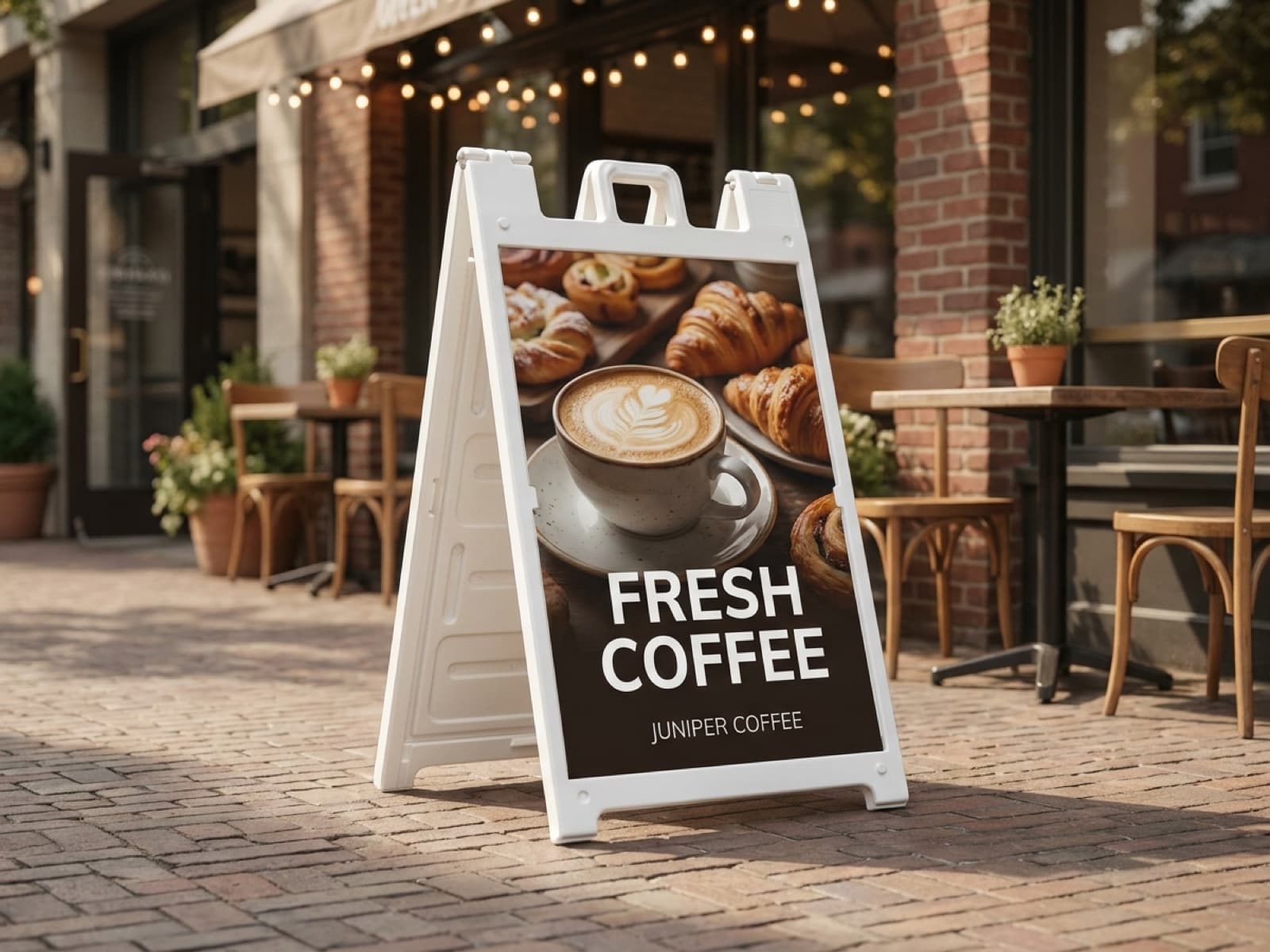
A sandwich board is a two panel, A shaped sign that stands on the ground and shows a message on both sides. The two panels lean against each other like a sandwich, which is where the name came from, and the same sign is sold as an A-frame or a sidewalk sign.
The Signicade frames are hollow plastic rather than folded metal, which keeps them light enough for a staff member to set out each morning and rigid enough to stand in a breeze. A Standard Signicade is 46 inches high, 25 inches wide and 3 inches deep folded, at about 19 pounds.
Two things are worth knowing before you shop. The graphic is smaller than the frame, always, so the numbers on the box are not the numbers on the artboard. And the graphic attaches in one of two ways, either bonded to the frame face as adhesive vinyl or dropped into a channel as a coroplast insert, which is the decision that most affects how you will live with the sign.
Which A-Frame Should You Buy?
Buy an adhesive vinyl frame when the message will sit for a year, and a drop-in insert frame when it changes with the season or the week. That single question separates the three frames we stock more cleanly than price does.
| Frame | Panel size | Graphic | One face / two faces | Replacement graphics |
|---|---|---|---|---|
| Standard Signicade | 24 x 36 in | Adhesive vinyl on the frame face | $267.49 / $288.89 | $74.89 one, $96.29 the pair |
| Deluxe Signicade | 24 x 36 in | Drop-in coroplast insert | $374.49 / $406.59 | $85.59 one, $106.99 the pair |
| SimpoSign II | 22 x 28 in | Drop-in coroplast insert | $278.19 / $299.59 | $74.89 one, $96.29 the pair |
The Deluxe frame comes in white or black, and black is the one to pick if the storefront is dark or the graphic has a lot of white in it. The SimpoSign II is the lightweight option: easier to carry out, and worth pairing with ballast if the spot is exposed.
Those are the three panel sizes we stock, 24 x 36 and 22 x 28. We do not stock 24 x 24 or 18 x 24 frames, so if you already own one, order the panel on its own as an any-size coroplast sign, which prices by the square foot and cuts to the size you give us.
What Should a Sandwich Board Say?
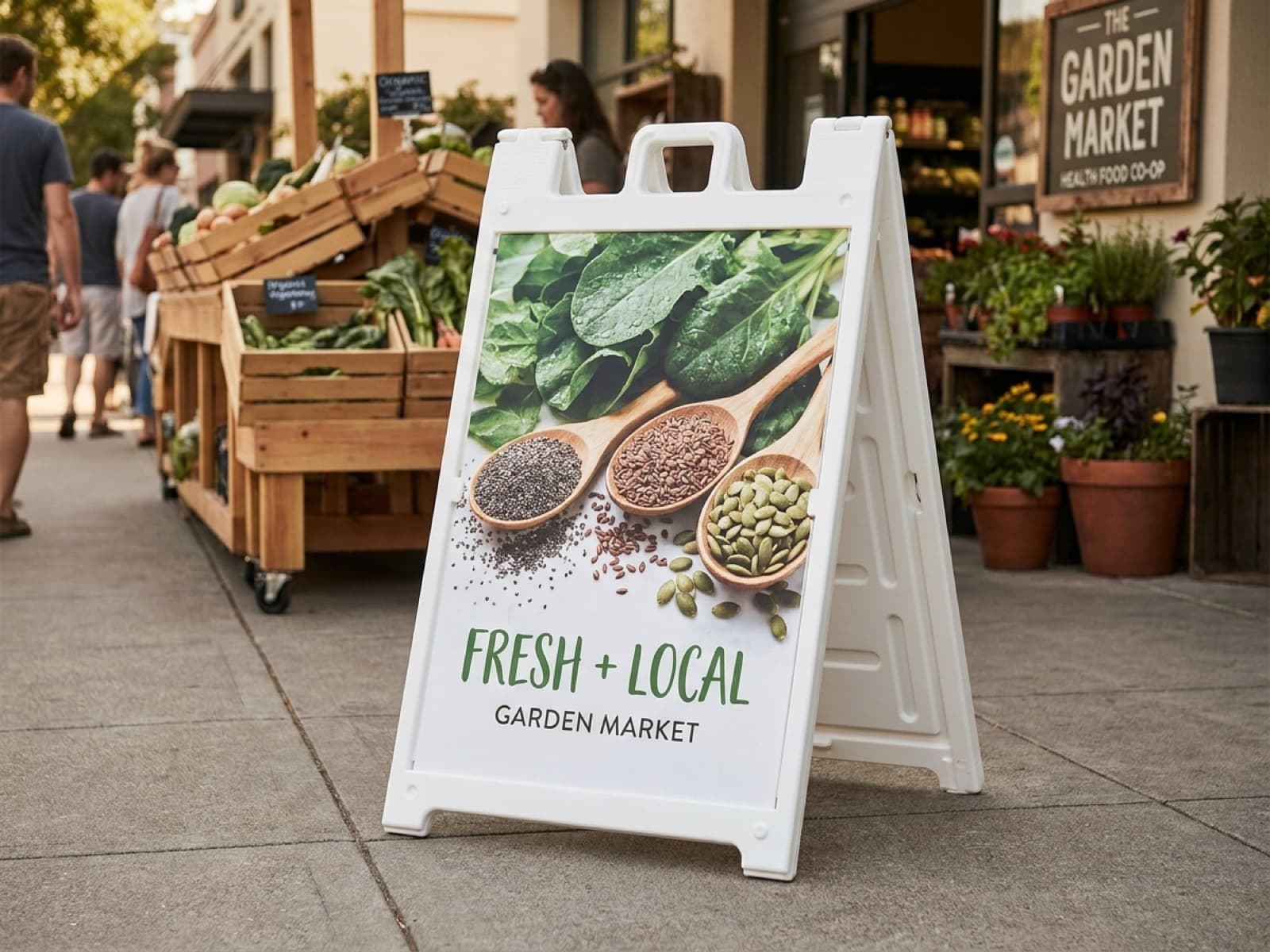
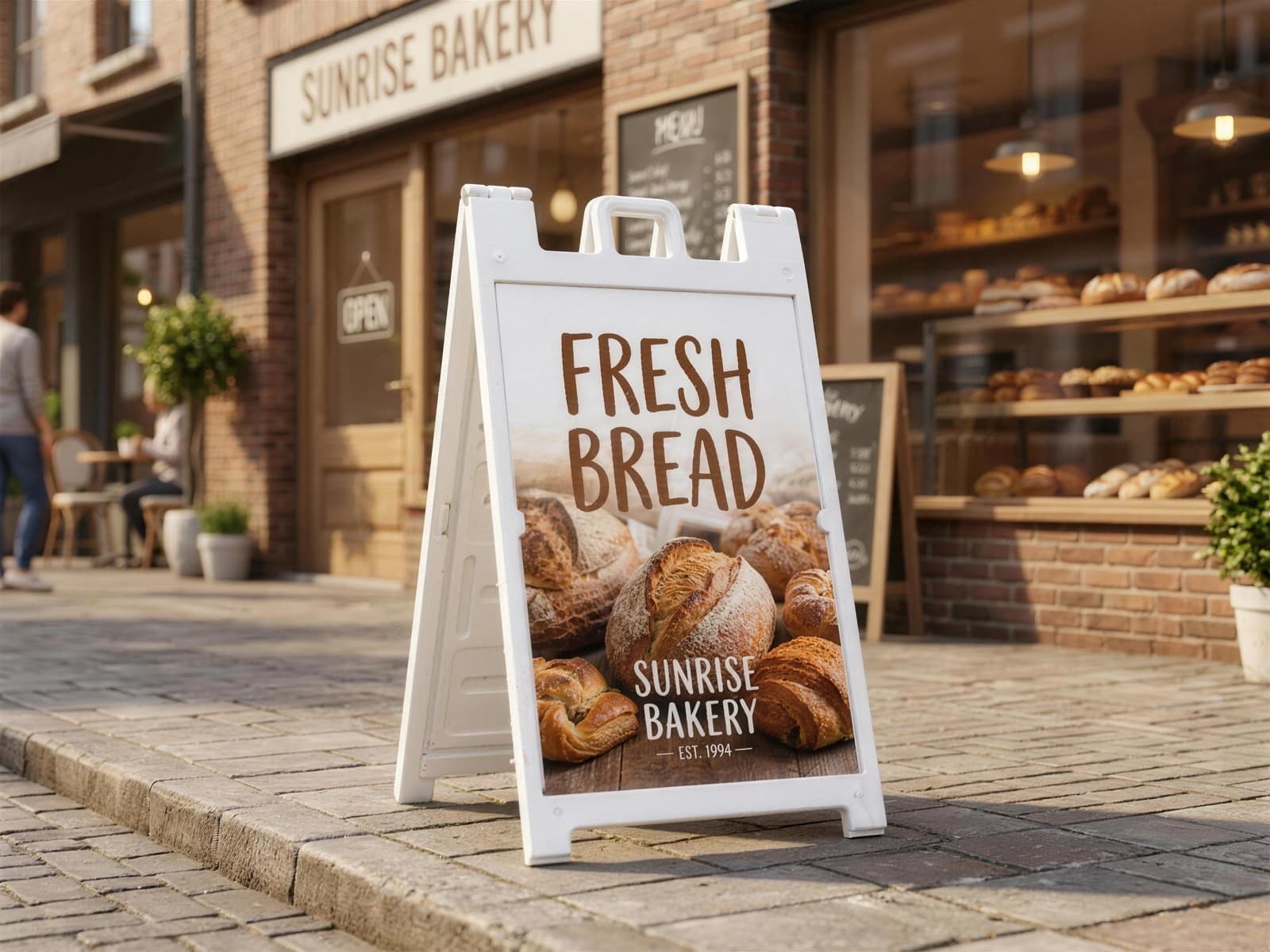
One message per face, in letters at least 3 inches tall. A sidewalk sign is read at walking speed by someone who has not decided to read it yet, so it works like a billboard, not like a menu.
Four rules do most of the work.
One offer, not a list. "Brunch until 2, pancakes 8 dollars" beats every item on the menu, because a list at walking speed is a blur. If two things matter, put one on each face.
High contrast. White on black, yellow on black or dark type on a light photo all survive glare, shade and the low sun at the end of the day. Mid tone on mid tone does not.
A reason to turn in now. Today, tonight, this weekend, while they last. A permanent statement of what you sell is what your storefront sign is for.
Room around the words. The frame lip covers about half an inch of the panel edge, and a crowded board reads as noise. The most effective sidewalk sign on any block is usually the emptiest one.
Hand lettered chalk still has a place. It signals that a person is inside and it changes in a minute. Printed panels win when the message repeats, when the artwork carries a logo, or when the board sits in full sun, because chalk bleaches and a UV printed graphic does not.
Which Businesses Get the Most From a Sidewalk Sign?
Any business whose customers arrive on foot and decide in the moment. That is the whole qualification, and it is why the same sign works outside a bakery and outside a tax office in February.
- Coffee shops, cafes and bakeries, for the daily special and the thing that just came out of the oven.
- Restaurants, for happy hour, brunch and event nights.
- Boutiques and retail, for a sale, an arrival or an open patio.
- Salons and barbers, for walk-in availability today.
- Real estate offices, for an open house and the direction to it.
- Churches and event venues, for service times, parking and where to enter.
- Market and fair vendors, for booth pricing and what is in season.
A sign outside a strip center or a shared lobby is doing a different job: it tells people you are in the building at all. That board can carry your name and an arrow and nothing else, and it will still be the best money on the list.
How Often Should You Change the Message?
Change a printed insert with the season and a chalk message daily. The people who pass your door every morning stop seeing a board that has not changed in a month, and they are the audience that was worth reaching.
This is where the drop-in frame pays for itself. Replacement coroplast inserts are $85.59 for one and $106.99 for the pair on a Deluxe Signicade, so a full seasonal rotation costs less than the difference between frames. With adhesive vinyl, replacement graphics are $74.89 and $96.29, and the old graphic has to come off the frame face first, which is a job rather than a swap.
A workable rhythm for most storefronts: one printed insert per season that carries the brand, plus a chalk or marker board for the day. That way the sign always looks deliberate even on a day nobody remembered to write on it.
Do You Need Permission to Put a Sign on the Sidewalk?
Usually, and the rule is local. Cities and counties set their own sidewalk sign codes, and the common conditions are a size limit, a placement limit, a required clear path for pedestrians of about 4 feet, and sometimes a small annual permit.
Two more permissions people forget. A landlord or shopping center often has its own sign rules that are stricter than the city's. And a sign on private property, your own patio or forecourt, is usually a different and easier question than a sign on a public walkway.
Check before you buy rather than after, because the answer occasionally decides the size of frame you order.
What We See in the Shop
The most common file we send back is a sandwich board designed at reading distance instead of walking distance. It looks balanced on a laptop and disappears on a sidewalk, because the type that felt generous at 100 percent on screen is an inch tall on a 36 inch panel.
The second is a border drawn at the panel edge. The frame lip covers the outer half inch of the graphic, so a one inch keyline comes back looking like a half inch keyline, uneven down one side. Let the background bleed off the edge and build any frame effect two inches in.
The third is one face ordered for a two way sidewalk. We ask about it on nearly every proof, because adding the second face later means paying for a graphic on its own rather than as part of the order, and the sign spends its whole life showing a blank panel to half the street.
What to Send Us
Send a print ready PDF at the insert size with 0.125 inch bleed, CMYK, 150 dpi at full size, fonts outlined, logos in vector, and every word a full inch inside the panel edge. Adhesive vinyl and drop-in coroplast take the same file.
Send any image, Canva export, PDF or logo through AI image to print and we make it print ready, covering size, bleed, resolution and color, for $14.99 once per item. If you want a designer to build the panel from scratch, Design it for me is +$29.99 with two revisions included. Every order includes a free digital proof, production is 3 business days once you approve it, and the graphics are printed in the USA and shipped with the frame anywhere in the country for a flat $10 per order. Keeping the sign upright through a windy afternoon is a separate question, and it is covered in wind-resistant sidewalk signs. The rest of the rigid range sits on the signs and boards hub.
Frequently Asked Questions
The best placement is 5 to 10 feet ahead of your door, on the side the busiest foot traffic arrives from and angled so the front face meets people head on rather than edge on. Leave a clear walking path of about 4 feet past the sign, which is the minimum many cities set for a public sidewalk.
The minimum headline letter height is 3 inches, or 4 inches if cars are part of the audience. The working rule is one inch of capital letter height for every ten feet of reading distance, and a pedestrian reads a sidewalk sign from about 15 to 25 feet away.
A standard panel measures 24 x 36 inches on each face. Lightweight frames step down to 22 x 28 inches. Sandwich board and A-frame describe the same sign, and the frame itself is larger than the panel: a Standard Signicade stands 46 inches high, 25 inches wide and 3 inches deep at about 19 pounds.
Two, in nearly every case. A sidewalk sign sits across the walkway, so half your foot traffic meets the back of it. The second face is $21.40 on a Standard Signicade, $32.10 on a Deluxe and $21.40 on a SimpoSign II, which makes it the cheapest upgrade on the board.
Change a printed insert seasonally and a chalk or marker message daily. A board that carries the same words for six months stops being read by the people who pass it every day, which is exactly the audience it was bought for. Replacement inserts run $96.29 to $106.99 a pair and replacement vinyl graphics $96.29 a pair, or $74.89 to $85.59 for a single panel.
Often yes, and the rule is local rather than national. Many downtown and business districts regulate size, placement and the clear path left for pedestrians, and some require a small annual permit. Call the city or county office that handles sign permits before you buy, because the answer sometimes decides the size.
The frames and the printed panels we ship are made for outdoors: UV printed graphics on a hollow plastic frame, or coroplast inserts that shed rain. Chalkboard faces are the exception, because direct sun bleaches chalk fast. Weight the frame or bring it in at closing and it will outlast several graphics.
Related Articles
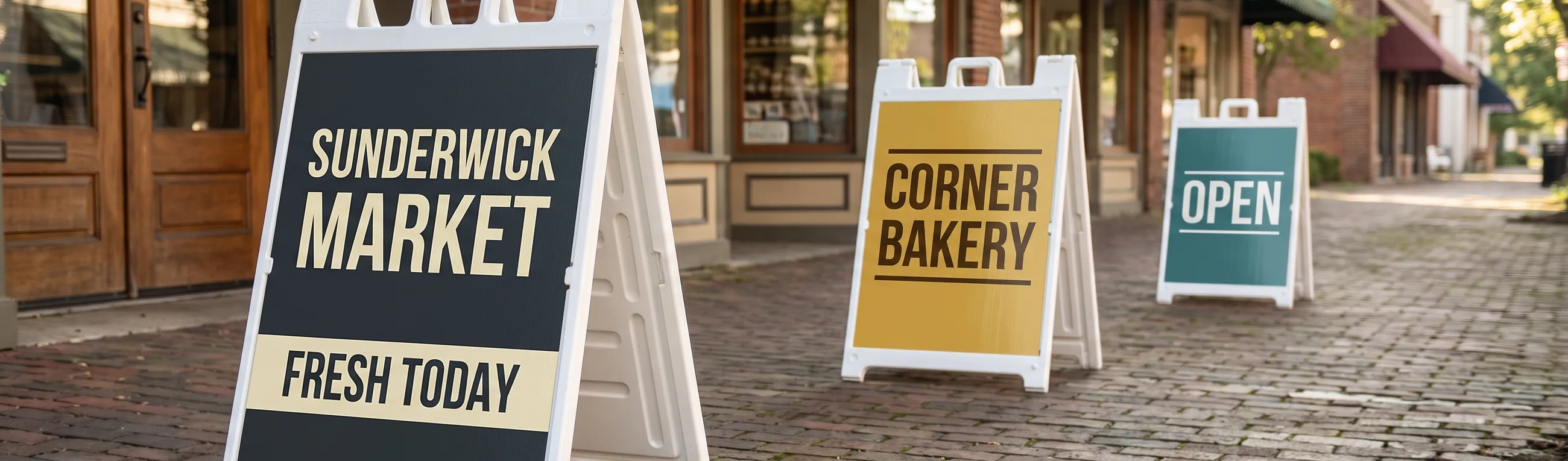
A-Frame Sign Sizes: 24 x 36 in Graphic and Frame Specs
The standard a-frame sign size is a 24 x 36 in graphic in a frame 46 in tall. Get 22x28 and [...]
Read More: A-Frame Sign Sizes: 24 x 36 in Graphic and Frame Specs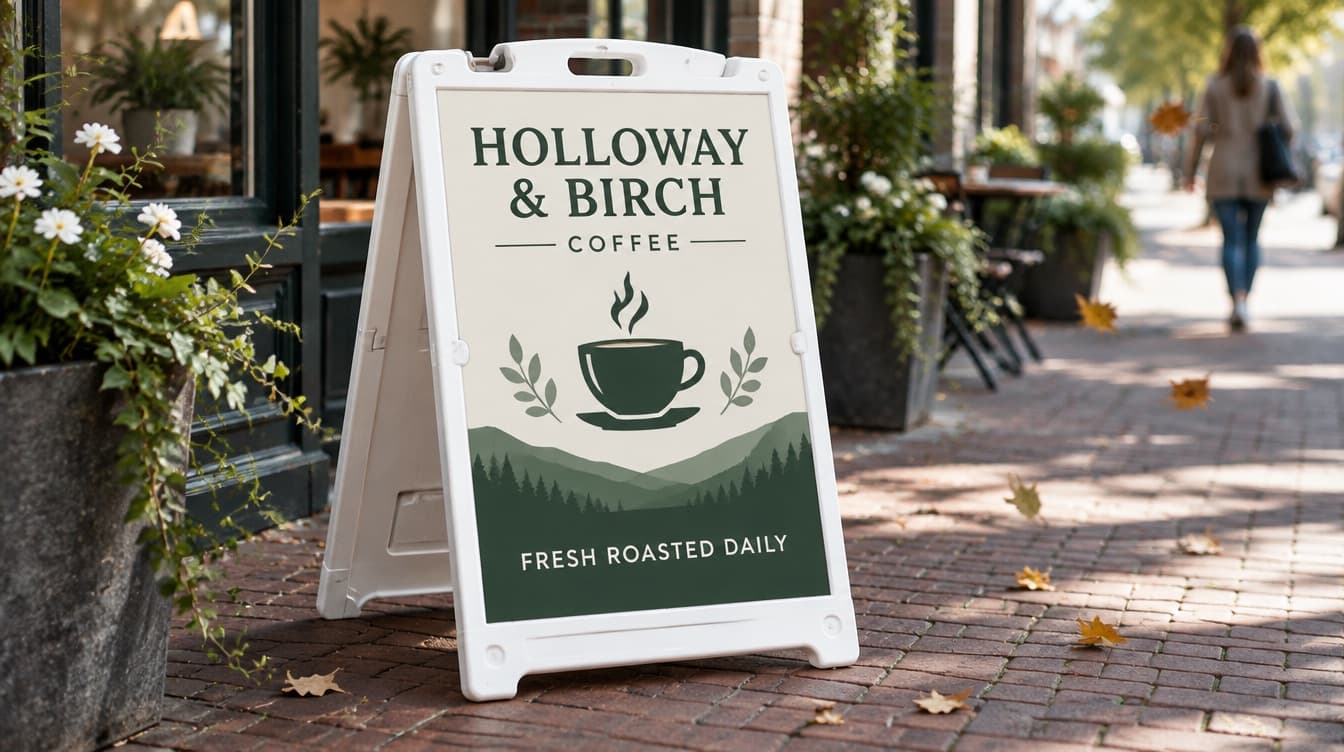
Wind Resistant Sidewalk Sign: Is a 19 lb A-Frame One?
A sidewalk A-frame is 46 by 25 by 3 inches and 19 lb, with one 24 by 36 inch vinyl graphic. [...]
Read More: Wind Resistant Sidewalk Sign: Is a 19 lb A-Frame One?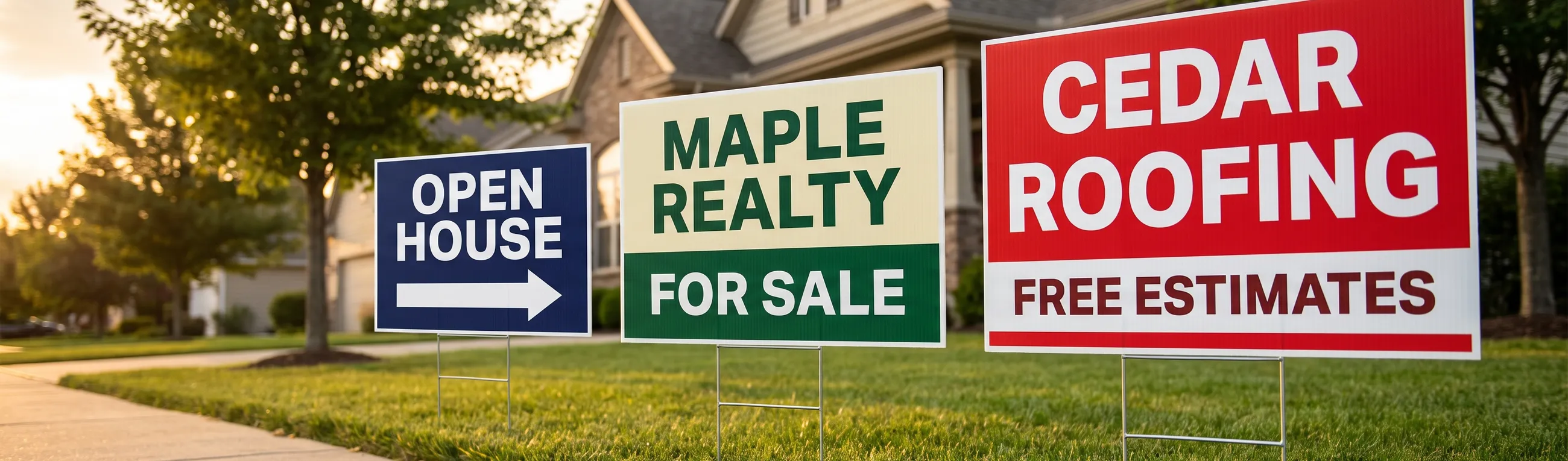
Yard Sign Sizes: 12x18 to 36x24 in, Bleed and Stakes
Standard yard sign sizes are 12x18, 18x24, 24x24 and 36x24 inches. Get letter height by [...]
Read More: Yard Sign Sizes: 12x18 to 36x24 in, Bleed and Stakes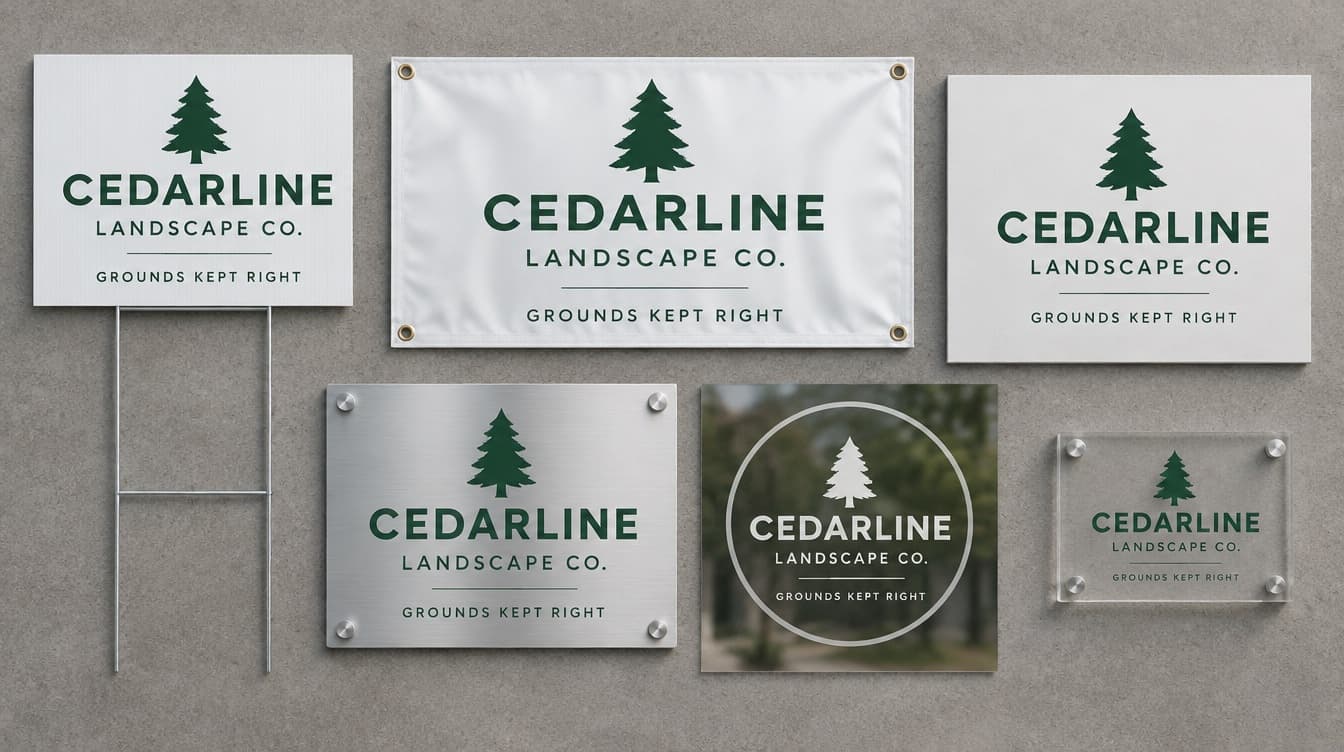
Business Signs: Choosing the Right Type for Each Job
A 13 oz vinyl banner suits temporary promotions; choose decals for glass, A-frames for [...]
Read More: Business Signs: Choosing the Right Type for Each Job