Single vs Double-Sided Banners: Cost, Uses and Specs
 Jean
January 24, 2026Updated October 19, 202610 min read
Are Double-Sided Banners Worth It?
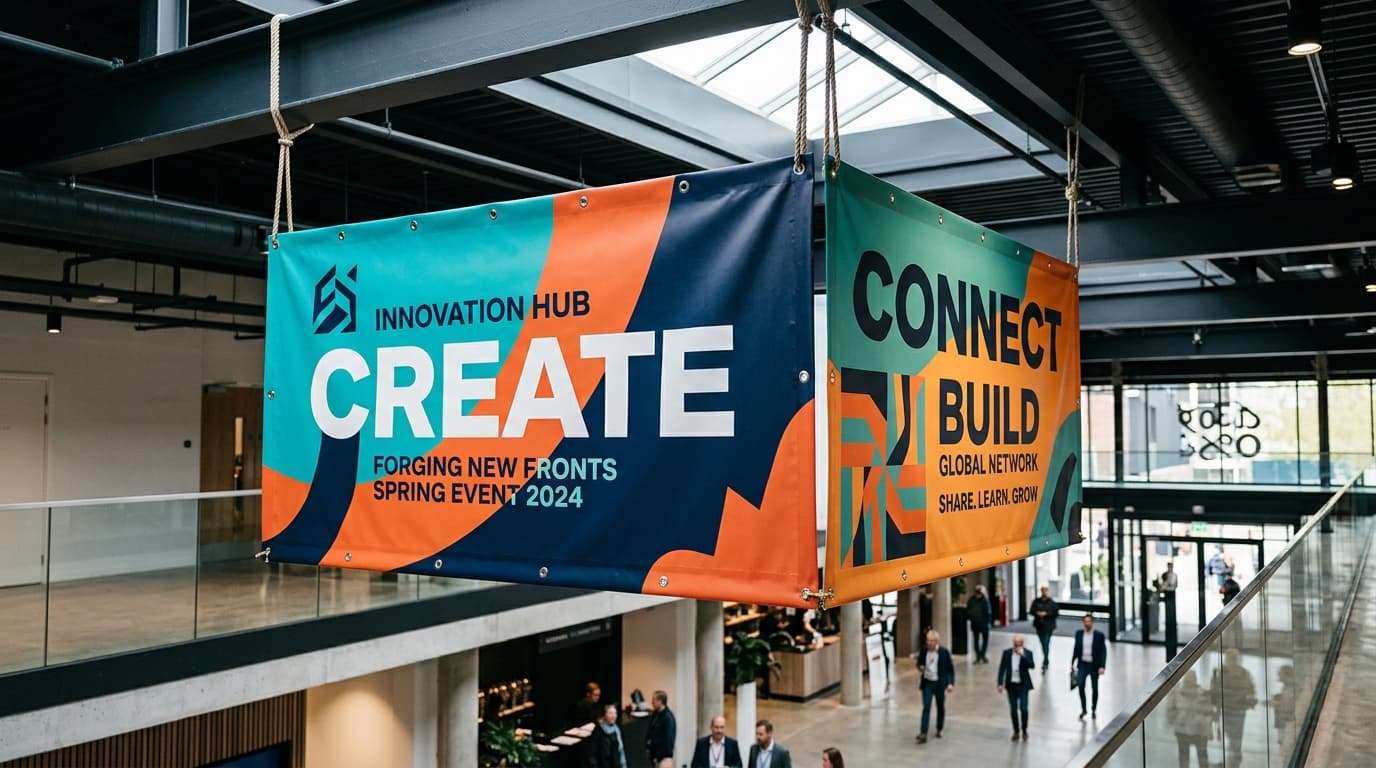
Choose double-sided only when people will see both faces of the banner. Double-sided printing runs on 18oz heavy duty vinyl, the only weight we print on both sides, and it adds about 60 percent to the price: a 4 x 8 goes from $288.89 single-sided to $470.79 double-sided.
A 4 x 8 ft double-sided banner on 18oz heavy duty vinyl is $470.79. It is printed in the USA in 3 business days after artwork approval and ships nationwide, with flat $10 shipping to any US address.
The decision comes down to placement. Stand where your audience will stand and look at the banner. If everyone approaches from one direction, the back is vinyl nobody will see. If people pass it on both sides, half of them face a blank rectangle on a single-sided print.
Here is the whole comparison in one place, priced on the 18oz heavy duty vinyl our custom vinyl banners offer, which is the only weight we print on both faces.
| Feature | Single-sided | Double-sided |
|---|---|---|
| Materials available | 13oz standard, 15oz premium, 18oz heavy duty vinyl, 9oz mesh | 18oz heavy duty vinyl only |
| Price, 3 x 6 ft on 18oz | $171.19 | $278.19 |
| Price, 4 x 8 ft on 18oz | $288.89 | $470.79 |
| What the second face shows | Blank vinyl, with a faint ghost of the front on lighter weights | A second full color design, readable on its own |
| Best for | Anything mounted flat or read from one direction | Anything people pass on both sides |
| Finishing | Hems and grommets included | Hems and grommets included |
| Production | 3 business days after proof approval | 3 business days after proof approval |
How Much Does a Double-Sided Banner Cost?
Double-sided printing adds about 60 percent to the price of the same banner single-sided, at every size we stock on 18oz. It is a near consistent uplift, so you can work it out on any size before you open the order form.
| Banner size | 18oz single-sided | 18oz double-sided | What the second face adds |
|---|---|---|---|
| 3 x 5 ft | $139.09 | $224.69 | $85.60 |
| 3 x 6 ft | $171.19 | $278.19 | $107.00 |
| 4 x 6 ft | $224.69 | $363.79 | $139.10 |
| 4 x 8 ft | $288.89 | $470.79 | $181.90 |
| 5 x 10 ft | $438.69 | $706.19 | $267.50 |
There is a second number worth seeing, because most people are not comparing 18oz single to 18oz double. They are comparing the cheap banner they had in mind to the double-sided one. A 3 x 6 on 13oz standard vinyl is $133.00 and a 3 x 6 double-sided on 18oz is $278.19. A 4 x 8 goes from $229.00 to $470.79. That is the real jump, and it is worth naming out loud before you decide.
Everything on both lists includes hems and grommets, a free digital proof with every order, and 3 business day production after you approve it. Shipping is a flat $10 per order either way, so it does not change the comparison.
How Is a Double-Sided Banner Printed?
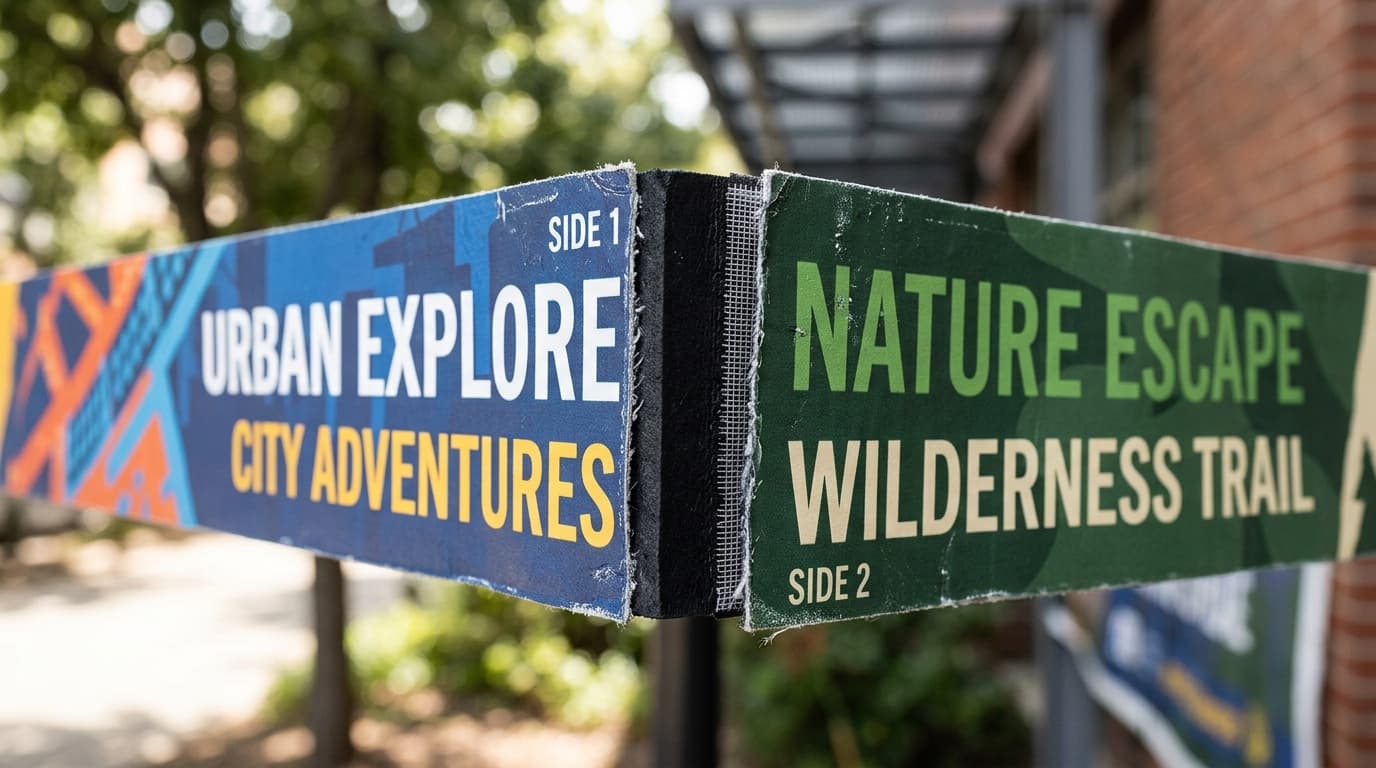
There are two ways the trade builds a banner that reads from both sides, and the difference is what sits between the two designs. One way prints both faces onto a single panel of heavy, opaque material. The other bonds two printed panels together with an opaque layer sandwiched between them, so a cut edge shows three layers: a printed face, a dark core, and a second printed face.
What matters to you as a buyer is the same in either case: the material has to be opaque enough that the front design does not read backward through the back design. That is why the second face is offered on 18oz heavy duty vinyl, the heaviest scrim we run, and not on 13oz or 15oz. If you are pricing this at another shop, ask which method they use and what the material weight is. A cheap double-sided quote on light vinyl is usually a print-through job, and print-through is what people mean when they say a double-sided banner looked muddy.
When Is a Single-Sided Banner the Right Choice?
Single-sided wins any time the back of the banner is against something or facing away from every reader. In those placements the second side is not a compromise, it is simply not visible.
- Mounted flat to a wall, a fence panel, a building face or a construction barrier
- Loaded into a retractable or X stand, where the back sits inside the hardware
- A step and repeat backdrop, which only gets photographed from the front
- A storefront window banner, read from the sidewalk only
- Hung against the back wall of a trade show booth or a stage
- Any banner on a fence line where people only walk or drive on one side
For all of these, take the money the second side would have cost and put it into size or weight instead. A 4 x 8 on 13oz at $229.00 outperforms a 3 x 6 double-sided at $278.19 on a wall every time, because the thing that gets read from a parking lot is letter height, not the number of faces. The full size ladder is in banner sizes.
One material note: mesh banners are single-sided only, because the perforations that let wind through let light through too.
When Does the Second Side Pay for Itself?
The second side pays when two different groups of people approach the banner from two different directions, and neither group can see the other side. Then you are not buying a second face, you are buying a second audience for about 60 percent more.
- Banners hanging from light poles or street poles, where drivers approach from each direction
- Banners bracketed out perpendicular to a building, so foot traffic reads it coming and going
- Hanging banners over a trade show aisle or an exhibit hall walkway
- Banners strung between two posts at a festival, market, fair or stadium event, with crowds on both sides
- Directional banners at an intersection, pointing drivers in from more than one road
- Any banner suspended over an entrance people walk through in both directions
If anyone will ever approach the banner from behind, price the second side. If the answer is no, you already have your answer.
Are Double-Sided Yard Signs Worth It?
Yes, and they are the one place where double-sided is the default rather than the upgrade. One 18 x 24 yard sign is $53.49 single-sided and $64.19 double-sided, so the second face costs $10.70 on a sign that gets planted at an intersection.
That is the whole difference between the two products. On a yard sign the second face is a small flat fee. On a banner it is a percentage of a much larger number, which is why a banner deserves the walk-around and a yard sign usually does not. Real estate, contractors, campaigns and event directional signs all default to double-sided for that reason.
How Do You Design the Back of a Banner?
Design the back as a second front. The most common way to waste a double-sided banner is to treat the back as a place to repeat the logo at half the size, which turns a paid second face into a decoration.
Give the back the same headline hierarchy, the same letter height and the same contrast as the front. It is often the same layout with one change: swap the call to action for the one that fits the direction that reader is traveling. A banner across a festival lane can say the booth number on one side and the offer on the other. A banner on a light pole can carry the event name facing traffic coming in and the date facing traffic going out.
The rest of the layout rules are the same on both faces, and they are collected in our graphic guidelines for banner design.
Two production notes that only matter on double-sided work. Everything still has to sit at least 2 inches inside the finished edge on both faces, because the hem folds over both of them. And if either face has a hard vertical element like a border or a split color block, keep it well inside the safe area, since the two faces are aligned to the finished size rather than to each other's artwork.
What We See in the Shop
The pattern we see most is a banner ordered double-sided for a wall. Somebody reads that double-sided is the better option, checks the box, and the banner ends up screwed flat to a brick face where the second design will never be seen by a single person. We catch it by asking one question on the proof: where is this hanging. It is a free question before the ink goes down and an expensive one afterward.
The opposite version shows up at events. A single-sided banner gets hung across an aisle or between two posts, and by the second morning somebody has zip tied a second banner to the back of it, off center, with the grommets fighting each other. Two banners tied back to back also catch wind like a sail and pull at the grommets, which is exactly the failure a proper double-sided panel avoids. If the placement is a hanging one, buy it as one double-sided banner the first time.
The third one is quieter. A back side arrives as a low resolution logo pulled off a website, because the front was designed properly and the back was an afterthought at 11pm. Blown up to four feet that logo is a blur, and it is the side half the crowd is standing in front of.
A Three Question Decision Tree
Ask three questions in order and the answer falls out of them.
- Can anyone physically see the back of where this banner will hang? If the back is against a wall, a fence, a stand or a booth, stop here. Order single-sided.
- Are the people on that side customers? A back face pointed at a parking lot wall or a loading dock is visible and worthless. It has to point at people you want.
- Is the second face worth what it costs at your size? Work it out on the table above. At a 3 x 6, the second face is $107.00. At a 5 x 10 it is $267.50, and at that price a second single-sided banner in a different spot may reach more people.
If all three answers are yes, order double-sided and design the back properly. If any one of them is no, spend the difference on a bigger banner.
What to Send Us
Send a print ready PDF for each face, built at the bleed size, CMYK, full size at 100 to 150 dpi, with fonts outlined or embedded and all text at least 2 inches inside the finished edge. Label the two files clearly as front and back so the proof comes back showing the faces the way you intend them.
Send any image, Canva export, PDF or logo through AI image to print and we make it print ready, covering size, bleed, resolution and color, for $14.99 once per item. If you have no design at all, Design it for me is +$29.99 on an item under $499 and free at $499 or more, which covers the larger banners in the tables above, and a designer builds it from scratch with two revisions included. Either way you see a free digital proof with every order before anything prints, and production is 3 business days after approval.
Frequently Asked Questions
About 60 percent is the added cost for the second face on 18oz heavy duty vinyl, not 100 percent. A 3 x 6 is $171.19 single-sided and $278.19 double-sided, and a 4 x 8 is $288.89 single-sided and $470.79 double-sided.
18oz heavy duty is the only vinyl weight offered with double-sided printing. 13oz standard and 15oz premium are printed on one face. The five stocked 18oz single-sided sizes run from $139.09 for a 3 x 5 to $438.69 for a 5 x 10.
No. Mesh is perforated so air can pass through it, which means light passes through it too and neither face reads cleanly. Mesh prints single-sided, from $64.19 for a 2 x 3 up to $634.00 for an 8 x 10. If a fence banner has to read from both directions, hang two mesh banners back to back on the same fence line.
Show-through depends on how opaque the material is, which is why double-sided printing is offered on the heaviest weight we run rather than on 13oz or 15oz. Keep both designs high contrast, avoid pale washes behind small type, and ghosting stops being something a reader ten feet away notices.
Production takes 3 business days after proof approval for both single-sided and double-sided banners. Sending the second design later can delay approval, so upload both files together and approve one proof that shows both faces.
The second face on one 18 x 24 yard sign costs $10.70: $53.49 single-sided versus $64.19 double-sided. The second face often makes sense where drivers approach from two directions; a banner needs closer review because its upgrade can cost much more.
Hang it perpendicular to the flow of traffic, not flat against a surface. That means strung between two posts, suspended from a ceiling or a truss in an aisle, or bracketed out from a wall or a pole so it stands at a right angle to the people walking or driving past it.
Related Articles
Banner Sizes: 2x4, 3x6, 4x8, 6x10 Feet and Letter Height
Standard banner sizes are 2 x 4, 3 x 6, 4 x 8 and 6 x 10 feet. Get the letter height rule, hem [...]
Read More: Banner Sizes: 2x4, 3x6, 4x8, 6x10 Feet and Letter Height
How to Hang a Banner: Safe Steps for Walls and Fences
A 6 ft x 3 ft banner hangs best when its surface, hardware, and load are matched before every [...]
Read More: How to Hang a Banner: Safe Steps for Walls and Fences
Banner Design Guidelines: Clear Artwork That Prints Well
Banner design guidelines start with a 6' × 3' layout, bold hierarchy, safe margins, and sharp [...]
Read More: Banner Design Guidelines: Clear Artwork That Prints Well
How to Get Wrinkles Out of a Vinyl Banner: 4 Safe Methods
Start with gentle, even tension for 1 to 3 hours. Learn when mild heat may be appropriate, what [...]
Read More: How to Get Wrinkles Out of a Vinyl Banner: 4 Safe Methods