What Is a Neon Sign? How Glass, Gas and Voltage Work
 Daniel
May 18, 2026Updated October 16, 20269 min read
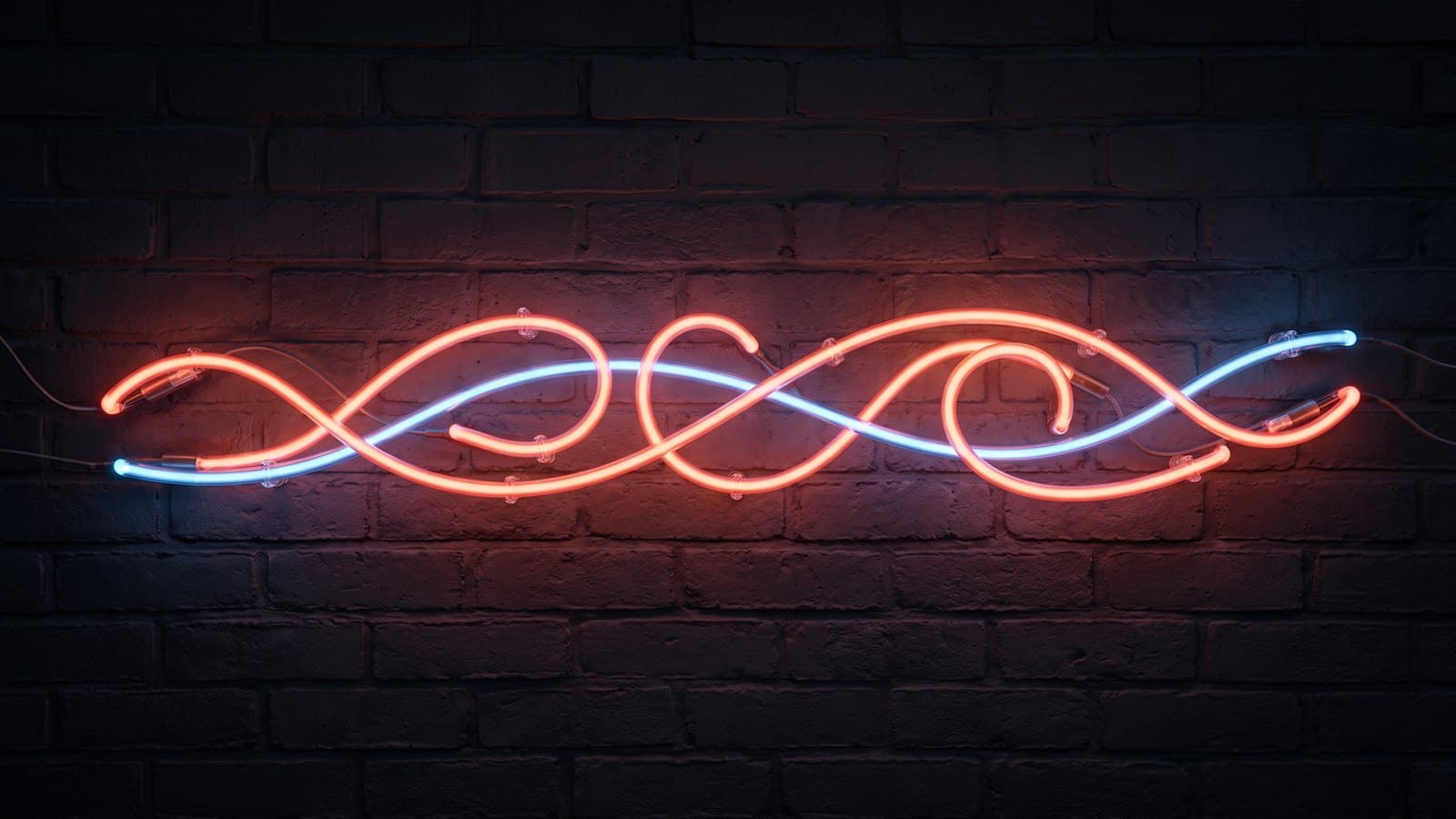

What Is a Neon Sign?
A neon sign is a sealed glass tube filled with neon or another inert gas that glows when 2,000 to 15,000 volts pass through it. Pure neon burns red orange, while argon with a trace of mercury reads blue. Every letter is bent by hand over a flame, which is why real neon costs more than an LED imitation.
The word has drifted. Most of what gets called neon today is flexible LED tubing shaped to look like glass, which is what the photo here shows. A true neon sign is glass, gas and high voltage, and it is a genuinely different object.
The technology has not changed in principle since Georges Claude first showed a neon tube publicly in 1910. Materials, phosphor coatings and transformers have all improved. The core of it is still a sealed glass tube, a small amount of gas at low pressure, an electrode at each end, and enough voltage to make the gas glow.
How Does a Neon Sign Work?
Electricity excites the gas, and the gas gives off light. When high voltage is applied across the electrodes, it strips electrons away from the gas atoms inside the tube. Those electrons fall back into place almost immediately, and each time one does, it releases the extra energy as a photon. Billions of those per second read as a steady glow.
The color is decided entirely by what is in the tube. This is the part people are usually surprised by: a wall full of different colored tubes is not different colored electricity, it is different gases and different coatings.
| Gas or coating | Color it produces | Where you see it |
|---|---|---|
| Neon | Red orange | Classic open signs and script lettering, the only true neon color |
| Argon with a trace of mercury | Blue | Cool blue tubing, and the base for most coated colors |
| Argon and mercury in a phosphor coated tube | Green, pink, purple, yellow, white | Most of the color range on a modern neon sign |
| Helium | Pink to pale orange | Accent tubing, uncommon in signage |
| Krypton | Pale gray white | Accent and specialty tubing |
| Xenon | Blue gray | Specialty tubing, rare |
Colored glass adds one more layer. A phosphor coated tube filled with argon can be housed in tinted glass to deepen or shift the color, which is how two signs with identical gas inside them end up looking nothing alike.
How Is a Neon Sign Made?
A neon sign is drawn flat, bent by hand over a flame, sealed, emptied and refilled, then aged before it is mounted. There are six steps and none of them are automated.
- Pattern. The artwork is printed at full size in reverse, and the bender works directly on top of that pattern so every curve lands where the design says it should.
- Bending. Straight lengths of glass tubing, typically 8 to 15 mm across, are heated in a gas flame until the glass softens, then bent against the pattern. The bender blows gently into the tube while bending so the walls do not collapse at the corner.
- Electrodes. An electrode is fused into each end of the finished run and the tube is sealed.
- Evacuation and filling. The air is pumped out, the tube is heated to drive off moisture and contaminants, then the chosen gas is introduced at low pressure. Pressure and purity both affect how the finished tube looks.
- Aging. The tube is run on high current for a period so the gas and the electrodes stabilize. A tube that skips this step is dim and patchy.
- Mounting. The runs are fixed to a backing panel or standoffs and wired back to the transformer.
That sequence is why real neon is priced as craft work. A skilled bender is producing a one-off object with a torch, and there is no version of this that a machine does faster.
How Much Power Does a Neon Sign Use?
A neon sign runs on 2,000 to 15,000 volts, stepped up from ordinary wall current by a transformer. The required voltage climbs with the total length of tubing, so a small script piece sits near the bottom of that range and a long storefront run sits near the top.
The transformer, sometimes called a neon power supply, is housed in a sealed metal enclosure mounted behind the sign or in a hidden cabinet nearby. Every connection between the transformer and the tubes carries that full voltage, which is the single most important thing to understand about neon: the wiring has to be grounded, weatherproofed and code compliant, and the work belongs to a licensed electrician. A neon sign holds a charge and stays dangerous after it is switched off.
Current draw is modest for the light produced, but neon uses meaningfully more power than an equivalent LED sign, and that gap is one of the reasons new storefront work has moved to LED.
How Long Does a Neon Sign Last?
A well built neon sign runs roughly 8 to 15 years before a tube or a transformer needs attention, and plenty of older signs have run far longer with periodic service. It fails gently: a section dims, flickers, or goes dark, rather than the whole sign quitting at once.
| Specification | Real glass neon |
|---|---|
| Tube | Hand bent glass, typically 8 to 15 mm outside diameter |
| Operating voltage | 2,000 to 15,000 volts through a transformer |
| Color source | The gas inside, plus any phosphor coating or glass tint |
| Typical service interval | 8 to 15 years |
| Repair | A damaged section is re-bent, re-sealed and refilled |
| Installation | Hard wired, grounded and weatherproofed by a licensed electrician |
Two failure modes account for most service calls. A cracked tube loses its gas and goes dark, which needs a bender. A humming, flickering or dimming sign with intact glass is usually the transformer, which is a straight replacement part.
Is LED Neon the Same Thing?
No. LED neon is a strip of diodes inside a flexible silicone tube, mounted to a cut acrylic backing, running on low voltage. It is built to look like glass and it does, from ten feet away.
The trade-offs run almost entirely one direction. LED neon costs less up front, draws a fraction of the power, is rated for 50,000 hours or more, needs no high voltage transformer, stays cool to the touch, survives shipping, and mounts with screws instead of an electrician. What it gives up is the thing collectors care about: a glass tube glows along its whole length with a soft falloff, while an LED tube is a row of points behind a diffuser. Get close and you can see the difference.
For a business ordering a glowing sign today, LED is usually the practical answer. For a bar, a diner or a gallery where the object itself is part of the brand, glass still wins on merit.

Where Real Neon Still Wins
Real neon wins wherever the craft is part of the product rather than a means to an end. That is a shorter list than it was in 1960 and it is not an empty one.
- Bars, diners and music venues trading on a mid-century look that LED reads as a copy of
- Heritage businesses preserving original signage that is part of the building's identity
- Galleries and art installations where the hand-bent tube is the artwork
- High-end hospitality using a single glass piece as a focal point in a room
- Historic districts where sign ordinances or preservation rules favor original neon
Outside of those, the reasons to specify glass get thin quickly, which is exactly what the market has done over the last two decades.
How Do You Care for a Neon Sign?
Keep it dry, keep it from getting knocked, and leave the electrical work to people licensed to do it. Neon needs very little routine attention, which is why so many signs survive decades of neglect.
Dust the glass with a dry soft cloth or a soft brush with the sign switched off and unplugged, and never spray liquid at a lit or recently lit tube. Outdoors, the thing that kills neon is water reaching the electrode housings or the transformer enclosure, so any cracked seal or weathered gasket is worth fixing before it becomes a tube replacement. Indoors, the risk is physical: a tube mounted in a low traffic spot lasts for years, and one within reach of a swinging door does not.
What We See in the Shop
The pattern we see is people asking for neon when what they actually want is a glow, and the two are not the same purchase. Somebody has a photo saved of a script sign on a brick wall, and the real question underneath it is how to make a corner of a shop or an event look finished. Nine times out of ten the honest answer starts with the printed pieces and the lighting already in the space, not with a fabrication project.
The second pattern is buyers who do not know which one they are being quoted. A quote that says neon and comes in well under what hand-bent glass costs is almost always LED neon, and there is nothing wrong with that unless nobody said so. Ask two questions of any quote: is this glass or silicone, and what voltage does it run on. The answers tell you exactly what you are buying.
What We Print, and What We Do Not
We do not make neon signs and we do not sell LED neon. We are a print shop: banners, printed signs, decals, vehicle graphics, displays and marketing prints, printed in the USA and shipped anywhere in the country.
What we do handle is everything printed that goes around a lit sign, and for most businesses that is the larger half of the storefront: printed signs for the wall and the door, window graphics for the glass, banners for the season, and printed backdrops for the photo corner people actually use the glow for.
If your project genuinely needs an illuminated sign, illuminated work is quoted after a site survey rather than sold from a size chart. You can read what channel letters and lightbox cabinets are, then tell us what you are trying to do through our contact page and we will point you at the right path instead of selling you the wrong product.
Frequently Asked Questions
Neon gas in the red orange tubes, and argon with a trace of mercury in almost everything else. Pure neon only makes one color. The rest of the range comes from argon and mercury inside a tube that has been coated on the inside with a phosphor powder, which converts the ultraviolet light the mercury gives off into green, pink, purple, yellow or white.
A neon sign uses between 2,000 and 15,000 volts, depending mostly on the total length of tubing in the sign. A transformer, often called a neon power supply, steps standard wall current up to that range and lives in a sealed metal enclosure behind or beside the sign. That voltage is why neon is hard wired by a licensed electrician rather than plugged in.
Because that is the only color neon gas gives. Each element emits light at its own set of wavelengths, and neon's fall in the red orange part of the spectrum. Every other color on a neon sign comes from a different gas, a phosphor coating inside the glass, or colored glass tubing, which is why the word neon has ended up describing signs that contain no neon at all.
A neon sign typically runs for roughly 8 to 15 years before a tube or transformer needs service, and well maintained signs have run far longer than that. Neon fails gradually rather than suddenly: a tube dims, flickers or goes dark in one section, and a bender can re-bend and refill that section without rebuilding the whole sign.
LED neon is not the same as real neon: it is flexible silicone tubing over a strip of diodes, runs on low voltage, and is rated for 50,000 hours or more. It mounts on a cut acrylic backing, imitates the look of glass, draws a fraction of the power, stays cool to the touch, and does not break like glass. What it does not have is the depth and slight unevenness of a hand bent glass tube.
Usually yes, by a neon bender. A cracked tube is cut out, a new section is bent to match, and the tube is re-sealed, evacuated and refilled. A dim or humming sign is more often the transformer than the glass, and a transformer is a straight replacement. Neither job is a homeowner repair: the sign holds high voltage even when it looks dark.
No. We are a print shop: banners, printed signs, decals, vehicle graphics, displays and marketing prints, printed in the USA and shipped nationwide. We do not bend glass tubing and we do not sell LED neon. If your project needs an illuminated sign, tell us through our contact page and we will point you at the right path rather than sell you the wrong product.
Related Articles
Neon vs LED Signs: Lifespan, Cost and Where Each Wins
LED neon signs run on 12V or 24V and last 50,000 hours or more. Glass neon lasts 8 to 15 years [...]
Read More: Neon vs LED Signs: Lifespan, Cost and Where Each Wins
Business Signs: Choosing the Right Type for Each Job
A 13 oz vinyl banner suits temporary promotions; choose decals for glass, A-frames for [...]
Read More: Business Signs: Choosing the Right Type for Each Job
Small Business Signage: 9 to 18 ft Flags at the Door
Feather flag kits run 9 to 18 ft, and the page opens on the 14 ft kit. Compare heights, bases, [...]
Read More: Small Business Signage: 9 to 18 ft Flags at the Door
Window Decals vs Window Clings: Which One Lasts Longer
Window decals use adhesive and stay put for years. Window clings use static and peel off clean. [...]
Read More: Window Decals vs Window Clings: Which One Lasts Longer